

Security News
The Code You Didn't Write Is Still Yours to Defend
AI agents are pulling packages into environments no scanner is watching, creating exposure before security teams can see it.
By Brad Arkin - Jun 23, 2026
bare-sqlite
Advanced tools
SQLite bindings for Bare.
npm i bare-sqlite
const { DatabaseSync } = require('bare-sqlite')

const db = new DatabaseSync(':memory:')

db.exec(`
  CREATE TABLE books (id INTEGER PRIMARY KEY, title TEXT);
  INSERT INTO books (title) VALUES ('Dune'), ('Foundation');
`)

for (const row of db.prepare('SELECT id, title FROM books').iterate()) {
  console.log(row)
}

db.close()
const db = new DatabaseSync(location[, options])Open a SQLite database. location is a path to a database file, or ':memory:' for an in-memory database.
Options include:
options = {
  open: true,
  readOnly: false,
  enableForeignKeyConstraints: true,
  enableDoubleQuotedStringLiterals: false,
  allowExtension: false,
  timeout: 0
}
open controls whether the database is opened during construction. With open: false, the instance is initialised but the underlying connection is deferred until db.open() is called.
readOnly opens the database in read-only mode.
enableForeignKeyConstraints controls whether foreign key constraints are enforced.
enableDoubleQuotedStringLiterals controls whether double-quoted strings are interpreted as string literals (rather than identifiers) in DML and DDL.
allowExtension is the master switch for db.loadExtension() and db.enableLoadExtension(). When false (the default), both methods throw. When true, extension loading via the C API is enabled; the SQL load_extension() function remains disabled.
timeout is the busy timeout in milliseconds. When non-zero, SQLite waits up to that long for a lock before returning a BUSY error.
db.isOpentrue if the database is currently open, false otherwise.
db.open()Open the database. Throws if already open. Useful when the database was constructed with open: false.
db.close()Close the database. Throws if not open. Prepared statements that are still reachable from JavaScript remain valid until they are finalized; the underlying connection is released once the last statement is gone.
db.exec(sql)Execute one or more SQL statements without returning rows. sql may contain multiple statements separated by ;.
const stmt = db.prepare(sql)Compile sql into a prepared statement. The returned StatementSync can be reused with different parameter values.
db.loadExtension(path[, entryPoint])Load an SQLite extension from path. entryPoint is the C initialization function name; when omitted, SQLite derives it from the filename. Throws if allowExtension was not enabled at construction.
db.enableLoadExtension(allow)Toggle extension loading at runtime. Useful for enabling extension loading during setup and disabling it before running user-supplied SQL. Throws if allowExtension was not enabled at construction.
stmt.sourceSQLThe original SQL string that the statement was compiled from.
stmt.expandedSQLThe SQL with bound parameter values substituted in, or null if SQLite couldn't expand it.
const rows = stmt.all(...params)Execute the statement and return all rows as an array of objects keyed by column name.
const row = stmt.get(...params)Execute the statement and return the first row, or undefined if there are no rows.
const result = stmt.run(...params)Execute the statement, discarding any rows. Returns { changes, lastInsertRowid }.
for (const row of stmt.iterate(...params)) { ... }Execute the statement and yield rows one at a time. The statement is reset automatically once the iterator is exhausted or abandoned.
const info = stmt.columns()Return an array describing the statement's result columns:
;[{ column, name, database, table, type }]
column is the underlying column name, name is the alias used in the result, database and table identify the source, and type is the declared SQLite type. All five are null for expression columns.
stmt.setReadBigInts(enabled)When true, INTEGER columns are returned as BigInt rather than Number. changes and lastInsertRowid from stmt.run() are returned as BigInt too. Default is false.
stmt.setAllowBareNamedParameters(allow)When true (the default), named-parameter lookup falls back to the bare key when the sigil-prefixed key (':foo') is not found. When false, only sigil-prefixed keys are considered.
stmt.setAllowUnknownNamedParameters(allow)When false (the default), passing a named-parameters object with keys that don't correspond to any placeholder throws INVALID_ARGUMENT. When true, extras are silently ignored.
The first argument to stmt.all, stmt.get, stmt.run, and stmt.iterate is treated as a named-parameters object when it is a non-null, non-array object that isn't a typed array or ArrayBuffer; otherwise all arguments are positional. Named and positional arguments may be combined by passing the object first and the positional values after it.
Supported input values map to SQLite types as follows. Any other value throws INVALID_ARGUMENT.
| JavaScript | SQLite |
|---|---|
null, undefined | NULL |
number | INTEGER or REAL |
BigInt | INTEGER |
string | TEXT |
ArrayBuffer, Uint8Array, Buffer, ... | BLOB |
Column values are returned as:
| SQLite | JavaScript |
|---|---|
NULL | null |
INTEGER | Number (or BigInt with setReadBigInts) |
REAL | Number |
TEXT | string |
BLOB | Buffer |
Apache-2.0
FAQs
SQLite bindings for Bare
The npm package bare-sqlite receives a total of 9,673 weekly downloads. As such, bare-sqlite popularity was classified as popular.
We found that bare-sqlite demonstrated a healthy version release cadence and project activity because the last version was released less than a year ago. It has 1 open source maintainer collaborating on the project.
Did you know?

Socket for GitHub automatically highlights issues in each pull request and monitors the health of all your open source dependencies. Discover the contents of your packages and block harmful activity before you install or update your dependencies.
Security News
AI agents are pulling packages into environments no scanner is watching, creating exposure before security teams can see it.

Security News
GitHub Actions checkout now blocks risky pull_request_target checkouts by default to help prevent pwn request supply chain attacks.
Product
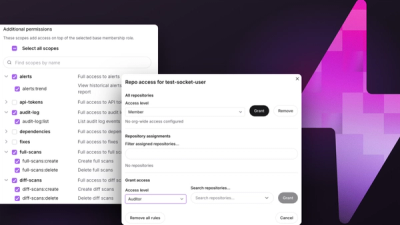
Socket now supports Custom Roles and Repository Access Permissions so organizations can control who can access specific repositories and actions.