
Research
/Security News
Miasma Mini Shai-Hulud Hits ImmobiliareLabs npm Packages
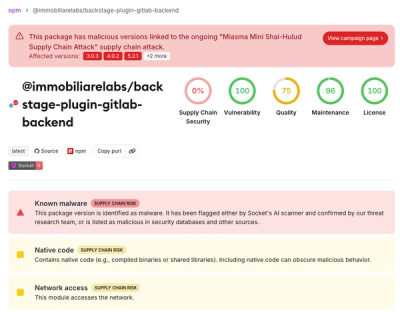
Miasma Mini Shai-Hulud hits @immobiliarelabs Backstage plugins, targeting GitLab and LDAP auth packages on npm.
By Socket Research Team - Jun 26, 2026
bare-tui-form
Advanced tools
A declarative form builder for bare-tui.
[!NOTE] This an experimental library. A version 1.0.0 release will signal stability.
bare-tui ships the field controls (textinput, textarea, select, radio, checkbox) and a focus ring, and deliberately stops there. This package adds the opinionated layer on top — labels, descriptions, per-field validation, focus movement, and submission — so you describe a form as data and get a working, validated, keyboard-driven UI.
const form = require('bare-tui-form')
const f = form.create({
title: 'Create your account',
fields: [
form.text({ name: 'name', label: 'Name', required: true }),
form.text({ name: 'email', label: 'Email', validate: isEmail }),
form.select({ name: 'plan', label: 'Plan', options: ['free', 'pro'] }),
form.confirm({ name: 'tos', label: 'Accept terms', required: true })
]
})
const values = await form.run(f) // { name, email, plan, tos } | null if cancelled
bare examples/signup.js
Two ways, depending on whether the form owns the screen or lives inside a larger app.
form.run(f)run() wires the form into a bare-tui Program, restores the terminal when it's done, and resolves with the collected values — or null if the user cancels with ctrl+c.
const values = await form.run(f)
A form is a normal bare-tui component (update/view). Embed it and react to the two messages it emits:
update(msg) {
  if (msg.type === 'form.submit') return [this, save(msg.values)]
  if (msg.type === 'form.cancel') return [this, quit]
  const [m, cmd] = this.form.update(msg)
  this.form = m
  return [this, cmd]
}
view() { return this.form.view() }
The form never calls quit — it only emits form.submit / form.cancel. So embedding it never tears the terminal down: on submit you can switch to a result view, swap in another form, or keep going, and your app stays live until you decide to quit. (That's the difference from run(), which calls quit for you.) See examples/embedded.js for a host app that shows a form, then continues running after submit.
form.value() and form.errors() are also available any time if you'd rather poll than react to messages.
Each factory returns a field; pass them to form.create({ fields: [...] }).
| Factory | Control | value() |
|---|---|---|
form.text(opts) | single-line text | string |
form.textarea(opts) | multi-line text | string |
form.number(opts) | numeric text | number | null |
form.select(opts) | dropdown | the chosen value |
form.radio(opts) | expanded choices | the chosen value |
form.confirm(opts) | checkbox | boolean |
form.multiselect(opts) | toggle list | array of values |
Common options on every field: name (the key in form.value()), label, description, required, requiredMessage, and validate. select, radio, and multiselect take options (strings or { label, value }). number takes min / max / integer. confirm treats required as "must be checked".
Presentation options (the same ones uiSchema exposes): every field also accepts help (a hint line), placeholder, hideLabel, autofocus, readonly (shown, not editable, still collected), and hidden (collected, never shown). text takes echoMode: 'password'; textarea takes rows. These live on the field, not the schema layer — so a hand-built form gets them for free, and fromSchema's uiSchema is just sugar that maps ui:* names onto them. (Field order is just the order you list them; choosing a control is just choosing the factory.)
form.group and form.array give hand-built forms the same structure fromSchema produces, and you can mix instances, groups, and arrays in one fields array:
form.create({
  fields: [
    form.text({ name: 'name', autofocus: true }),
    form.group({
      name: 'address',
      title: 'Address',
      optional: false,
      fields: [form.text({ name: 'street' }), form.text({ name: 'city' })]
    }),
    form.array({
      name: 'phones',
      minItems: 1,
      removable: false,
      fields: [
        { type: 'text', name: 'label' }, // item fields are DEFS, not instances
        { type: 'text', name: 'number' }
      ]
    })
  ]
})
// value → { name, address: { street, city }, phones: [ { label, number }, … ] }
form.group({ optional: true }) is a checkbox-gated section. form.array takes minItems/maxItems/addable/removable. Its item fields must be plain { type, name } defs, not field instances — each entry needs its own field, so a shared instance would bleed values between rows (the factory throws if you pass an instance).
validate(value) returns an error string when invalid, or a falsy value when fine. required is checked first, then your validator.
form.text({
  name: 'email',
  required: true,
  validate: (v) => (v.includes('@') ? null : 'need an @')
})
Validation runs when you confirm a field (enter) and again on submit. Enter won't leave an invalid field, and submit jumps focus to the first error.
Make validate an async function and the form handles the rest: while it runs it shows a spinner next to the field, gates input so the check can't be raced, and then either shows the returned error or advances. Nothing else to wire up.
form.text({
  name: 'username',
  label: 'Username',
  required: true,
  validatingMessage: 'checking availability…', // shown beside the spinner
  validate: async (value) => {
    const available = await api.checkUsername(value) // your real API call
    return available ? null : 'that username is taken'
  }
})
Under the hood this runs as a bare-tui Cmd and comes back as a message, stamped with a per-field run id so a cancelled or superseded check can never apply a stale result. An async check only fires for a non-empty value (an empty optional field just advances). ctrl+c cancels an in-flight check. See examples/async-validation.js.
A user can fill a form without confirming every field, so an async check might never have run by the time they submit. By default the form closes that gap: on submit it re-runs any async validators that are dirty (never ran, or whose value changed since they last passed), one at a time, behind a single footer spinner that counts progress (validating… 2/3). Input is gated while it runs; the first failure stops the run and focuses that field; if they all pass, the form submits. Serial (not parallel) keeps load predictable when checks hit a real API.
This is on by default. Opt out explicitly — and then you own making sure those checks ran:
form.create({
  validateAsyncOnSubmit: false, // submit immediately; don't re-run async checks
  fields: [...]
})
A field that already passed its check (e.g. you confirmed it with enter) isn't re-run unless you edit it again. See examples/async-submit.js.
Pass a theme to form.create({ theme }) to restyle the form chrome. A theme is a bag of string → string style functions plus two markers; your partial theme is merged over the defaults, so you override only what you want.
const { style } = require('bare-tui')

form.create({
  theme: {
    title: (s) => style().bold(true).foreground('magenta').render(s),
    labelFocused: (s) => style().bold(true).foreground('cyan').render(s),
    error: (s) => style().foreground('yellow').render(s),
    spinner: { frames: 'line', fps: 12 } // 'dots' | 'line' | 'points' or an array
  },
  fields: [...]
})
| Theme key | Styles |
|---|---|
title | the form title |
label / labelFocused | a field label (blurred / focused) |
description | a field's description line |
error | an error message |
validating | the spinner + validating message line |
help | the footer hint |
sectionTitle | a nested-object / array section heading |
requiredMarker | string appended to a required label (' *') |
errorPrefix | string prefixed to an error ('✗ ') |
spinner | { frames, fps } for the async spinner |
frame | wrap the whole form in a border / background |
Field controls (the textinput cursor, the select dropdown colours) are styled by bare-tui itself; the theme here covers the form's own chrome.
theme.frame wraps the whole rendered form in a border / background / padding. The form measures the rows your frame adds, so scrolling still fits the terminal. There are four ways to set it, easiest first:
// 1. a ready-made preset
form.create({ theme: { frame: form.frames.rounded } }) // .normal / .thick / .double

// 2. a descriptor object (no style() chain)
form.create({
  theme: {
    frame: {
      border: 'rounded',
      color: '#a78bfa',
      background: '#0d0b1f',
      padding: [1, 3],
      width: 56
    }
  }
})

// 3. the builder (same options, reusable)
const fancy = form.frame({ border: 'rounded', color: '#a78bfa', padding: [1, 3] })
form.create({ theme: { frame: fancy } })

// 4. a function, for full control
const { style } = require('bare-tui')
form.create({
  theme: { frame: (s) => style().border(style.borders.rounded).padding(1, 2).render(s) }
})
frame options: border ('normal' | 'rounded' | 'thick' | 'double', or a bare-tui border object), color (the border line colour), background (fills the box — content keeps its own colours), padding (a number or [v, h]), width, align.
Because every chrome key is just a string → string function over style (which supports truecolor #rrggbb), you can go as far as gradients and accent "glow" on focus. examples/glow.js is a full dressed-up form — gradient title, rounded truecolor frame, dark background, cyan focus accent — to crib from.
| Key | Action |
|---|---|
tab / shift+tab | move between fields (no validation — a free escape hatch) |
enter | confirm the focused field and advance; on a button (array add/remove), press it |
ctrl+s | submit the form (emits form.submit) |
ctrl+c | cancel (emits form.cancel) |
pageup/pagedown | scroll, when the form is taller than the terminal |
Submit is deliberate, not enter. Enter confirms a field, advances, or presses a button — it never submits. Submitting is its own key (ctrl+s by default) so a form that ends in an array's + Add button can't be submitted by accident. (The default is ctrl+s rather than a modifier+enter because most terminals can't distinguish ctrl/shift+enter from a plain enter — they all arrive as \r. In raw mode ctrl+s is delivered to the app, not swallowed as flow control.)
Some controls own keys while focused: textarea keeps enter for newlines (use tab to move on), an open select uses ↑/↓/enter/esc for its menu, radio uses the arrows, and space toggles confirm/multiselect.
Every form-level binding is configurable — pass a partial keys map (merged over the defaults). Each action is an array of chords.
form.create({
  keys: {
    submit: ['alt+enter'], // if your terminal can distinguish it
    cancel: ['esc'],
    next: ['tab', 'ctrl+n'],
    prev: ['shift+tab', 'ctrl+p']
  },
  fields: [...]
})
// keys: { submit, cancel, confirm, next, prev, scrollUp, scrollDown }
When the form is taller than the terminal, the body scrolls to keep the focused field visible — as you tab down past the fold, the view follows. The title stays pinned at the top and the help footer at the bottom; pageup/pagedown scroll a page at a time. This needs the terminal height: form.run() gets it automatically, and an embedded form gets it as long as you forward the { type: 'resize' } message into form.update() (which you already do if you forward all messages).
form.fromSchema(jsonSchema) builds a form from a JSON Schema. Because LLMs are good at producing and consuming JSON Schema, this is the pairing it's built for: a model describes the questions it needs answered as a schema, this turns it into a real terminal form, and the answers come back as a matching JSON object.
const f = form.fromSchema({
  type: 'object',
  title: 'New project',
  required: ['name', 'license'],
  properties: {
    name: { type: 'string', title: 'Project name', minLength: 2 },
    license: {
      type: 'string',
      enum: ['MIT', 'Apache-2.0', 'none'],
      enumNames: ['MIT', 'Apache 2.0', 'No license']
    },
    private: { type: 'boolean', default: false },
    features: { type: 'array', items: { enum: ['tests', 'ci', 'docs'] }, default: ['tests'] },
    teamSize: { type: 'integer', minimum: 1, maximum: 50, default: 1 }
  }
})

const values = await form.run(f) // { name, license, private, features, teamSize }
bare examples/schema.js
It's a thin mapping onto the field definitions below — fromSchema produces the same { type, name, … } objects you can write by hand (see examples/from-objects.js).
Pass formData to pre-fill the form with an existing object (like react-jsonschema-form). It overrides schema defaults; properties it omits keep their default. This makes "edit this record" forms a one-liner, and round-trips: form.run gives you back the same shape.
const f = form.fromSchema(schema, {
  formData: { name: 'Ada', license: 'MIT', private: true, features: ['tests', 'ci'], teamSize: 4 }
})
For any form (schema-built or hand-written), form.setValues(obj) does the same thing on demand — it's the inverse of form.value().
A JSON Schema is often untrusted — an LLM produced it, or it arrived from a peer. fromSchema treats it that way, because it's the boundary where someone else's data becomes regexes you compile and text you paint onto a terminal. It's hardened by default:
formData. A label like "\x1b]0;…" can't move the cursor, repaint the screen, or set the window title.pattern regexes are screened for ReDoS. A catastrophic-backtracking pattern ((a+)+$ and friends) is refused rather than compiled, the source length is capped, and matching runs against bounded input — so a schema can't hang the event loop. Invalid regexes are dropped, not thrown.__proto__, constructor, prototype) are refused, in the schema and in formData.minLength: "evil" or minimum: NaN is ignored, not trusted.Anything dropped or clamped is reported on form.warnings (an array of strings) rather than silently swallowed:
const f = form.fromSchema(untrustedSchema)
if (f.warnings.length) console.error('schema hardened:', f.warnings)
If you trust the source, opt back into full fidelity:
form.fromSchema(schema, {
  trusted: true, // compile `pattern` regexes verbatim (no ReDoS screen)
  limits: { maxFields: 1000, maxEnum: 5000 } // raise the size caps
})
(Hand-written forms via form.create are your own code, so they aren't sanitized. If you feed untrusted values into form.setValues outside of fromSchema, clean them yourself — require('bare-tui-form/harden').cleanText is the same helper.)
Tracking a useful slice of react-jsonschema-form, starting reasonable:
| Schema | Becomes |
|---|---|
type: 'object' with properties | a form, one field per property |
a nested type: 'object' | a sub-section (subform / optional section) |
oneOf / anyOf | a variant selector (or a select if scalar) |
if / then / else | conditional fields driven by a controller |
const | a fixed, non-interactive value |
type: 'string' | text field |
type: 'number' / 'integer' | number field (minimum/maximum/integer) |
type: 'boolean' | confirm (checkbox) |
any enum | select (single choice) |
type: 'array' + items.enum | multiselect (choose many) |
type: 'array' + object items | a repeatable subform (add/remove entries) |
required: [...] | required fields |
title / description | labels & help text (form- and field-level) |
default | initial values |
enumNames | option labels |
minLength / pattern / format | string validation |
maxLength | caps input |
Booleans aren't forced true by required (a checkbox always has a value), matching JSON Schema. Formats currently cover email and uri.
A type: 'object' property nested inside another becomes a sub-section, and its required status decides the UX:
required fields are validated, so a half-filled section is caught.The collected value is nested to match the schema:
const f = form.fromSchema({
  type: 'object',
  required: ['name', 'address'],
  properties: {
    name: { type: 'string' },
    address: {
      // required → an always-included subform
      type: 'object',
      title: 'Address',
      required: ['street'],
      properties: { street: { type: 'string' }, city: { type: 'string' } }
    },
    billing: {
      // not required → an optional section the user gates with a checkbox
      type: 'object',
      title: 'Billing',
      properties: { card: { type: 'string' } }
    }
  }
})

const values = await form.run(f)
// { name, address: { street, city } }            ← billing left off
// { name, address: { street, city }, billing: { card } }  ← billing filled in
form.value(), setValues(), and errors() are all path-aware: setValues rehydrates a nested object (and arms the gate of any section present in the data), and errors() keys by dotted path ('address.street'). Nesting is bounded by a maxDepth limit and the global maxFields cap (see the security section). See examples/nested.js.
oneOf / anyOf / if-then-else)The form set can change based on a value — a selector, or another field's value. Hidden fields aren't focusable, collected, or validated; the form recomputes live as you type.
oneOf / anyOf on a property → a variant. A selector picks which branch applies, and only that branch's fields are live. The chosen branch's data nests under the property. (anyOf is rendered the same as oneOf — pick one — matching react-jsonschema-form's UI.) When every branch is a const/enum scalar it collapses to a plain select instead. A const property in a branch (the common discriminator) is collected but not editable.
const f = form.fromSchema({
  type: 'object',
  properties: {
    payment: {
      title: 'Payment method',
      oneOf: [
        {
          title: 'Credit card',
          properties: { kind: { const: 'card' }, number: { type: 'string' } }
        },
        {
          title: 'PayPal',
          properties: { kind: { const: 'paypal' }, email: { type: 'string', format: 'email' } }
        }
      ]
    }
  }
})
// → { payment: { kind: 'card', number } }  or  { payment: { kind: 'paypal', email } }
if / then / else on an object → conditional fields. When the if matches the current values, the then fields (and their required) go live; otherwise the else fields. The supported if is the common discriminator shape — { properties: { field: { const } | { enum: [...] } } } — matched against sibling controllers.
form.fromSchema({
  type: 'object',
  properties: { country: { type: 'string', enum: ['US', 'other'] } },
  if: { properties: { country: { const: 'US' } } },
  then: { properties: { zip: { type: 'string' } }, required: ['zip'] },
  else: { properties: { postalCode: { type: 'string' } } }
})
Rehydration handles both: formData points a variant's selector at the branch its shape best matches, and conditionals resolve from the controller's value. See examples/dynamic.js.
An array whose items is an object becomes a repeatable subform: a list of entries the user grows with + Add and shrinks with a per-entry ✕ Remove, each entry being the item object's fields. The result is a real array.
const f = form.fromSchema({
  type: 'object',
  properties: {
    contacts: {
      type: 'array',
      title: 'Contacts',
      minItems: 1,
      maxItems: 5,
      items: {
        type: 'object',
        title: 'Contact',
        required: ['name'],
        properties: {
          name: { type: 'string', title: 'Name' },
          email: { type: 'string', title: 'Email', format: 'email' }
        }
      }
    }
  }
})
// → { contacts: [ { name, email }, … ] }
minItems/maxItems bound the count (the add button hides at the max; remove hides at the min), and each entry's own required fields are validated. Entries are tracked by a stable identity, so removing the one in the middle shifts the rest down without scrambling their values, and formData rehydrates the array to the right length. Reach the buttons with tab; enter moves through the data fields and submits past them. See examples/array.js.
The schema says what to collect; a react-jsonschema-form-style uiSchema says how to present it. Pass it as form.fromSchema(schema, { uiSchema }). It's a parallel tree keyed by property name (items for array items, nested objects recurse). This is a terminal, not a responsive web page, so the subset is the parts that mean something here — no CSS/layout.
const f = form.fromSchema(schema, {
  uiSchema: {
    'ui:order': ['title', 'rating', '*'], // field order; '*' = everything else
    title: { 'ui:autofocus': true, 'ui:placeholder': 'A headline' },
    bio: { 'ui:widget': 'textarea', 'ui:options': { rows: 6 }, 'ui:help': 'markdown ok' },
    pin: { 'ui:widget': 'password' },
    role: { 'ui:widget': 'radio' }, // an enum as radio instead of a dropdown
    source: { 'ui:widget': 'hidden' }, // collected, never shown
    plan: { 'ui:readonly': true } // shown, not editable, still collected
  }
})
| uiSchema key | Effect |
|---|---|
ui:order | property order; '*' stands in for the unlisted ones |
ui:title / ui:description | override the schema's label / help text |
ui:help | an extra hint line under the field |
ui:placeholder | placeholder for text/number/select |
ui:label: false | hide the field's label |
ui:widget | textarea (+ui:rows), password, radio, hidden, or custom |
ui:autofocus | start focus on this field |
ui:disabled / ui:readonly | non-interactive (shown, value still collected) |
ui:options: { addable, removable } | gate an array's add / remove buttons |
Every ui:x may also be written ui:options: { x: … } (the two forms are equivalent, as in RJSF). uiSchema strings are untrusted like the schema — they're sanitized the same way, and an unknown ui:widget falls back to the default with a warning rather than failing.
Custom widgets. Pass a widgets registry — { name: (info) => fieldDef } — and a ui:widget of that name renders your field. info is { name, label, description, required, value, schema }; return a field definition (a { type, … } object) or a field instance. This is the seam for richer custom controls later.
form.fromSchema(schema, {
  uiSchema: { rating: { 'ui:widget': 'stars' } },
  widgets: {
    stars: ({ name, label }) => ({
      type: 'select',
      name,
      label,
      options: [1, 2, 3, 4, 5].map((n) => ({ label: '★'.repeat(n), value: n }))
    })
  }
})
See examples/ui-schema.js. Not yet from uiSchema: ui:enumDisabled/ui:enumOrder, ui:emptyValue, ui:field, array orderable, markdown, and the web-only ui:classNames/ui:style (ignored).
Arrays of primitives or free-form items, nested arrays (an array inside an array's items), allOf (schema merge), and $ref. Unsupported shapes — including a oneOf that mixes object and scalar branches — throw a clear error rather than silently building the wrong form.
Apache-2.0
FAQs
A declarative form builder for bare-tui
We found that bare-tui-form demonstrated a healthy version release cadence and project activity because the last version was released less than a year ago. It has 1 open source maintainer collaborating on the project.
Did you know?

Socket for GitHub automatically highlights issues in each pull request and monitors the health of all your open source dependencies. Discover the contents of your packages and block harmful activity before you install or update your dependencies.
Research
/Security News
Miasma Mini Shai-Hulud hits @immobiliarelabs Backstage plugins, targeting GitLab and LDAP auth packages on npm.

Security News
Rolldown paused Rust React Compiler integration after a 5MB binary size increase raised concerns about shipping React-specific code to all Vite users.

Security News
/Research
Mini Shai-Hulud expands into the Go ecosystem after hitting LeoPlatform npm packages and targeting GitHub Actions workflows.