
Product
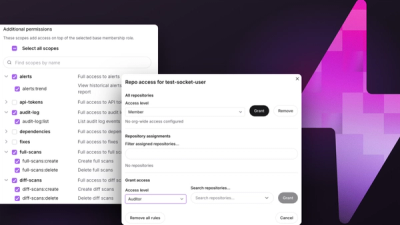
Introducing Repository Access Permissions and Custom Roles
Socket now supports Custom Roles and Repository Access Permissions so organizations can control who can access specific repositories and actions.
By Joe Werle - Jun 19, 2026
batch-file-renamer
Advanced tools
Module to simplify writing node.js commandline applications that rename groups of files
A module to make writing node.js commandline applications that rename files easier to write.
To create a trivial application using Batch-File-Renamer:
#!/usr/bin/env node
// lowercaser.js
var batchFileRenamer = require('batch-file-renamer');
batchFileRenamer({
rule: function (filename) {
return filename.toLowerCase()
}
});
Can then be used as follows:
$ ls
FileName01.TXT fileNAME02.txt FiLeNaMe.TxT

$ ./lowercaser.js *

$ ls
filename01.txt filename02.txt filename.txt
To prevent a file from being renamed, you can simply have the rule return null and it won't rename that file.
Rules can be synchronous, node callbacks, or promises.
It is possible to pass in CLI Options to batch renamer for extending the commandline flags it accepts:
// example.js
batchFileRenamer({
    rule: rule,
    cliOptions: {
        options: {
            foo: { alias: 'F', description: 'Are you foo or not?', type: 'boolean' }
        }
    }
})
And we can see this in the help generated.
$ ./example.js -h
Options:
  --foo, -F           Are you foo or not?                              [boolean]
  --colour            Colour logging                   [boolean] [default: true]
  --verbose, -v       Verbose logging                                  [boolean]
  --quiet             Only log errors                                  [boolean]
  --silent            No logging                                       [boolean]
  --force, -f         Overwrite existing files                         [boolean]
  --recursive, -r     Name files in directory recursively              [boolean]
  --interactive, -i   Prompt for file change                           [boolean]
  --backup            Create backup of file                            [boolean]
  --error-on-missing  Fail if any source file missing                  [boolean]
  --version, -V       Show version number                              [boolean]
  --help, -h          Show help                                        [boolean]
Uses yargs in the back, so you should be able to pass anything you would pass to yargs.options method.
Add pre, post and onError hooks. Post hook only runs on successful renaming.
// example.js
batchFileRenamer({
    pre: function () {
        db.openConnection();
    },
    rule: rule,
    post: function () {
        db.closeConnection();
    },
    onError: function () {
        db.closeConnection();
    }
})
The pre and post options may be async (promises or callback), whilst the onError command is synchronous.
You could just log to stdout using console.log, however this won't respond to the provided verbose, silent, quiet and (hidden) DEBUG flags. A useful logger is provided.
var batchFileRenamer = require('batch-file-renamer');
var logger = batchFileRenamer.logger;

batchFileRenamer({
    pre: function () {
        logger.debug('The application is starting');
        logger.log('Welcome to this amazing application!');
    },
    rule: function (filename) {
        filename = filename.toLowerCase();
        if (filename.length > 100)  {
            logger.warn('That is a long filename');
        }
        if (filename === 'never_gonna_give_you_up') {
            logger.error('Rickrolled');
        }
        return filename;
    }
})
The logger commands can only be used inside the batch-file-renamer process, as they are initialised according to verbosity variables.
By default, warnings and errors are shown, whereas logs are only shown in verbose mode.
By default the application will throw an error if duplicate destinations are provided, however it is also possible to provide a duplicate destination resolver.
This is an example of how you might use it:
var incrementers = {};

batchFileRenamer({
    rule: rule,
    duplicationResolver: function (duplicateDests, srcDestPairs) {
        return srcDestPairs.map(function (pair) {
            var src = pair[0];
            var dest = pair[1];
            var i;
            if (duplicateDests.indexOf(dest) !== -1) {
                if (!incrementers[dest]) {
                    incrementers[dest] = 0;
                } else {
                    incrementers[dest] += 1;
                }
                i = incrementers[dest];
                dest = dest + i;
            }
            return [src, dest];
        })
    }
})
Bare in mind that further duplication checks are not run after this function.
If you throw an error (or return error in promise / node callback) it gets handled by batch-file-renamer's error handler. You can provide your own message simply by throwing an error with your own message.
Also, if you want to provide custom error messages for system errors, you can add them like so:
batchFileRenamer({
    rule: rule,
    errorMessages: {
        ENOMEM: 'Sorry to mention it, but you are out of memory'
    }
})
This relies on the error.code being ENOMEM.
FAQs
Module to simplify writing node.js commandline applications that rename groups of files
We found that batch-file-renamer demonstrated a not healthy version release cadence and project activity because the last version was released a year ago. It has 1 open source maintainer collaborating on the project.
Did you know?

Socket for GitHub automatically highlights issues in each pull request and monitors the health of all your open source dependencies. Discover the contents of your packages and block harmful activity before you install or update your dependencies.
Product
Socket now supports Custom Roles and Repository Access Permissions so organizations can control who can access specific repositories and actions.
Product
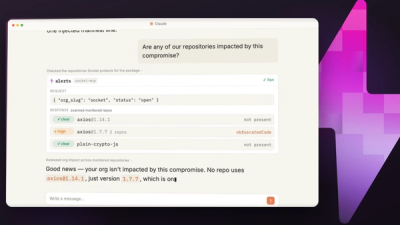
Socket MCP now lets AI assistants review org alerts, investigate threats using the Socket threat feed, and inspect package files in addition to dependency scoring.
Product
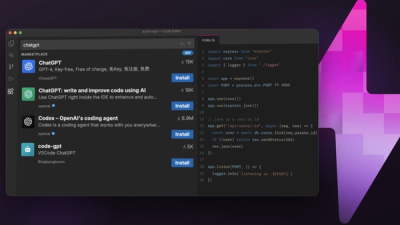
Socket Firewall blocks malicious VS Code and Open VSX extensions before install, protecting developers from compromised editor marketplaces.