

Research
/Security News
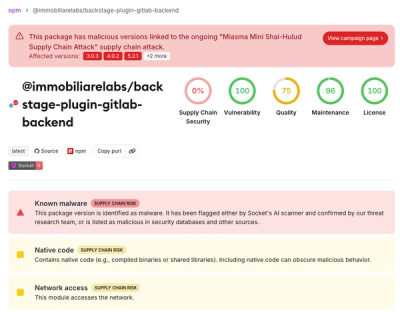
Miasma Mini Shai-Hulud Hits ImmobiliareLabs npm Packages
Miasma Mini Shai-Hulud hits @immobiliarelabs Backstage plugins, targeting GitLab and LDAP auth packages on npm.
By Socket Research Team - Jun 26, 2026
Message-based two-way remote procedure call. Useful for WebSockets and Workers communication.
When using WebSocket, you need to pass your custom serializer and deserializer.
import type { ServerFunctions } from './types'
const ws = new WebSocket('ws://url')
const clientFunctions: ClientFunctions = {
hey(name: string) {
return `Hey ${name} from client`
}
}
const rpc = createBirpc<ServerFunctions>(
clientFunctions,
{
post: data => ws.send(data),
on: fn => ws.on('message', fn),
// these are required when using WebSocket
serialize: v => JSON.stringify(v),
deserialize: v => JSON.parse(v),
},
)
await rpc.hi('Client') // Hi Client from server
import type { ClientFunctions } from './types'
import { WebSocketServer } from 'ws'

const serverFunctions: ServerFunctions = {
  hi(name: string) {
    return `Hi ${name} from server`
  }
}

const wss = new WebSocketServer()

wss.on('connection', (ws) => {
  const rpc = createBirpc<ClientFunctions>(
    serverFunctions,
    {
      post: data => ws.send(data),
      on: fn => ws.on('message', fn),
      serialize: v => JSON.stringify(v),
      deserialize: v => JSON.parse(v),
    },
  )

  await rpc.hey('Server') // Hey Server from client
})
As JSON.stringify does not supporting circular references, we recommend using structured-clone-es as the serializer when you expect to have circular references.
import { parse, stringify } from 'structured-clone-es'

const rpc = createBirpc<ServerFunctions>(
  functions,
  {
    post: data => ws.send(data),
    on: fn => ws.on('message', fn),
    // use structured-clone-es as serializer
    serialize: v => stringify(v),
    deserialize: v => parse(v),
  },
)
MessageChannel will automatically serialize the message and support circular references out-of-box.
export const channel = new MessageChannel()
import type { AliceFunctions } from './types'
import { channel } from './channel'

const Bob: BobFunctions = {
  hey(name: string) {
    return `Hey ${name}, I am Bob`
  }
}

const rpc = createBirpc<AliceFunctions>(
  Bob,
  {
    post: data => channel.port1.postMessage(data),
    on: fn => channel.port1.on('message', fn),
  },
)

await rpc.hi('Bob') // Hi Bob, I am Alice
import type { BobFunctions } from './types'
import { channel } from './channel'

const Alice: AliceFunctions = {
  hi(name: string) {
    return `Hi ${name}, I am Alice`
  }
}

const rpc = createBirpc<BobFunctions>(
  Alice,
  {
    post: data => channel.port2.postMessage(data),
    on: fn => channel.port2.on('message', fn),
  },
)

await rpc.hey('Alice') // Hey Alice, I am Bob
Refer to ./test/group.test.ts as an example.

MIT License © 2021 Anthony Fu
Comlink is a library that makes WebWorkers enjoyable. It allows you to use WebWorkers as if they were local objects. Compared to birpc, Comlink provides a more seamless and higher-level abstraction for working with WebWorkers, but it is primarily focused on WebWorkers and may not be as flexible for other contexts.
Postmate is a powerful, simple, promise-based library for cross-domain iframe communication. It allows you to easily communicate between an iframe and its parent window. While birpc can also handle iframe communication, Postmate is specifically designed for this purpose and provides a more specialized API.
rpc-websockets is a library for creating RPC servers and clients over WebSockets. It is more suitable for networked applications where WebSocket communication is required. Compared to birpc, rpc-websockets is more focused on network communication rather than inter-context communication within the same application.
FAQs
Message based Two-way remote procedure call
The npm package birpc receives a total of 8,199,968 weekly downloads. As such, birpc popularity was classified as popular.
We found that birpc demonstrated a healthy version release cadence and project activity because the last version was released less than a year ago. It has 2 open source maintainers collaborating on the project.
Did you know?

Socket for GitHub automatically highlights issues in each pull request and monitors the health of all your open source dependencies. Discover the contents of your packages and block harmful activity before you install or update your dependencies.
Research
/Security News
Miasma Mini Shai-Hulud hits @immobiliarelabs Backstage plugins, targeting GitLab and LDAP auth packages on npm.

Security News
Rolldown paused Rust React Compiler integration after a 5MB binary size increase raised concerns about shipping React-specific code to all Vite users.

Security News
/Research
Mini Shai-Hulud expands into the Go ecosystem after hitting LeoPlatform npm packages and targeting GitHub Actions workflows.