

Company News
AWS Security Hub Adds Socket for Supply Chain Security
Socket is now in the AWS Security Hub Extended plan. Adopt it through AWS, apply committed spend, and block malicious open source packages.
By Feross Aboukhadijeh - Aug 04, 2026
MCP launcher for brokre — local credential broker for Cursor, Claude Code, Kimi Code, Trae, OpenClaw, Hermes Agent, ChatClaw, and other MCP clients
MCP launcher for brokre — a local credential broker for AI agents. Use it with Cursor, Claude Code, Kimi Code, Trae, OpenClaw, Hermes Agent, ChatClaw, and other MCP-capable clients to run ssh / mysql / psql and more — passwords never enter AI context, environment variables, or ps output. Agents list credential aliases and execute saved connections via MCP without exposing passwords to the AI.
Developed by Techinone (成都同创合一科技有限公司).
Current version: 0.2.17 · npm
npm install -g brokre
# or use without global install:
npx -y brokre@latest
| Feature | Behavior |
|---|---|
| SessionRelay by default | Routed SSH aliases such as b150::db use brokre tunnel agent --stdio over SSH by default. Inner credentials stay on the bastion; the laptop only relays terminal bytes. |
| Multi-hop routed SSH | Routes such as b1::b2::db peel one hop per agent: the laptop starts the agent on b1, then b1 continues with b2::db. Default route depth is 2 unless configured. |
| Local-only list by default | brokre_list no longer SSHs to bastions or triggers bastion unlock unless include_bastions=true is set. Cursor startup can list local metadata without opening bastion auth. |
| Legacy escape hatch | Set BROKRE_TUNNEL=0 on the MCP server process only for emergency rollback to the old routed SSH path. |
| Auto MCP registration | postinstall → brokre-setup-mcp. Detects installed IDEs only; merges npx -y brokre@latest into global MCP config. Idempotent — no duplicate entries, no writes for missing software. |
| Auto binary upgrade | Each MCP start compares npm version vs ~/.brokre/bin/brokre / PATH; downloads matching release when needed. |
| Manual controls | brokre mcp setup · npx brokre-setup-mcp · --dry-run · --force · skip: BROKRE_MCP_SKIP_SETUP=1 |
IDEs with auto-setup (global config paths):
| IDE | Config file |
|---|---|
| Cursor | ~/.cursor/mcp.json |
| VS Code | …/Code/User/mcp.json |
| VS Code Insiders | …/Code - Insiders/User/mcp.json |
| Claude Code | ~/.claude.json |
| Claude Desktop | …/Claude/claude_desktop_config.json |
| Trae | …/Trae/User/mcp.json |
| Kimi Code | ~/.kimi-code/mcp.json |
| Windsurf | ~/.codeium/windsurf/mcp_config.json |
| OpenClaw | ~/.openclaw/openclaw.json (mcp.servers) |
Operate many inner hosts through one jump box — passwords stay on the bastion, not in AI context.
| Advantage | What it means in practice |
|---|---|
| Single control plane | Register bastion alias b150, sync inner aliases, drive cluster via brokre_list |
| Smart routing | b150::db, multi-hop b1::b2::inner — separator ::; routed SSH uses SessionRelay by default |
| Secrets on bastion | Routed exec uses remote ~/.brokre/bin/brokre; laptop holds metadata + gate only |
| Human gate | Unlock via TTY, /bastion-auth, or MCP URL elicitation; survives manage UI idle expiry |
| Cluster-safe list | Local-only by default; explicit bastion discovery, loop detection, audit route/bastion |
| Privileged over routes | brokre_exec_elevated, sudo/sudo -i through bastions with session reuse |
Gate policy (default vs strict) — inactive until brokre bastion set-key. Default: unlock only for bastion outbound (:: routes, registered bastion SSH, bastion list discovery). Strict: every exec requires unlock; list remains local-only unless include_bastions=true. CLI: brokre bastion strict on|off|status · MCP: brokre_bastion_policy. Config: ~/.brokre/bastion/policy.json. See main README.
Typical MCP flow:
{ "binary": "ssh", "args": ["b150::db", "uname", "-a"] }
CLI setup:
brokre bastion enable b150
brokre bastion sync b150 --json
brokre bastion unlock
brokre list --include-bastions --json
See brokre_list — local-first list below.
npx)brokre from GitHub Releases into ~/.brokre/bin/ when the local binary is missing or older than the npm package version.sudo/su shells): Unix only (macOS / Linux).Optional — install the CLI yourself (recommended for production):
curl -fsSL https://raw.githubusercontent.com/Furowu/brokre/main/install.sh | bash
Re-run the same command to upgrade; the script skips download when already up to date.
Any tool with stdio MCP support can use brokre — configure npx -y brokre@latest (or brokre mcp after CLI install) as the MCP server command. Tested and documented below for Cursor and Claude Code; the same pattern applies to Kimi Code, Trae, OpenClaw, Hermes Agent, ChatClaw, and similar agents.
One-click install: Install brokre in Cursor
Or add to ~/.cursor/mcp.json or .cursor/mcp.json:
{
  "mcpServers": {
    "brokre": {
      "command": "npx",
      "args": ["-y", "brokre@latest"]
    }
  }
}
Or use the native binary directly (no Node, after CLI install):
{
  "mcpServers": {
    "brokre": {
      "command": "brokre",
      "args": ["mcp"]
    }
  }
}
Project scope (.mcp.json at repo root):
{
  "mcpServers": {
    "brokre": {
      "type": "stdio",
      "command": "npx",
      "args": ["-y", "brokre@latest"]
    }
  }
}
CLI:
claude mcp add --scope project brokre -- npx -y brokre@latest
Recommended: npx -y brokre@latest so the npm launcher stays current (package version 0.2.17).
On each MCP start, this package compares the npm package version with any local brokre binary (on PATH or in ~/.brokre/bin/). If the binary is missing or older, it downloads the matching release from GitHub into ~/.brokre/bin/ and uses that — even when an older brokre is already on PATH.
npm i brokre, 0.2.8+)On npm install brokre (local or global), postinstall runs brokre-setup-mcp, which detects installed IDEs (app bundle, CLI, or real usage artifacts — not empty directories) and merges a global brokre MCP entry (npx -y brokre@latest) into each client's config file. Does not create config files for software that is not installed. Existing non-brokre servers are preserved; duplicate brokre aliases under other names are not added.
| IDE | Global config path |
|---|---|
| Cursor | ~/.cursor/mcp.json |
| VS Code | ~/Library/Application Support/Code/User/mcp.json (macOS) |
| VS Code Insiders | …/Code - Insiders/User/mcp.json |
| Claude Code | ~/.claude.json (mcpServers) |
| Claude Desktop | …/Claude/claude_desktop_config.json |
| Trae | …/Trae/User/mcp.json |
| Kimi Code | ~/.kimi-code/mcp.json |
| Windsurf | ~/.codeium/windsurf/mcp_config.json |
| OpenClaw | ~/.openclaw/openclaw.json (mcp.servers) |
Manual re-run: brokre mcp setup or npx brokre-setup-mcp (add --dry-run to preview, --force to overwrite). Skip on install: BROKRE_MCP_SKIP_SETUP=1.
CLI on PATH: On first download, brokre-mcp adds ~/.brokre/bin to your shell profile (~/.zshrc, etc.) and tries to symlink /usr/local/bin/brokre when writable. Open a new terminal (or source ~/.zshrc) so brokre manage works.
Empty vault: Each MCP connect while the vault has no credentials starts brokre manage in the background and opens http://127.0.0.1:56777/?t=… (or the next free port) in your default browser. Session tokens are never returned to the AI.
Manual CLI install (install.sh) does the same version check: re-run the script to upgrade when a newer release is available.
When the vault is empty, brokre mcp automatically opens brokre manage in your browser (e.g. http://127.0.0.1:56777/?t=…) so you can add accounts. Session tokens are never returned to the AI — only your browser receives them.
Disable auto-open: BROKRE_MCP_NO_AUTO_OPEN=1
| Tool | Purpose |
|---|---|
brokre_list | Saved local aliases (metadata only) by default; set include_bastions=true to discover bastion::inner routes, which may require unlock |
brokre_exec | Run a saved connection (binary + args); ssh + shell_command for remote scripts; ssh + sudo/su auto-reuses elevated session |
brokre_exec_elevated | Remote privileged command (alias, command, mode); default session=reuse |
brokre_setup | Open manage UI in browser for the human |
brokre_audit_list | Query audit history (metadata only — args redacted) |
brokre_audit_verify | Verify tamper-evident audit log chain |
brokre_bastion_policy | Read/set gate mode: default (bastion outbound only) or strict (all exec; list remains local-only unless include_bastions=true); returns key_set, unlocked |
Not exposed: reveal, password export, or manage session tokens.
The npm package launches MCP, but the underlying tool is the brokre CLI (~/.brokre/bin/brokre or PATH). Humans and agents debugging in a terminal use the same vault.
Always prefix brokre — bare ssh prod / mysql prod does not inject saved passwords.
brokre list --json                    # list aliases (metadata only)
brokre ssh prod uname -a              # SSH one-shot (split argv after alias)
brokre mysql prod-db -e "SHOW TABLES"
brokre ssh prod sh -c 'echo hi > /tmp/f'   # remote script ( -c script is one arg )
brokre manage --open                  # add credentials in browser
brokre ssh user@10.0.0.1              # first-time save (TTY; type password when prompted)
Run brokre --help for pass-through syntax and subcommands (list, manage, mcp, bastion, …).
| Task | MCP | CLI |
|---|---|---|
| List aliases | brokre_list | brokre list --json |
| SSH command | brokre_exec binary=ssh, args=["prod","uname","-a"] | brokre ssh prod uname -a |
| Other CLI | brokre_exec binary=mysql, args=[…] | brokre mysql <alias> … |
| Remote script | shell_command="…" | brokre ssh <alias> sh -c '…' |
| Privileged | brokre_exec_elevated | brokre ssh <alias> sudo … |
| Setup | brokre_setup | brokre manage --open |
AI antipatterns: ssh prod cmd (missing brokre); MCP args=["prod","cmd arg"] (use argv tokens or shell_command).
brokre_list — local-first listBy default, brokre_list reads local metadata only. It does not SSH to bastions, does not discover remote aliases, and does not trigger bastion unlock.
Set include_bastions=true only when the user needs cross-network routed aliases. Then brokre:
b150::db (route: ["b150"], access: "via_b150")b1::b2::db when the bastion catalogs expose themUse probe: true for reachability checks and all: true to include unreachable entries. Prefer routed aliases only when they are actually listed and needed.
Example response (cross-network via VPN to bastion b150):
{
  "items": [
    {
      "profile": "ssh",
      "name": "db",
      "addr": "b150::db",
      "route": ["b150"],
      "kind": "inner",
      "access": "via_b150",
      "host_alias": "10.0.0.20",
      "availability": "available",
      "status": {
        "reachable": true,
        "probe_ms": 3,
        "source": "b150",
        "checked_at": "2026-06-21T12:00:00Z"
      }
    }
  ],
  "bastion_gate": {
    "required": true,
    "unlocked_during_call": true,
    "idle_expires_at": "2026-06-21T12:10:00Z"
  }
}
Execute routed alias:
{ "binary": "ssh", "args": ["b150::db", "uname", "-a"] }
Multi-hop uses the same argv layout when every hop has the next bastion registered:
{ "binary": "ssh", "args": ["b1::b2::db", "uname", "-a"] }
When both direct and routed paths work, both appear — access: "direct" vs access: "via_b150".
SessionRelay tunnel (default): routed ssh aliases such as b150::db use SessionRelay by default. The laptop starts brokre tunnel agent --stdio on b150; the agent runs brokre ssh db using the bastion vault, so inner credentials stay on the bastion. Multi-hop routes peel one hop per agent: b1::b2::db starts on b1, then b1 continues with b2::db. Routed brokre_exec responses include:
{
  "exit_code": 0,
  "stdout": "...",
  "stderr": "",
  "tunnel": { "mode": "session_relay", "active": true }
}
Set BROKRE_TUNNEL=0 on the MCP server process only as a temporary legacy escape hatch. TcpForward, endpoint sync, Manage UI controls, and persistent tunneld are later phases.
default vs strict)| Mode | Unlock required when key is set |
|---|---|
default (strict_mode: false) | Bastion outbound only: b150::db routes, SSH to registered bastion aliases, brokre_list only when include_bastions=true. Local brokre_list / brokre_exec — no unlock. |
strict (strict_mode: true) | Every brokre_exec; brokre_list remains local-only unless include_bastions=true. |
brokre bastion set-key           # gate inactive until this
brokre bastion strict status
brokre bastion strict on         # strict
brokre bastion strict off        # default
brokre bastion unlock
{ "strict_mode": true }
MCP brokre_bastion_policy (omit strict_mode to read). Unlock TTL defaults: 30 min idle / 8 h max — env BROKRE_BASTION_IDLE_SECS, BROKRE_BASTION_MAX_SECS. List/exec include bastion_gate in responses.
brokre_exec_elevated)Runs a command on a saved SSH host with sudo, sudo -i environment (sudo_login), or su. By default the MCP server reuses a background elevated shell (same alias + mode + user) so sudo is not re-prompted every call.
{
  "alias": "prod",
  "command": "systemctl restart nginx",
  "mode": "sudo_login",
  "session": "reuse"
}
| Field | Values |
|---|---|
mode | sudo, sudo_login (aliases: sudo-i), su |
session | reuse (default), new, close (use command: "") |
user | Target user for su; default root |
Response (session pool enabled): exit_code, stdout, stderr, session_reused, session_idle_expires_at. The expiry field is a rolling idle-window hint, not a fixed deadline. With BROKRE_MCP_SESSION=0, only the first three fields are returned (one-shot subprocess).
brokre_exec shortcut: binary=ssh, args=["prod","sudo","systemctl","status","nginx"] uses the same pool (always reuse; cannot pass session=new|close).
shell_command)For scripts or file writes with complex quoting, use shell_command (ssh only). Pass only the alias in args; brokre runs sh -c <shell_command> on the remote host.
{
  "binary": "ssh",
  "args": ["prod"],
  "shell_command": "cat > /tmp/deploy.sh <<'EOF'\n#!/bin/sh\necho ok\nEOF"
}
Do not: put sh -c '...' in args, split printf/redirects across argv tokens, or rely on line-by-line echo >> workarounds. For privileged paths use brokre_exec_elevated.command. Bastion routes: args=["b150::db"] with the same shell_command field.
Limits: idle teardown 10 min, max lifetime 30 min, per-command timeout 120 s (configurable via env below). No interactive sudo -i without a command, no vim/top. Sudo password must match vault password.
| Variable | Description |
|---|---|
BROKRE_MCP_SKIP_SETUP | Set to 1 to skip auto MCP registration on npm install |
BROKRE_BIN | Pin a specific brokre binary (skips version check and auto-download) |
BROKRE_VERSION | Release version to download (default: npm package version) |
BROKRE_SKIP_AUTO_INSTALL | Set to 1 to use PATH only, no GitHub download |
BROKRE_MCP_NO_AUTO_OPEN | Set to 1 to skip browser on empty vault |
BROKRE_MCP_SESSION | Set to 0 to disable elevated session pool (default: enabled on Unix) |
BROKRE_MCP_SESSION_IDLE_SECS | Idle session teardown (default: 600) |
BROKRE_MCP_SESSION_MAX_SECS | Max session lifetime (default: 1800) |
BROKRE_MCP_SESSION_CMD_TIMEOUT | Per remote command timeout in seconds (default: 120) |
BROKRE_BASTION_NO_AUTO_OPEN | Set to 1 to skip browser on bastion gate unlock (non-TTY) |
BROKRE_BASTION_IDLE_SECS | Bastion unlock idle timeout in seconds (default: 1800) |
BROKRE_BASTION_MAX_SECS | Bastion unlock max session lifetime in seconds (default: 28800) |
MIT · Techinone
FAQs
MCP launcher for brokre — local credential broker for Cursor, Claude Code, Kimi Code, Trae, OpenClaw, Hermes Agent, ChatClaw, and other MCP clients
The npm package brokre receives a total of 153 weekly downloads. As such, brokre popularity was classified as not popular.
We found that brokre demonstrated a healthy version release cadence and project activity because the last version was released less than a year ago. It has 1 open source maintainer collaborating on the project.
Did you know?

Socket for GitHub automatically highlights issues in each pull request and monitors the health of all your open source dependencies. Discover the contents of your packages and block harmful activity before you install or update your dependencies.
Company News
Socket is now in the AWS Security Hub Extended plan. Adopt it through AWS, apply committed spend, and block malicious open source packages.
Research
/Security News
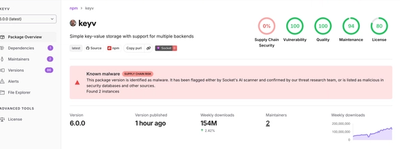
Popular npm packages keyv and cacheable compromised.

Security News
A misconfiguration gave three Anthropic models internet access, and one, believing it was in a simulation, shipped a credential-stealing package to PyPI.