

Company News
AWS Security Hub Adds Socket for Supply Chain Security
Socket is now in the AWS Security Hub Extended plan. Adopt it through AWS, apply committed spend, and block malicious open source packages.
By Feross Aboukhadijeh - Aug 04, 2026
browserctl-cli
Advanced tools
Self-contained browserctl CLI with auto-start Chrome/Edge daemon (no Electron required)
Self-contained global CLI to drive a standalone Chrome/Edge via browserctl commands. Designed for non-Electron use: CI pipelines, local automation scripts, or any context where you want the full browserctl command set without the Electron shell.
The command set is identical to the Electron-embedded browserctl; the difference is the daemon runs as a plain Node.js process rather than inside Electron.
Requirements: Node.js ≥ 20, Google Chrome or Microsoft Edge installed.
npm install -g browserctl-cli
# or
pnpm add -g browserctl-cli
Then:
browserctl open https://www.baidu.com
browserctl snapshot --interactive
browserctl quit
Global install registers the browserctl command (auto-starts a background daemon on first use).
pnpm --filter browserctl-cli build
Produces:
dist/cli.js — the CLI entry (handles all subcommands)dist/daemon.js — the background daemon entry (auto-started by the CLI)bin directory to PATH (no install step)Windows — add to your user PATH in System Settings:
packages\browserctl-cli\bin
macOS / Linux — add to your shell profile (~/.bashrc, ~/.zshrc):
export PATH="/path/to/packages/browserctl-cli/bin:$PATH"
Then open a new terminal and run browserctl --help.
Note: on Windows the
bin/browserctlPOSIX wrapper is unused;bin/browserctl.cmdis picked up automatically bycmd.exe/ PowerShell.
pnpm --filter browserctl-cli link --global
After linking, browserctl is available system-wide via pnpm's global bin directory (no PATH editing needed).
# Open a URL (auto-starts daemon + Chrome on first command)
browserctl open https://www.baidu.com

# Take a full-page snapshot and enter interactive element-picker mode
browserctl snapshot --interactive

# Compact snapshot with depth limit and scoped subtree
browserctl snapshot -c -d 3 -s "#main"

# Fill an input identified by element number
browserctl fill @eN "search query"

# Click an element identified by element number
browserctl click @eN

# Hover / double-click / focus an element
browserctl hover @eN
browserctl dblclick @eN
browserctl focus @eN

# Type (append, does not clear) into an input identified by element number
browserctl type @eN "search query"

# Check / uncheck a checkbox or radio
browserctl check @eN
browserctl uncheck @eN

# Drag from one element to another
browserctl drag @eN @eM

# Upload files to an <input type="file">
browserctl upload @eN file1.png file2.pdf

# Wait for page conditions (selector, URL glob, network idle, JS expression)
browserctl wait --selector "#result"
browserctl wait --url "https://example.com/dashboard"
browserctl wait --load networkidle
browserctl wait --load load
browserctl wait --load domcontentloaded
browserctl wait --fn "document.querySelector('.ready') !== null"

# Run JavaScript in the page context
browserctl eval "document.title"
browserctl eval --file ./script.js [--timeout 15000]

# Get the current page URL
browserctl get url

# Read element text or state
browserctl get text @eN
browserctl is visible @eN
browserctl is enabled @eN
browserctl is checked @eN
browserctl find role button click --name "Submit"
browserctl find first "#kw" fill "keywords"

# Save a screenshot to a file
browserctl screenshot --out shot.png

# Annotated screenshot with @eN labels (for HITL / vision models)
browserctl snapshot --interactive
browserctl screenshot --annotate --out shot-annotated.png
The daemon process manages the browser session in the background.
Auto-start — the first browser command automatically starts the daemon (default: Chrome, headed, persistent profile at ~/.browserctl/profile-chrome). No explicit step needed.
Chrome window closed — if you close the browser window, the daemon exits automatically; the next browserctl command starts a fresh daemon and Chrome (login state is kept in the persistent profile). You do not need browserctl quit in this case.
Explicit start with non-default config — runs in the foreground; press Ctrl+C to stop:
browserctl serve --browser edge --headless
Stop — shuts down the daemon and closes the browser:
browserctl quit
Use the persistent profile to avoid repeated logins:
browserctl open https://your-oa/) — Chrome opens with the persistent profile.Subsequent daemon starts reuse the same profile, so login state is retained automatically.
browserctl quit writes a stop signal and cleans the state file, but process.kill may not reliably terminate the daemon process on Windows. If the daemon lingers after quit:
~/.browserctl/daemon.json.taskkill /PID <pid> /F
Chrome is closed indirectly by the daemon's shutdown handler; if Chrome also lingers, close it manually.
Maintainers(需先 npm login):
# 推荐:自动 bump 版本 + 测试 + 发布(auto = npm 已有同版本则 patch+1)
pnpm publish:browserctl-cli

# 或在包目录指定 bump 级别
pnpm --filter browserctl-cli release:patch
pnpm --filter browserctl-cli release:minor
pnpm --filter browserctl-cli release:major
| 命令 | 版本规则 |
|---|---|
release / publish:browserctl-cli | auto:npm 无包→用当前版本;npm 已有且 ≥ 本地→在 npm 最新上 patch+1 |
release:patch | 本地版本 patch+1 |
release:minor | 本地版本 minor+1 |
release:major | 本地版本 major+1 |
发布后请 commit packages/browserctl-cli/package.json 的版本号变更。
prepublishOnly 会在 publish 前自动 tsup build。Dry-run:pnpm --filter browserctl-cli pack
FAQs
Self-contained browserctl CLI with auto-start Chrome/Edge daemon (no Electron required)
The npm package browserctl-cli receives a total of 17 weekly downloads. As such, browserctl-cli popularity was classified as not popular.
We found that browserctl-cli demonstrated a healthy version release cadence and project activity because the last version was released less than a year ago. It has 1 open source maintainer collaborating on the project.
Did you know?

Socket for GitHub automatically highlights issues in each pull request and monitors the health of all your open source dependencies. Discover the contents of your packages and block harmful activity before you install or update your dependencies.
Company News
Socket is now in the AWS Security Hub Extended plan. Adopt it through AWS, apply committed spend, and block malicious open source packages.
Research
/Security News
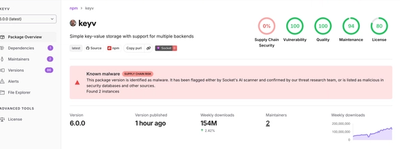
Popular npm packages keyv and cacheable compromised.

Security News
A misconfiguration gave three Anthropic models internet access, and one, believing it was in a simulation, shipped a credential-stealing package to PyPI.