

Company News
AWS Security Hub Adds Socket for Supply Chain Security
Socket is now in the AWS Security Hub Extended plan. Adopt it through AWS, apply committed spend, and block malicious open source packages.
By Feross Aboukhadijeh - Aug 04, 2026
browserctl-cli
Advanced tools
Self-contained browserctl CLI with auto-start Chrome/Edge daemon (no Electron required)
Self-contained global CLI to drive a standalone Chrome/Edge via browserctl commands. Designed for non-Electron use: CI pipelines, local automation scripts, or any context where you want the full browserctl command set without the Electron shell.
The command set is identical to the Electron-embedded browserctl; the difference is the daemon runs as a plain Node.js process rather than inside Electron.
Requirements: Node.js ≥ 20, Google Chrome or Microsoft Edge installed.
npm install -g browserctl-cli
# or
pnpm add -g browserctl-cli
Then:
browserctl open https://www.baidu.com
browserctl snapshot --interactive
browserctl quit
Global install registers the browserctl command (auto-starts a background daemon on first use).
Quick start:
browserctl open https://www.baidu.com
browserctl snapshot --interactive
browserctl fill @e1 "search query"
browserctl click @e2
browserctl screenshot --annotate --out shot.png
browserctl quit
Full command reference (same as desktop browserctl, minus Electron-only open-artifact / close):
browserctl health
browserctl open <url>                 # = navigate
browserctl snapshot [--max-nodes 200] [--compact|-c] [--depth N|-d N] [--scope <sel>|-s <sel>] [--tree | --interactive]
browserctl wait (--selector <css> [--state visible|hidden] | --text <text> | --url <glob> | --load load|domcontentloaded|networkidle | --fn <js> | --fn-file <path> | --fn-stdin | --ms <n>) [--timeout 10000]
browserctl eval (<js> | --file <path> | --stdin) [--timeout 10000]
browserctl tab
browserctl tab new [--label <name>] [url]
browserctl tab <tN|label>
browserctl tab close [tN|label]
browserctl click <@eN|selector> [--confirm "确认文案"]
browserctl fill <@eN|selector> (<text> | --text-file <path> | --text-stdin)
browserctl hover|dblclick|focus|check|uncheck <@eN|selector>
browserctl type [@eN|selector] (<text> | --text-file <path> | --text-stdin)
browserctl drag <@eN|selector> <@eN|selector>
browserctl upload <@eN|selector> <file...>
browserctl press <key> [@eN|selector] [--ctrl|--shift|--alt|--meta]
browserctl scroll [@eN|selector] [--to top|bottom] [--by <px>]
browserctl select <@eN|selector> (<value> | --label <文本>)
browserctl get url|title|value|text|html|count|box|styles|attr <@eN|selector> [attrName]
browserctl is visible|enabled|checked <@eN|selector>
browserctl find role|text|…  # positional;或 find <action> --role|--selector|… flag 模式
browserctl back|forward|reload
browserctl scrollintoview|scroll-into-view <@eN|selector>
browserctl dialog status|accept [text]|dismiss
browserctl extract-text
browserctl screenshot [--full] [--annotate] [--out <path>]
browserctl batch [--bail] [--json] "<cmd>" …
Detailed syntax, find flag mode, dialog semantics, and batch examples:
command reference.
Browser extension recorder flows should be exported as browserctl-flow.json
and validated before they are turned into skills:
browserctl validate-flow browserctl-flow.json --pretty
browserctl run-flow browserctl-flow.json --var RECORDED_USERNAME=demo --var RECORDED_PASSWORD=secret
browserctl generate-skill browserctl-flow.json --out-dir ./skills
browserctl batch --json remains the low-level command-array executor. Use
run-flow for full browserctl-flow.json files because it resolves
credentials, inputs, and runtime capture bindings first.
fill focuses and clears the target, inserts text, then dispatches
input / change / blur. type appends without clearing; without a
target it types into the current focused element.
Tabs follow agent-browser's switch-then-operate style. Use stable tN IDs or
labels, never numeric indexes; run a fresh snapshot after switching. There is
no public --tab option. Structured batch --json items may capture
data.tabId and reuse it as a complete ${KEY} argv token; see the command
reference for the schema and errors.
The daemon process manages the browser session in the background.
Auto-start — the first browser command automatically starts the daemon (default: Chrome, headed, persistent profile at ~/.browserctl/profile-chrome). No explicit step needed.
Chrome window closed — if you close the browser window, the daemon exits automatically; the next browserctl command starts a fresh daemon and Chrome (login state is kept in the persistent profile). You do not need browserctl quit in this case.
Explicit start with non-default config — runs in the foreground; press Ctrl+C to stop:
browserctl serve --browser edge --headless
Stop — shuts down the daemon and closes the browser:
browserctl quit
Use the persistent profile to avoid repeated logins:
browserctl open https://your-oa/) — Chrome opens with the persistent profile.Subsequent daemon starts reuse the same profile, so login state is retained automatically.
| Variable | Default | Description |
|---|---|---|
BROWSER_RUNTIME_BRIDGE_URL | http://127.0.0.1:34555 | Daemon bridge URL (auto-set by CLI) |
BROWSER_RUNTIME_TIMEOUT_MS | 60000 | Per-request socket timeout |
BROWSERCTL_STATE_DIR | ~/.browserctl | Daemon PID/state directory |
browserctl quit writes a stop signal and cleans the state file, but process.kill may not reliably terminate the daemon process on Windows. If the daemon lingers after quit:
Find the PID in ~/.browserctl/daemon.json.
Force-kill it:
taskkill /PID <pid> /F
Chrome is closed indirectly by the daemon's shutdown handler; if Chrome also lingers, close it manually.
FAQs
Self-contained browserctl CLI with auto-start Chrome/Edge daemon (no Electron required)
The npm package browserctl-cli receives a total of 19 weekly downloads. As such, browserctl-cli popularity was classified as not popular.
We found that browserctl-cli demonstrated a healthy version release cadence and project activity because the last version was released less than a year ago. It has 1 open source maintainer collaborating on the project.
Did you know?

Socket for GitHub automatically highlights issues in each pull request and monitors the health of all your open source dependencies. Discover the contents of your packages and block harmful activity before you install or update your dependencies.
Company News
Socket is now in the AWS Security Hub Extended plan. Adopt it through AWS, apply committed spend, and block malicious open source packages.
Research
/Security News
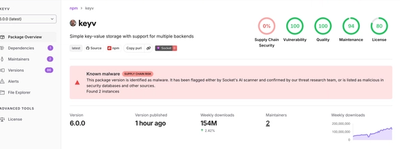
Popular npm packages keyv and cacheable compromised.

Security News
A misconfiguration gave three Anthropic models internet access, and one, believing it was in a simulation, shipped a credential-stealing package to PyPI.