



Security News
Deno Goes the Way of the Dinosaur
Cloudflare is acquiring Deno’s team, which will provide another year of bug fixes and security updates before ending support for the runtime.
By Sarah Gooding - Oct 16, 2026
claude-taskflow
Advanced tools
Run taskflow on Claude Code: the npm tarball provides the Claude subagent runner and MCP server; the plugin is distributed through the repository marketplace.
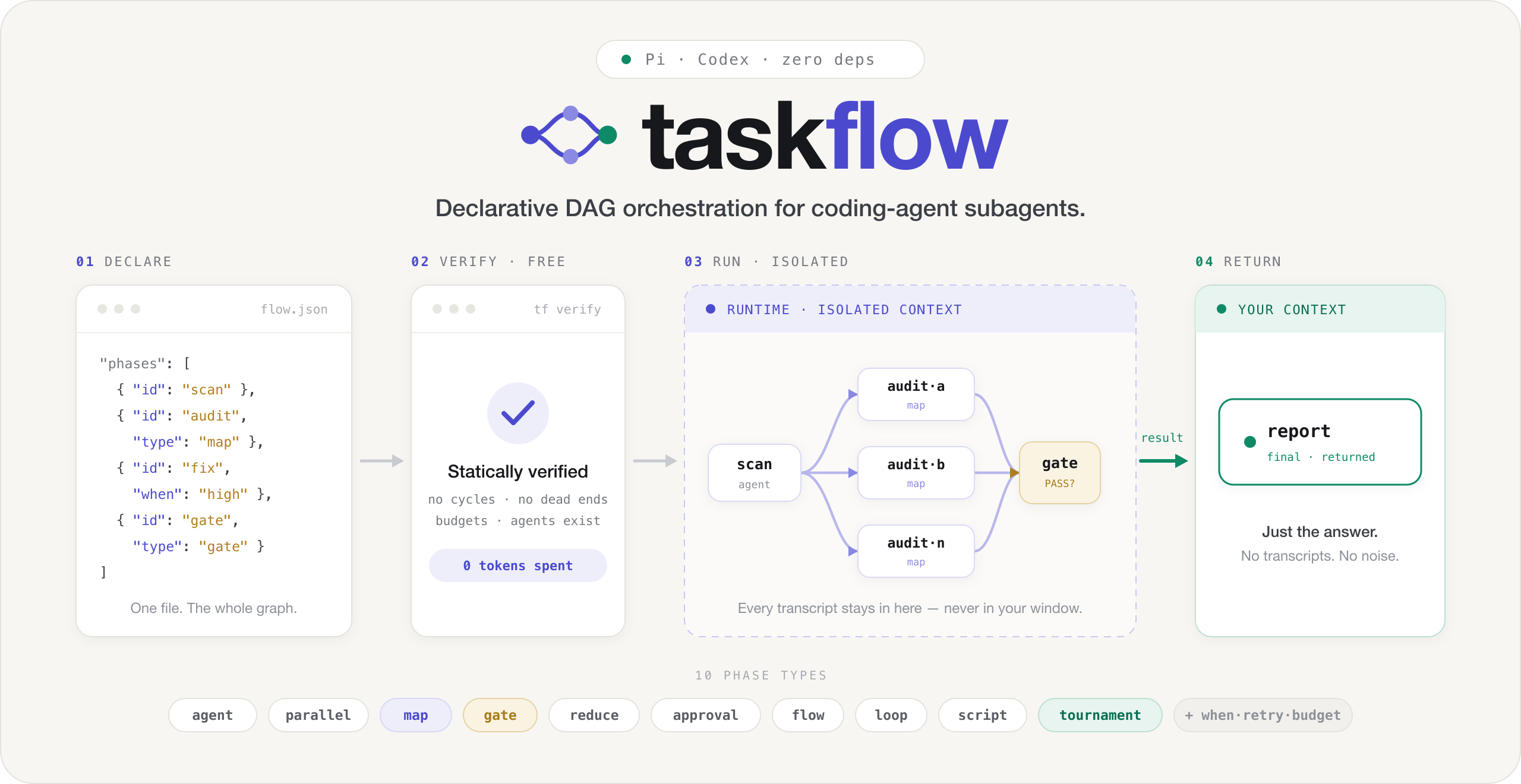
taskflow is a declarative runtime for coding-agent workflows. It turns a graph into a verifiable execution contract, runs phases in isolation, and keeps intermediate work out of the host conversation. In Taskflow 1.0, the contract also describes the effects a phase is allowed to propose.
Taskflow 1.0.0 includes the DAG runtime, trusted filesystem effects and complete Control Plane (CLI/MCP/WebUI). GitHub Releases and npm establish publication; see the acceptance scoreboard for verified scope and limits.
An agent can propose content. It should not become the mutation authority merely because it can run a command.
For admitted, declared filesystem-write targets, taskflow 1.0 makes the path explicit and routes the final mutation through the resources transaction:
flow / .tf.ts
│
▼
validate + verify ──► EffectIR + FlowIR hash
│ │
│ ▼
│ admit declared targets
│ │
▼ ▼
isolated phase ───────► stage → commit | restore + reject
│
▼
ledger-backed why-effect
This is not an OS sandbox. Resolve-only hosts cannot prevent every write to an undeclared path. Secret and service references are typed and fail closed in this cut; they do not imply a vault or network backend.
| Layer | What it does | Support boundary |
|---|---|---|
| Taskflow runtime | Declarative DAGs, 12 phase types, budgets, retries, approvals, isolation, resume, replay, trace, and recompute | Stable runtime contract |
| Trusted Effects | Closed EffectIR, PathRef / SecretRef / ServiceRef, confidentiality/integrity labels, effect validation, overlap checks, and ledger-backed why-* explainers | Declared-target contract |
| Resource transaction | Snapshot → lease → durable intent/permit → stage → commit, or restore and reject | Declared-target contract |
| Host adapters | Pi, Codex, Claude Code, OpenCode, Grok Build, and Hermes Agent use the same flow contract | Existing host surface; support remains host-specific |
| Control Plane | Authenticated multi-project admission, global concurrency, durable replay, approvals/CAS, Receipts and operator CLI/MCP | Bundled in public taskflow-mcp-core; Unix UDS, Windows pipes non-GA |
| WebUI | Runs, approval edits, Receipts and evidence browsing | Local token login, live authorization and project isolation |
The 1.0 release plan defines the stable scope and acceptance gates. The filesystem-transaction details are in docs/internal/0.3.0-trusted-effects-mvp.md. The 0.3-C Control Plane plan is docs/internal/0.3-c-control-plane-plan.md.
Use Node.js ≥ 22.19.0. To run from the 1.0 source checkout:
git clone https://github.com/heggria/taskflow.git
cd taskflow
git checkout v1.0.0
pnpm install
pnpm run typecheck
pnpm test
Install the matching 1.0.0 package set after confirming the release is available:
npm install --global pi-taskflow@1.0.0
npm install --global codex-taskflow@1.0.0
The host-specific plugin and MCP commands remain in the host guides.
Run the no-LLM Trusted Effects vertical-slice fixture:
pnpm exec node --conditions=development --experimental-strip-types --test \
  packages/taskflow-core/test/effects-e2e-fixture.test.ts
This exercises the checked-in examples/trusted-effects-write.json path without a live LLM. For an interactive run, use the host guide for the adapter you already run. The release guide covers packed-consumer validation and release gates.
In Pi, run /tf web to start the bundled local Control Console and open the default browser. If browser opening fails, the command shows a manual loopback URL. Use the one-use token in the reported private (0600) handoff file to log in; tokens are never included in the URL or command notifications.
The console shows Control Plane runs, approvals, Receipts and existing evidence. Legacy Pi run transcripts are outside this view. Repeating the command in the same project reuses its service; changing projects or leaving the Pi session stops only the console process started by that session. Unix local transport is required. If another host already owns the Control home, stop that owner explicitly before launching this console.
See Pi compatibility for the tested SDK matrix and the distinction between real-process fixtures and live-provider acceptance.
Effects are part of the flow contract, not a free-form prompt promise:
{
  "name": "trusted-effects-write",
  "phases": [
    {
      "id": "write-report",
      "type": "script",
      "run": ["node", "scripts/render-report.mjs"],
      "effects": [
        {
          "id": "report",
          "kind": "fs.write",
          "purpose": "write final report",
          "target": {
            "kind": "path",
            "path": {
              "workspace": "project",
              "subpath": { "literalPath": "out/report.md" },
              "intent": "create-file"
            }
          },
          "confidentiality": "internal",
          "integrity": "project"
        }
      ],
      "final": true
    }
  ]
}
The declaration is not authorization by itself. The runtime resolves the PathRef, checks labels and overlaps, records the resource intent, and only then permits the transaction to stage and finalize the declared target. taskflow_why_effect explains the resulting authorization and ledger state without model calls.
The 0.2 runtime remains the foundation. A flow can be authored as portable JSON or compiled from TypeScript DSL to FlowIR:
JSON / .tf.ts
      │
      ▼
validate → Taskflow JSON → FlowIR + content hash
                                  │
                                  ▼
                         isolated DAG runtime
                                  │
                   resume · replay · recompute · trace
                                  │
                                  ▼
                         finalOutput to the host
| Family | Phases | Use them for |
|---|---|---|
| Work | agent · parallel · map · reduce · script | Single tasks, static concurrency, dynamic fan-out, aggregation, and zero-token shell steps |
| Control | gate · approval · flow · loop | Quality decisions, human checkpoints, composition, and iterative refinement |
| Selection | tournament · race | Best-of-N quality or first-success latency |
| Dynamic graph | expand | Validate and execute a runtime-produced nested or grafted fragment |
Across those phase types, the runtime provides shared behavior: dependencies, conditions, retries, timeouts, output contracts, budgets, workspace isolation, explicit final-output selection, and persistence for resume. Each phase kind accepts only the fields that are safe and meaningful for it.
Useful zero-token operations include:
| Operation | Question it answers |
|---|---|
taskflow_plan | What will run, what arguments bind, and what is the worst-case agent-call bound? |
taskflow_verify / taskflow_compile | Is the graph structurally valid and what is its canonical form? |
taskflow_trace / taskflow_replay | What happened, or what would a zero-token what-if replay decide? |
taskflow_why_stale / taskflow_recompute | What changed and what is the smallest affected frontier? |
taskflow_why_effect | Why was a declared effect allowed, staged, committed, rejected, or left unknown? |
taskflow_analytics | How have recent runs behaved? |
The MCP surface currently exposes 20 tools. Intermediate transcripts remain inside the runtime unless you explicitly inspect them with peek or trace; the host normally receives only finalOutput.
The same flow contract can be delivered through six coding-agent hosts:
/tf commands, live run views, and interactive approvals.Host support is not a blanket security guarantee. Read the host support baseline and the Trusted Effects documentation before enabling mutating phases.
effects[] is a declaration and validation surface; it is not ambient authority.SecretRef and ServiceRef are typed handles only; no vault or live service adapter ships in this cut.taskflow-mcp-core provides the control binaries; operator actions require an explicitly provisioned separate credential. Request audit fields never grant authority.pnpm install
pnpm run typecheck
pnpm test
pnpm run build
pnpm run build:website
pnpm run test:pack
The monorepo contains the host-neutral taskflow-core, Trusted Effects and resources code, the taskflow-control 0.3-C contract package, the TypeScript DSL, MCP/host adapters, examples, and the website. See AGENTS.md for architecture and coding conventions.
| Start here | Use it for |
|---|---|
| 1.0 overview | 1.0 scope, support, and the security boundary |
| Getting Started | First flow and host setup |
| Core Concepts | DAGs, isolation, verification, resume, and evidence |
| Compiler & Runtime | JSON, TypeScript DSL, FlowIR, replay, and recompute |
| Host Guides | Pi, Codex, Claude Code, OpenCode, Grok, and Hermes |
| Examples | Runnable flow definitions, including Trusted Effects |
| Changelog | Release history and version notes |
Declare the effect. Verify the path. Commit through one authority.
FAQs
Run taskflow on Claude Code: the npm tarball provides the Claude subagent runner and MCP server; the plugin is distributed through the repository marketplace.
The npm package claude-taskflow receives a total of 0 weekly downloads. As such, claude-taskflow popularity was classified as not popular.
We found that claude-taskflow demonstrated a healthy version release cadence and project activity because the last version was released less than a year ago. It has 1 open source maintainer collaborating on the project.
Security News
Cloudflare is acquiring Deno’s team, which will provide another year of bug fixes and security updates before ending support for the runtime.

Security News
Anthropic’s free OSS Scanner uses Mythos and other Claude models to find open source vulnerabilities and send maintainers reports with proposed fixes.

Security News
On Front Lines’ Early Adopters: CISO podcast, Andrew Becherer shares lessons from Datadog, weighs the long-term costs of AI-built tools, and explains how founders can actually gain a CISO’s trust.