
Research
/Security News
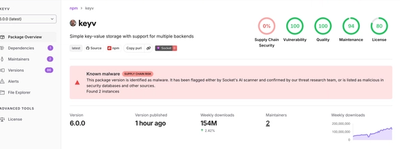
Popular npm Packages in the keyv and Cacheable Namespaces Compromised in Active Supply Chain Attack
Popular npm packages keyv and cacheable compromised.
By Socket Research Team - Aug 04, 2026
code-sentinel-mcp
Advanced tools
MCP server for code quality analysis - security, errors, deceptive patterns, and placeholder detection
A comprehensive code quality analysis server for the Model Context Protocol (MCP). CodeSentinel integrates with Claude Code and other MCP-compatible clients to detect security vulnerabilities, deceptive patterns, incomplete code, and highlight good practices.
AI coding assistants can inadvertently introduce subtle issues: hardcoded secrets, empty catch blocks, TODO placeholders left behind, or patterns that hide errors. CodeSentinel acts as a quality gate, analyzing code for 93 distinct patterns across 5 categories before issues reach production.
Key differentiators:
CodeSentinel intentionally uses a pattern-based approach rather than AST parsing. Here's why:
Traditional linters (ESLint, tree-sitter) detect syntax errors and style violations. CodeSentinel detects semantically deceptive patterns - code that is:
// AST sees: valid try-catch block
// CodeSentinel sees: error swallowing that masks failures
try { riskyOperation(); } catch(e) { }
// AST sees: valid function returning boolean
// CodeSentinel sees: fake implementation that always succeeds
function validateUser() { return true; } // TODO: implement
// AST sees: valid fallback expression
// CodeSentinel sees: failure masking - "no data" vs "fetch failed" indistinguishable
const users = response.data || [];
// AST sees: valid return statement
// CodeSentinel sees: silent failure hiding
if (error) { return null; } // error case
| Issue Type | AST/Tree-sitter | CodeSentinel |
|---|---|---|
| Syntax errors | Yes | No (not our goal) |
| Missing semicolons | Yes | No |
| Unused variables | Yes | No |
| Empty catch blocks | Partially | Yes |
| Silent error returns | No | Yes |
| Fake success responses | No | Yes |
| TODO/placeholder code | No | Yes |
| Error-masking fallbacks | No | Yes |
| Hardcoded secrets | Limited | Yes |
| Deceptive comments | No | Yes |
AI coding agents produce code that looks correct but contains subtle deceptions:
return true, return [], TODO comments|| [] fallbacks that mask fetch failures@ts-ignore, eslint-disable to hide type errorsThese patterns pass every linter and compile successfully. AST tools see valid structure. Only pattern-based detection catches the semantic intent behind the code.
| Tool | Use For |
|---|---|
| ESLint/TSLint | Style consistency, syntax rules, unused code |
| Tree-sitter | Syntax highlighting, code navigation, refactoring |
| TypeScript | Type safety, compile-time errors |
| CodeSentinel | Agent-generated deceptions, error hiding, incomplete implementations |
CodeSentinel complements these tools - it catches what they structurally cannot.
npm install -g code-sentinel-mcp
git clone https://github.com/salrad22/code-sentinel.git
cd code-sentinel
npm install
npm run build
claude mcp add code-sentinel -- npx code-sentinel-mcp
claude mcp add code-sentinel -- code-sentinel
Add to your Claude Code MCP configuration file (~/.claude/claude_desktop_config.json):
{
  "mcpServers": {
    "code-sentinel": {
      "command": "npx",
      "args": ["code-sentinel-mcp"]
    }
  }
}
CodeSentinel is also available as a remote MCP server on Cloudflare Workers. No local installation required!
claude mcp add-remote code-sentinel https://code-sentinel-mcp.sharara.dev/sse
Or use the Streamable HTTP endpoint (recommended for newer clients):
claude mcp add --transport http code-sentinel https://code-sentinel-mcp.sharara.dev/mcp
| Endpoint | Protocol | Description |
|---|---|---|
https://code-sentinel-mcp.sharara.dev/mcp | Streamable HTTP | Recommended |
https://code-sentinel-mcp.sharara.dev/sse | Server-Sent Events | Legacy support |
https://code-sentinel-mcp.sharara.dev/ | HTTP GET | Health check / server info |
Deploy your own instance:
cd cloudflare
npm install
npm run dev      # Local development at localhost:8787
npm run deploy   # Deploy to your Cloudflare account
Requirements:
npm install -g wrangler)wrangler login to authenticateThe server uses Durable Objects for persistent MCP connections. No database required.
analyze_codeFull analysis returning structured JSON with all issues and strengths. Best for programmatic processing.
Parameters:
code (string, required): The source code to analyzefilename (string, required): Filename for language detection (e.g., "app.ts")Returns: JSON object with issues, strengths, and summary statistics.
generate_reportFull analysis with a visual HTML report. Best for human review.
Parameters:
code (string, required): The source code to analyzefilename (string, required): Filename for language detectionReturns: Markdown summary plus complete HTML report.
check_securitySecurity-focused analysis only. Use when you specifically want to audit for vulnerabilities.
Parameters:
code (string, required): The source code to checkfilename (string, required): FilenameReturns: List of security issues or confirmation of none found.
check_deceptive_patternsCheck for code patterns that hide errors or create false confidence.
Parameters:
code (string, required): The source code to checkfilename (string, required): FilenameReturns: List of deceptive patterns found.
check_placeholdersFind TODOs, dummy data, and incomplete implementations.
Parameters:
code (string, required): The source code to checkfilename (string, required): FilenameReturns: List of placeholder code found.
analyze_patternsAnalyze code for architectural, design, and implementation patterns. Detects pattern usage, inconsistencies, and provides actionable suggestions.
Parameters:
code (string, required): The source code to analyzefilename (string, required): Filename for language detectionlevel (string, optional): Pattern level to analyze:
architectural: System structure patterns (layering, modules)design: Gang of Four patterns (Singleton, Factory, Observer)code: Implementation idioms (error handling, async patterns)all: All levels (default)query (string, optional): Natural language query to focus analysis (e.g., "how is error handling done?")Returns: LLM-optimized JSON with detected patterns, inconsistencies, suggestions, and ready-to-execute action items.
analyze_design_patternsFocused analysis of Gang of Four (GoF) design patterns. Best for understanding OOP structure.
Parameters:
code (string, required): The source code to analyzefilename (string, required): Filename for language detectionReturns: Detected design patterns with confidence levels, locations, and implementation details.
Ask Claude to analyze code:
Analyze this code for quality issues:

const API_KEY = "sk-abc123456789";

async function fetchData() {
  try {
    const response = await fetch(url);
    return response.json();
  } catch (e) {
    // TODO: handle error
  }
}
CodeSentinel will detect:
| ID | Pattern |
|---|---|
| SEC001 | Hardcoded secrets (API keys, tokens, passwords) |
| SEC002 | GitHub tokens |
| SEC003 | OpenAI API keys |
| SEC004 | AWS access keys |
| SEC005-010 | SQL injection patterns |
| SEC011-015 | XSS vulnerabilities |
| SEC016 | Command injection (eval, exec) |
| ID | Pattern |
|---|---|
| DEC001-003 | Empty/comment-only catch blocks |
| DEC010-012 | Silent promise rejections |
| DEC020-025 | Error-hiding fallbacks ( |
| DEC030+ | Linter suppression, fake success responses |
| ID | Pattern |
|---|---|
| PH001-005 | TODO/FIXME/HACK/XXX/NOTE comments |
| PH010-015 | Lorem ipsum, placeholder text |
| PH020-025 | Test/dummy data (test@example.com, password123) |
| PH030+ | console.log debugging, debugger statements |
| ID | Pattern |
|---|---|
| ERR001-005 | Loose equality (==), type coercion issues |
| ERR010-015 | Null reference risks |
| ERR020-025 | Async anti-patterns |
| ERR030+ | parseInt without radix, array mutation in loops |
| ID | Pattern |
|---|---|
| STR001-005 | TypeScript strict typing |
| STR010-015 | Proper error handling patterns |
| STR020-025 | Test coverage indicators |
| STR030+ | Documentation, input validation |
Quality score (0-100) calculated as:
Score = 100 - (critical × 25) - (high × 15) - (medium × 5) - (low × 1) + (strengths × 2)
| Severity | Point Deduction |
|---|---|
| Critical | -25 points |
| High | -15 points |
| Medium | -5 points |
| Low | -1 point |
| Strength | +2 points (bonus) |
CodeSentinel detects language from file extensions:
| Extension | Language |
|---|---|
.ts, .tsx | TypeScript |
.js, .jsx | JavaScript |
.py | Python |
.go | Go |
.rs | Rust |
.java | Java |
.kt | Kotlin |
.swift | Swift |
.cs | C# |
.cpp, .c | C/C++ |
.php | PHP |
.vue | Vue |
.svelte | Svelte |
CodeSentinel uses a data-driven pattern system that separates pattern definitions from regex generation. This makes adding new patterns easier and more maintainable.
src/
├── patterns/
│   ├── types.ts           # Type definitions for pattern configs
│   ├── builders.ts        # Functions that generate regex from configs
│   ├── compiler.ts        # Compiles definitions to executable patterns
│   └── definitions/
│       ├── security.ts    # Security vulnerability patterns
│       ├── deceptive.ts   # Error-hiding patterns
│       ├── placeholders.ts # Incomplete code patterns
│       ├── errors.ts      # Code smell patterns
│       └── index.ts       # Exports all definitions
├── analyzers/
│   ├── core.ts            # Unified analyzer using compiled patterns
│   ├── security.ts        # Security analyzer (delegates to core)
│   ├── deceptive.ts       # Deceptive analyzer (delegates to core)
│   ├── placeholders.ts    # Placeholder analyzer (delegates to core)
│   ├── errors.ts          # Error analyzer (delegates to core)
│   └── strengths.ts       # Strength analyzer
└── index.ts               # MCP server entry point
Instead of writing regex manually, you define what to detect and the system generates the regex:
// Old approach (manual regex)
{
  id: 'CS-DEC001',
  pattern: /catch\s*\([^)]*\)\s*\{\s*\}/g,  // Error-prone
  title: 'Empty Catch Block',
  // ...
}

// New approach (data-driven)
{
  id: 'CS-DEC001',
  title: 'Empty Catch Block',
  description: 'Silently swallowing errors makes debugging impossible.',
  severity: 'high',
  category: 'deceptive',
  suggestion: 'At minimum, log the error. Better: handle it appropriately.',
  match: {
    type: 'catch_handler',
    behavior: 'empty'
  }
}
| Match Type | Description | Example Config |
|---|---|---|
empty_block | Empty catch/finally/promise blocks | { type: 'empty_block', constructs: ['catch', '.catch'] } |
function_call | Function/method calls | { type: 'function_call', names: ['eval', 'exec'] } |
returns_only | Return statements with specific values | { type: 'returns_only', values: ['null', '[]', '{}'] } |
contains_text | Text in comments/strings | { type: 'contains_text', terms: ['TODO', 'FIXME'], context: 'comment' } |
fallback_value | Fallback patterns | { type: 'fallback_value', operators: ['||'], values: ['[]'] } |
catch_handler | Catch block behaviors | { type: 'catch_handler', behavior: 'empty' } |
promise_catch | Promise .catch() behaviors | { type: 'promise_catch', behavior: 'returns_silent' } |
comment_marker | TODO/FIXME/HACK markers | { type: 'comment_marker', markers: ['TODO', 'FIXME'] } |
string_literal | Patterns inside strings | { type: 'string_literal', patterns: ['password', 'secret'] } |
secret_pattern | API keys and tokens | { type: 'secret_pattern', kind: 'github' } |
url_pattern | URL patterns | { type: 'url_pattern', protocol: 'http', excludeLocalhost: true } |
suppression_comment | Linter suppressions | { type: 'suppression_comment', tools: ['ts-ignore', 'eslint-disable'] } |
type_cast | Type casts | { type: 'type_cast', targets: ['any'] } |
comparison | Comparison operators | { type: 'comparison', operators: ['==', '!='] } |
loop_pattern | Loop patterns | { type: 'loop_pattern', kind: 'while_true' } |
raw_regex | Escape hatch for complex patterns | { type: 'raw_regex', pattern: 'your-regex', flags: 'gi' } |
src/patterns/definitions/<category>.tsnpm run build{
id: string; // Unique ID: CS-<CAT><NUM> (e.g., CS-SEC001)
title: string; // Short description (displayed in results)
description: string; // Detailed explanation of the issue
severity: Severity; // 'critical' | 'high' | 'medium' | 'low' | 'info'
category: Category; // 'security' | 'deceptive' | 'placeholder' | 'error'
suggestion?: string; // How to fix the issue
match: MatchConfig; // What to detect (see match types above)
verification?: { // Optional: reduce false positives
status: 'needs_verification' | 'confirmed';
assumption?: string;
confirmIf?: string;
falsePositiveIf?: string;
}
}
# Install dependencies
npm install

# Build
npm run build

# Watch mode
npm run watch

# Test with MCP inspector
npm run inspector
Contributions welcome! Please:
MIT
FAQs
MCP server for code quality analysis - security, errors, deceptive patterns, and placeholder detection
The npm package code-sentinel-mcp receives a total of 24 weekly downloads. As such, code-sentinel-mcp popularity was classified as not popular.
We found that code-sentinel-mcp demonstrated a healthy version release cadence and project activity because the last version was released less than a year ago. It has 1 open source maintainer collaborating on the project.
Did you know?

Socket for GitHub automatically highlights issues in each pull request and monitors the health of all your open source dependencies. Discover the contents of your packages and block harmful activity before you install or update your dependencies.
Research
/Security News
Popular npm packages keyv and cacheable compromised.

Security News
A misconfiguration gave three Anthropic models internet access, and one, believing it was in a simulation, shipped a credential-stealing package to PyPI.

Security News
/Company News
Socket has joined the new Composer and Packagist sponsorship program as a launch sponsor, supporting the team that keeps PHP's package ecosystem secure.