
Product
Socket Now Protects the Firefox Extension Ecosystem
Socket is bringing experimental protection to Firefox, scanning 97,000+ extensions in Mozilla's official directory for malware and risky updates.
By John Tuckner - Aug 20, 2026
codex-usage-analyzer
Advanced tools
codex-usage-analyzer is the local usage analysis package that emits UsageSnapshot v2 JSON.
The package is designed to be reused by product-specific CLIs and web services. It analyzes local usage sources and returns a validated snapshot; account identity, submit tokens, public profile URLs, and rendered cards belong to the product that wraps it.
The published CLI entry point is:
npx codex-usage-analyzer@latest analyze --json
The --json mode writes a single UsageSnapshot v2 object to stdout. Errors and usage text are written to stderr.
The production analyze --json path reads local Codex session JSONL files from the Codex home directory. It uses --codex-home <path> when provided, otherwise CODEX_HOME, otherwise the default Codex home. When the session source is missing or unreadable, the command still emits a valid snapshot: required numeric totals are zero, unavailable usage details are null or empty arrays, and extensions["codexUsageAnalyzer.diagnostics"] explains the unavailable source. The production path does not return the sample fixture.
The parser currently derives token totals, daily token buckets, model ranking, skill/plugin ranking, longest task duration, streaks, reasoning effort, and total thread count from allowlisted session event fields. Skill/plugin rankings are counted only from actual invocation events that can be classified by session tool catalog metadata; catalog or enabled-tool lists alone do not increment usage. Custom/local skill and plugin names may appear in topSkills and topPlugins, but the analyzer does not emit raw local file paths, raw JSONL lines, session ids, prompts, responses, tool input, or tool output.
Streak fields are local-only analyzer results. The current parser treats a UTC date as active when local session JSONL contains positive last_token_usage for that date.
Codex Desktop's profile screen is backed by its remote profile data and may include account-level usage that is no longer present in local session files, usage from another device, or data retained after local cleanup. For that reason, activity.currentStreakDays and activity.longestStreakDays are not guaranteed to match the Codex Desktop profile. The diagnostic extension includes profileComparison.parity: "not_guaranteed" when the analyzer has not compared against a remote profile baseline.
The analyzer does not call Codex Desktop remote profile APIs or plugin-store APIs. skills and plugins are local session-derived fields, so they are unavailable when actual invocation source events are absent.
codexAssets.pet is a safe logical reference, not an image export. The analyzer can report the Codex Desktop built-in pet catalog and the selected pet id when that setting is available. If no selected pet setting is persisted, it follows Codex Desktop's default and reports the built-in codex pet as codex-built-in:pet:codex. When a selected custom pet is found under pets/<id>/pet.json with an allowlisted spritesheet extension, the analyzer reports codex-local:pet:custom-selected.
The default analyzer output does not include local file paths, custom pet directory names, image bytes, data URLs, or generated image artifacts. Files under generated_images/ are treated as private generated artifacts and are not promoted to codexAssets. A wrapper that wants to render custom pet images in a web application must provide its own opt-in asset export, upload, or local serving layer.
Local repository smoke command:
node bin/codex-usage-analyzer.js analyze --json
Parser fixture smoke command:
node bin/codex-usage-analyzer.js analyze --json --codex-home src/__tests__/fixtures/parser
Asset fixture smoke command:
node bin/codex-usage-analyzer.js analyze --json --codex-home src/__tests__/fixtures/assets
Development fixture command:
node bin/codex-usage-analyzer.js analyze --json --fixture-sample
The --fixture-sample mode is for tests, examples, and contract inspection only. It returns the packaged sample snapshot and must not be treated as real local Codex usage.
Use the profile smoke helper from a repository checkout when you want to compare a local analyzer result with values manually copied from Codex Desktop's profile UI. The comparison uses a redacted baseline file; do not commit a baseline copied from a real account.
The helper is not published as an npm package binary. It is a maintainer QA tool for release and parser parity checks.
Create a production snapshot:
node bin/codex-usage-analyzer.js analyze --json > <local-snapshot.json>
Create a redacted baseline using
src/__tests__/fixtures/profile-baseline/redacted-baseline.json as the shape
reference, then compare:
node scripts/profile-smoke.js --baseline <redacted-baseline.json> --snapshot <local-snapshot.json>
The smoke output is a field-level summary. Result statuses mean:
match: expected and actual values are equal.within_tolerance: numeric values differ only within the baseline tolerance.mismatch: the field is comparable and differs outside tolerance.not_comparable: the baseline intentionally marks the field as visible in
profile UI but not comparable to local analyzer data.skipped: the baseline did not include that expected field.Mismatch reasons distinguish parser-bug candidates from expected source differences:
numeric_mismatch, value_mismatch, actual_field_absent, and ranking
shape reasons mean a comparable field differed.source_mismatch means the baseline author marked that field as comparing
different sources, such as remote profile data versus local analyzer data.profile_parity_not_guaranteed means the local snapshot itself reports that
remote profile parity is not guaranteed, and the field is source-sensitive.remote_profile_source_differs is used with not_comparable fields that
should be visible in the profile baseline but intentionally not compared.Use optional baseline sourcePolicy metadata to keep a field comparable while
labeling source-driven differences:
{
  "sourcePolicy": {
    "activity.totalThreads": "source_mismatch",
    "skills.topSkills": "source_mismatch",
    "plugins.topPlugins": "source_mismatch"
  }
}
sourcePolicy belongs only to the redacted smoke baseline. It is not part of
UsageSnapshot v2, and the analyzer output schema does not change. A
source-aware mismatch still makes the smoke command exit nonzero; the field
reason is what separates source differences from likely parser regressions.
Known mismatch reasons:
--fixture-sample snapshots are rejected by the profile smoke helper, so a
packaged example cannot pass as a real profile parity check.Redaction rules for real local baselines:
import {
  analyzeUsage,
  assertUsageSnapshotV2,
  createSampleUsageSnapshotV2,
  validateUsageSnapshotV2
} from "codex-usage-analyzer";

const snapshot = await analyzeUsage();
assertUsageSnapshotV2(snapshot);
analyzeUsage() returns the production analyzer result. You can pass codexHome for deterministic tests or custom Codex home discovery:
const snapshot = await analyzeUsage({
  codexHome: "/path/to/codex-home"
});
When a local source is unavailable, fields use zero, null, empty arrays, and a namespaced diagnostic extension rather than sample values.
Use createSampleUsageSnapshotV2() only for examples, tests, and contract inspection.
Public exports:
analyzeUsage(options?)createSampleUsageSnapshotV2(overrides?)validateUsageSnapshotV2(value)assertUsageSnapshotV2(value)isUsageSnapshotV2(value)USAGE_SNAPSHOT_V2_SCHEMA_VERSIONsampleUsageSnapshotV2The npm package includes the CLI entry point, runtime analyzer source, parser modules, snapshot validators, type declarations, and the sample snapshot fixture used by the SDK. It excludes repository tests, parser fixtures, working docs, and repository-only smoke helper scripts.
The analyzer owns local usage fields such as token totals, token breakdown, model usage, skill usage, plugin usage, activity statistics, and safe Codex pet logical references.
Web products own GitHub login, display name, avatar URL, bio, profile visibility, submit tokens, devices, public URLs, rendered cards, and any uploaded or web-served pet image assets.
Product-specific wrappers can call this SDK and submit the resulting snapshot to their own service:
import {
  analyzeUsage,
  assertUsageSnapshotV2
} from "codex-usage-analyzer";

const snapshot = assertUsageSnapshotV2(await analyzeUsage());
await submitToProductService({ snapshot });
Wrapper metadata such as bearer tokens, device ids, account handles, visibility, GitHub bio, GitHub avatar URLs, custom pet upload URLs, and card-only rendering hints must stay outside the analyzer snapshot.
npm test
node bin/codex-usage-analyzer.js analyze --json
node bin/codex-usage-analyzer.js analyze --json --codex-home src/__tests__/fixtures/parser
node bin/codex-usage-analyzer.js analyze --json --codex-home src/__tests__/fixtures/assets
node bin/codex-usage-analyzer.js analyze --json --fixture-sample
The test suite validates the SDK exports, production parser behavior, asset safe output behavior, fixture-only CLI behavior, and UsageSnapshot v2 schema rules.
Before publishing:
npm test
npm pack --dry-run
node bin/codex-usage-analyzer.js analyze --json
npx --yes github:postmelee/codex-usage-analyzer analyze --json
After the package is published:
npx --yes codex-usage-analyzer@latest analyze --json
Do not paste raw production snapshot output into release notes, PR bodies, or issue comments. Record only structural pass/fail results, exit codes, and package metadata needed for release verification.
This package does not:
This repository is the standalone home for the analyzer package. The production analyzer path is separated from the packaged sample fixture, and the release checklist above is the maintainer path for npm publishing and npx verification. Broader parity work against Codex Desktop profile data remains outside the npm release flow.
FAQs
Read Codex account usage through the official app-server protocol.
The npm package codex-usage-analyzer receives a total of 135 weekly downloads. As such, codex-usage-analyzer popularity was classified as not popular.
We found that codex-usage-analyzer demonstrated a healthy version release cadence and project activity because the last version was released less than a year ago. It has 1 open source maintainer collaborating on the project.
Did you know?

Socket for GitHub automatically highlights issues in each pull request and monitors the health of all your open source dependencies. Discover the contents of your packages and block harmful activity before you install or update your dependencies.
Product
Socket is bringing experimental protection to Firefox, scanning 97,000+ extensions in Mozilla's official directory for malware and risky updates.
Research
/Security News
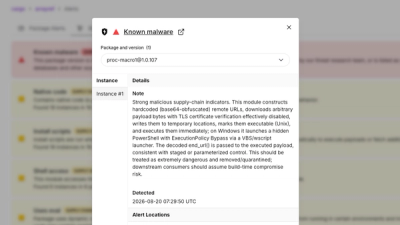
Three compromised Rust crates pulled in a malicious dependency that downloaded and executed cross-platform malware during Cargo builds.

Research
/Security News
Socket uncovered 77 linked Firefox extensions, including 40 that steal wallet secrets or credentials and 37 deceptive sports-score shells.