
Product
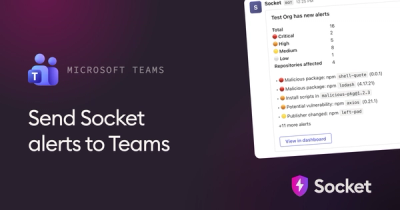
Microsoft Teams Notifications Are Now Available in Socket
Socket can now send alerts and supply chain attack notifications to Microsoft Teams, with filters that route the right updates to each channel.
By Jeppe Hasseriis - Sep 01, 2026
codex-usage-profile
Advanced tools
Connect the account usage shown by Codex to a GitHub-backed Codex Usage Profile and receive a stable README card URL.
The public release line starts at codex-usage-profile@0.1.0. This source tree
contains the unpublished 0.1.2 candidate, which uses the canonical production
service by default and keeps custom service origins available through the
explicit --server option.
The public
latesttag remains0.1.1and defaults tohttps://codex-usage-profile-stage5.meleeisdeveloping.chatgpt.siteuntil the canonical Site passes private/public smoke. Do not request or pin0.1.2from npm before its release gate completes.
codex CLI on PATH, or on macOS a standard ChatGPT.app or
Codex.app installation under the system or user Applications directoryaccount/usage/readgh CLI for the terminal GitHub star promptAPI-key-only and Bedrock Codex authentication do not provide the account usage method consumed by the analyzer.
Executable lookup prefers codex on PATH. If it is absent on macOS, the
analyzer checks /Applications/ChatGPT.app,
/Applications/Codex.app, ~/Applications/ChatGPT.app, then
~/Applications/Codex.app. Nonstandard installations must expose the
official Codex CLI on PATH.
One command can start browser login when needed and continue with submission:
npx codex-usage-profile@latest submit
The public @latest CLI defaults to the current stage5 service. Once login succeeds, the
service origin and a narrow submit credential are stored locally. Use
--server only for local development or an explicitly reviewed alternative
deployment.
During device login, supported interactive terminals render only the verification URL as a clickable cyan OSC 8 hyperlink. Piped output, submit --json, NO_COLOR, TERM=dumb, and terminals without a supported hyperlink signal receive the same plain URL without ANSI control sequences.
After browser approval, Device approved means only that device authorization
is complete. A submit flow continues in the same CLI process, and the terminal
reports its final submission result. An explicit login flow instead shows the
next submit command, preserving --server for a local or alternate service.
The browser does not redirect, copy to the clipboard, or execute a command
automatically; those actions remain under the user's control. Older clients
without an intent receive a generic return-to-terminal message. See the
detailed CLI guide below for the complete approval flow.
An account can have up to three active CLI/API tokens. If browser approval completes after that limit is reached, the CLI reports:
Active token limit reached. Revoke an API token in Settings, then try again.
Revoke an old Device login token under the web Settings API Tokens section
and retry. CLI logout removes only the local credential file; it does not
revoke the corresponding server token.
After a successful human-readable submit, supported interactive terminals
render the Profile and Card URLs as clickable cyan OSC 8 hyperlinks. The
README value remains exact plain HTML-for-Markdown so it can be copied without
terminal control sequences. Its default width="50%" is adjustable, the image
uses the stable queryless card URL, and clicking it opens the public share page.
The result separates capture metadata from a compact,
indented Links block:
✓ Usage submitted successfully.
Captured: 2026-07-11T00:00:00.000Z

Links
  Profile: https://example.com/?view=profile
  Card:    https://example.com/u/octocat/card.png
  README:  <a href="https://example.com/api/share/octocat"><img width="50%" src="https://example.com/u/octocat/card.png" alt="Codex usage profile" /></a>
On a color-capable TTY, the Links heading is dim gray. JSON, piped output,
NO_COLOR, TERM=dumb, and unsupported terminals keep the same information
structure without terminal control sequences; Profile and Card remain plain
URLs where hyperlinks are unavailable.
After a fresh interactive login or a successful human-readable submit, the
CLI waits for this prompt block before printing the existing command result:
Help us grow! 🌱
A GitHub star helps others discover Codex Usage Profile (postmelee/codex-usage-profile).
Would you like to star it on GitHub as @octocat? (Y/n)
✓ Starred! Thank you for your support, @octocat. ⭐
Enter is Yes; y and yes also star, while n and no continue without
starring. Consent runs a fixed gh api --silent --method PUT request for
/user/starred/postmelee/codex-usage-profile and never opens a browser. The
displayed account is the active local gh account, which may differ from the
Codex Usage Profile owner. The block is separated from the surrounding login or
submit output by blank lines. On a color-capable TTY the heading is cyan, the
explanation is dim gray, and the success message is green. NO_COLOR and
TERM=dumb preserve the same wording and spacing without color SGR. The
TERM=dumb prompt also disables readline terminal mode so it emits no cursor
control escapes; an interactive NO_COLOR prompt may still use readline cursor
control while adding no color.
The prompt is skipped when the repository is already starred, gh is missing
or unavailable, an existing credential makes login return Already signed in, the product command fails, or the command is running with --json, in CI,
or without TTY stdin and stdout. An automatic login inside submit offers it
only once, after submission succeeds. All gh failures are optional and
fail-soft: they do not replace the original command result or exit status.
This integration uses only the local gh credential for the fixed GitHub API
request. It does not use or store the product's GitHub OAuth token or service
submit credential, and it does not expose raw gh errors.
npx codex-usage-profile@latest status
npx codex-usage-profile@latest submit
npx codex-usage-profile@latest logout
On first use, npm may ask for confirmation before installing the displayed package and version. Review both before approving the installation.
Set CODEX_USAGE_PROFILE_URL instead of repeating --server. CODEX_USAGE_PROFILE_TOKEN can supply an externally managed submit token, but the CLI never accepts a token as a command argument.
On a trusted machine with an existing ChatGPT-backed Codex sign-in, use a pre-issued service token and pin the CLI to an exact version. --yes intentionally skips npm's installation confirmation and should not be combined with @latest in unattended execution.
CODEX_USAGE_PROFILE_URL=https://codex-usage-profile-stage5.meleeisdeveloping.chatgpt.site \
CODEX_USAGE_PROFILE_TOKEN='<service-submit-token>' \
npx --yes codex-usage-profile@0.1.1 submit --json
JSON, CI, and non-TTY execution never run the optional star prompt, so stdout remains one machine-readable JSON document.
The CLI imports codex-usage-analyzer, starts the installed Codex app-server, and sends one Account Usage Contract v1 document to POST /api/account-usage/submit. The document contains only:
GitHub name, login, avatar, visibility, and public URL remain server-owned. The CLI does not send Codex/OpenAI credentials, GitHub OAuth credentials, prompts, responses, tool data, or local session files.
Device id and display name travel in product-specific headers rather than inside the analyzer document. The submit credential is sent only in the Authorization header.
Device login returns a raw service credential once. The CLI stores it in an owner-only config directory using an atomic file replacement and 0600 file permissions on macOS and Linux. File credentials are bound to the service origin that issued them and are never sent to another origin.
logout removes the local file. It cannot unset CODEX_USAGE_PROFILE_TOKEN; remove that variable from the shell environment yourself. Revoke issued credentials immediately from the web Settings screen when a machine or token is no longer trusted.
MIT. This independent community project is not affiliated with, endorsed by, or sponsored by OpenAI. OpenAI and Codex names and trademarks belong to their respective owners.
FAQs
Connect local Codex usage to a Codex Usage Profile.
The npm package codex-usage-profile receives a total of 45 weekly downloads. As such, codex-usage-profile popularity was classified as not popular.
We found that codex-usage-profile demonstrated a healthy version release cadence and project activity because the last version was released less than a year ago. It has 1 open source maintainer collaborating on the project.
Product
Socket can now send alerts and supply chain attack notifications to Microsoft Teams, with filters that route the right updates to each channel.

Security News
pnpm 12 rewrites the package manager in Rust, cutting install times by up to 90% while preserving pnpm 11 workflows and lockfiles.
Security News
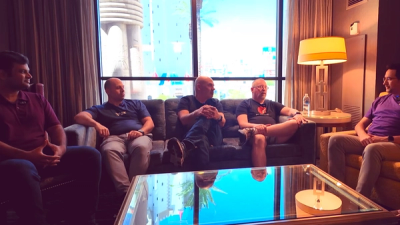
Socket CTO Ahmad Nassri joins AppSec leaders at Black Hat to discuss active malware, package manager risks, and software supply chain defense.