Security News
/Company News
Socket Is Sponsoring Composer and Packagist
Socket has joined the new Composer and Packagist sponsorship program as a launch sponsor, supporting the team that keeps PHP's package ecosystem secure.
This module is not intended to do any minification or compression. It's just supposed to concatenate @imported CSS files together and doing it properly. This applies to the relative paths to images as well.
While npm isn't needed for this module to work, I highly recommend it - it makes managing your modules and it's dependencies very comfortable.
npm install -g css-concat
CSS Concat reads from input.css and writes to output.css. If you don't specify output.css explicitly, it will write to input-out.css. Options currently only consist of --no-comments, which will disable automatic generation of comments - this will not strip comments from the source files!
css-concat [input.css] ([output.css] [options])
Calling concat with the path to your CSS file, you will get a string containing the same output as the command-line version. By default, comments are enabled - to disable them just pass along the appropriate options object.
var cssConcat = require('css-concat'),
options = { comments : true },
outputString = cssConcat.concat('path/to/your.css', options);
FAQs
Concatenate @imported CSS files.
We found that css-concat demonstrated a not healthy version release cadence and project activity because the last version was released a year ago. It has 1 open source maintainer collaborating on the project.
Did you know?

Socket for GitHub automatically highlights issues in each pull request and monitors the health of all your open source dependencies. Discover the contents of your packages and block harmful activity before you install or update your dependencies.

Security News
/Company News
Socket has joined the new Composer and Packagist sponsorship program as a launch sponsor, supporting the team that keeps PHP's package ecosystem secure.

Research
/Security News
Benign-looking npm packages split malicious functionality across a dependency chain that deploys a cross-platform RAT targeting Alibaba developers.

Research
/Security News
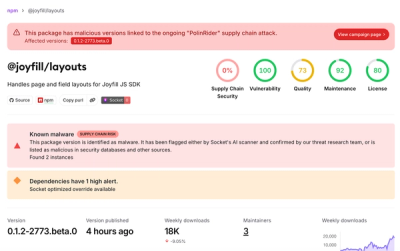
Two Joyfill npm beta releases contain an import-time implant that uses blockchain transactions to retrieve a remote-access trojan.