

Security News
Next.js moves to scheduled security releases
Vercel is formalizing a monthly release program for Next.js. The change follows React2Shell and a sharp rise in AI-assisted vulnerability discovery.
By Sarah Gooding - Jul 16, 2026
dcp-gateway
Advanced tools
MCP transparent compression proxy — DCP-encode tool responses without server modification
MCP transparent compression proxy — DCP-encode tool responses without server modification.
Any MCP server → Gateway → 40-70% fewer tokens on repeated calls.
Client (Claude Code) ←stdio→ DCP Gateway ←stdio→ MCP Server (unmodified)
The gateway sits between the MCP client and server as a stdio relay:
$schema, additionalProperties, redundant descriptions) to slim tool definitionsprovisional v1, and DCP-encodes immediatelyconfirmed v2 (null-rate filtered); subsequent calls use the refined schemaMany APIs return { total_count, items: [...] } instead of a flat array. The gateway detects single-array wrapper objects, DCP-encodes the inner array, and prepends scalar fields as a JSON metadata line:
{"total_count":4939,"incomplete_results":false}
["$S","search_repositories:v1","id","name","full_name",...]
[9028031,"DCPathButton","Tangdixi/DCPathButton",...]
[65034998,"dcping","example/dcping",...]
dcp-gateway --server <command> [args...] [--presets <dir>]
{
  "mcpServers": {
    "github-via-gateway": {
      "command": "node",
      "args": [
        "/path/to/dcp-gateway/dist/src/cli.js",
        "--server", "npx", "@modelcontextprotocol/server-github"
      ],
      "env": {
        "GITHUB_PERSONAL_ACCESS_TOKEN": "..."
      }
    }
  }
}
Single gateway endpoint fronting N MCP servers. Client sees one unified tool list; tool names are prefixed with alias__ to prevent collisions.
dcp-gateway --servers gateway.json
// gateway.json
{
  "servers": [
    { "alias": "github", "command": "node", "args": ["/path/to/server-github/dist/index.js"] },
    { "alias": "slack",  "command": "node", "args": ["/path/to/server-slack/dist/index.js"] }
  ]
}
| Client calls | Routed to | As |
|---|---|---|
github__search_repositories | github server | search_repositories |
slack__list_channels | slack server | list_channels |
ResponseInterceptor; alias-prefixed tool names prevent cross-server collisionsREST APIs often return 60-120+ fields per object, most irrelevant to the caller. DCP encoding alone removes key repetition but still carries every field. Field filtering reduces this further.
Layer 0: Raw       — all fields pass through (current behavior, default)
Layer 1: User      — ignore/only list per tool (user writes in presets)
Layer 2: Hard cap  — maxFields safety valve (last resort)
Layer 0 — no filtering. Gateway works as pure DCP encoder. Default.
Layer 1 — User profile (in presets dir, per tool)
// presets/github.filter.json
{
  "search_repositories": {
    "ignore": ["node_id", "owner.gravatar_id", "owner.subscriptions_url"]
  },
  "list_issues": {
    "only": ["id", "title", "state", "user.login", "labels", "created_at"]
  }
}
ignore — blocklist, drop these fields (dot-notation source paths)only — allowlist, keep only these fieldsonly takes precedence if both present.Layer 2 — Hard cap (maxFields in profile or CLI)
After Layer 1, if field count still exceeds cap, truncate. Defaults to Infinity (off).
An earlier design included a Layer 1 "smart auto" that cut fields with null rate ≥ 0.9, derived from the Phase 1 sample. This was dropped for the following reasons:
ignore: [...]
makes a deliberate choice. Auto-filter makes that choice invisibly.If smart filtering is revisited, the minimum viable approach would be to accumulate N≥10 samples before computing null rates, and to treat the threshold conservatively (= 1.0, i.e. field was null in every observed response). Even then, user confirmation before persisting the filtered schema is advisable.
Schemas are not static — they are versioned and refined over time by a SchemaValidator
that runs alongside the encoding pipeline.
provisional v1  →  (N samples observed)  →  confirmed v2
                →  (drift detected)       →  provisional v(n+1)
confirmed   vN  →  (major drift)          →  provisional v(N+1)
$S header
(tool:v1, tool:v2, ...).| Event | Action |
|---|---|
| N samples accumulated | Compute null rate per field; exclude all-null fields; promote to confirmed |
| Type drift detected | Invalidate, re-infer from latest sample → new provisional |
| New field appeared | Invalidate, re-infer from latest sample → new provisional |
N defaults to 10 (configurable). Null-rate threshold is 1.0 (field absent in all N samples) — conservative by design. A lower threshold risks discarding fields that are merely sparse in the observed window. See also: Why no smart auto-filter.
Waiting for confirmed before encoding would mean N calls with no compression benefit —
the gateway would appear broken. Provisional encoding gives immediate visible effect.
The confirmed upgrade is transparent: the client sees a more compact $S from call N+1.
interface SchemaCacheEntry {
  schema: DcpSchema;
  mapping: FieldMapping;
  version: number;                      // 1 = provisional, increments on each promotion
  status: "provisional" | "confirmed";
  sampleCount: number;                  // samples observed by Validator
  lastUsed: number;
  hitCount: number;
}
Tested against @modelcontextprotocol/server-github v0.6.2, 8 tools, 30 items per response.
| Tool | JSON (chars) | DCP (chars) | Reduction | Fields |
|---|---|---|---|---|
| search_repositories | 6,201 | 3,816 | -38% | 23 |
| search_users | 37,388 | 23,042 | -38% | 20 |
| search_issues | 137,140 | 92,775 | -32% | 123 |
| list_issues | 153,915 | 110,081 | -29% | 61 |
| list_commits | 176,221 | 127,210 | -28% | 60 |
| list_pull_requests | 199,346 | 135,617 | -32% | 85 |
| get_file_contents | 372,832 | 372,767 | ~0% | single obj + base64 |
| search_code | 152 | 152 | 0% | 0 results |
{total_count, items} correctly unwrappeduser_url, assignee_login)$R nested sub-schemas generated for array-of-objects fields (labels, assignees)| Test | Accuracy | Notes |
|---|---|---|
| Schema ID reference | 100% (3/3 trials) | Cross-schema queries, aggregation, reverse lookup |
$R nested structure | 100% (3/3 trials) | Empty arrays, flag discrimination, cross-row lookup |
| Positional 120 fields | No degradation | Field count is not the bottleneck |
$S offset error | ~15% stochastic | +2 position shift, solved with 2-line format hint |
npm test # tsc && node --test dist/**/*.test.js
| Suite | What it covers |
|---|---|
SchemaValidator — batch mode | N rows at once → promoted to confirmed v2; always-null fields removed; partially-null fields retained |
SchemaValidator — incremental mode | stays provisional until N-th sample; does not promote twice |
SchemaValidator — drift detection | new field → provisional re-infer; type mismatch → provisional re-infer; fresh sample accumulation toward next promotion after drift |
ResponseInterceptor — DCP lifecycle | valid DCP on first call (provisional v1); upgrades at N; batch promotion drops nulls; drift mid-stream stays valid; wrapper unwrap preserved through lifecycle |
Process-level tests: spawns the compiled gateway with two independent instances of mock-mcp-server.ts (aliases srvA, srvB), communicates via stdio JSON-RPC.
| Suite | What it covers |
|---|---|
tools/list merges with alias prefix | all 4 tools (2 × 2 servers) present; correct alias__ prefixes; descriptions preserved; no duplicate names |
alias__toolname routing | srvA__search_users routes to correct server, returns DCP with expected fields; srvB__get_metrics likewise; cross-alias calls both work; unknown alias → error -32601 |
ResponseInterceptor isolation per server | schema IDs differ by alias; srvA's schema version advances faster than srvB's (proves separate interceptor instances, not a shared cache); different tool names within the same server are also keyed independently |
Design note — isolation assertion: instead of checking for a specific version number (fragile: drift on repeated data causes extra reinfers), the test drives srvA with 9+ more calls than srvB and asserts srvAVersion > srvBVersion. If interceptors were shared, both would sit at the same version — this assertion would fail.
test-tavily.mjs — manual integration test for Tavily API shape. Kept at repo root, excluded from npm test via .gitignore (test-*.mjs pattern). Run directly with:
node test-tavily.mjs
src/
  cli.ts                  — CLI entry, arg parsing (single + multi-server)
  relay.ts                — Single-server stdio JSON-RPC relay
  aggregator.ts           — Multi-server aggregator (Phase 4)
  server-connection.ts    — Per-server child process wrapper
  interceptor.ts          — Phase 1/2 DCP encoding logic + wrapper unwrap
  schema-validator.ts     — SchemaValidator: provisional→confirmed lifecycle, drift detection
  tools-list-compressor.ts — tools/list definition slimming
  field-filter.ts         — User-defined field filtering (ignore/only lists + null-rate filter)
  schema-cache.ts         — LRU N-limit schema cache (128 entries default)
  preset-loader.ts        — Pre-built schema loading from disk
  types.ts                — Shared types
  schema-validator.test.ts — Unit tests: SchemaValidator + ResponseInterceptor
  aggregator.test.ts      — Integration tests: AggregatorRelay (routing, isolation, merging)
tests/
  mock-mcp-server.ts      — Minimal MCP server (search_users + get_metrics) used by aggregator.test
  integration-test.ts     — End-to-end relay test
Schemas are persisted as JSON (DcpSchemaDef). Human-readable, directly inspectable.
{
  "$dcp": "schema",
  "id": "search_repositories:v2",
  "fields": ["id", "name", "full_name", "stargazers_count"],
  "fieldCount": 4,
  "types": { "id": { "type": "number" }, ... }
}
A registry of N schemas is itself a collection of uniform rows — a natural fit for DCP. When the registry grows large enough, encoding it would reduce the token cost of loading all schemas into context.
More importantly, in a multi-agent setting an agent that encounters an unknown tool response could fetch the relevant schema from a DCP-encoded registry directly, decoding it with minimal context overhead. This requires:
$S header describing the fields of a DcpSchemaDef row)The current JSON format is designed to be forward-compatible with this: each registry entry is a uniform object, so the transition to a DCP-encoded registry is a mechanical transformation. No schema redesign needed when the time comes.
dcp-wrap — Schema inference, DCP encoding/decodingWindows: .cmd/.bat server commands (e.g. npx.cmd) are spawned with shell: true automatically.
Apache-2.0
FAQs
MCP transparent compression proxy — DCP-encode tool responses without server modification
We found that dcp-gateway demonstrated a healthy version release cadence and project activity because the last version was released less than a year ago. It has 1 open source maintainer collaborating on the project.
Did you know?

Socket for GitHub automatically highlights issues in each pull request and monitors the health of all your open source dependencies. Discover the contents of your packages and block harmful activity before you install or update your dependencies.
Security News
Vercel is formalizing a monthly release program for Next.js. The change follows React2Shell and a sharp rise in AI-assisted vulnerability discovery.

Research
/Security News
11 malicious NuGet tools pose as game cheats to deploy Windows payloads, track hosts, and use Google Sheets for telemetry and control.
Research
/Security News
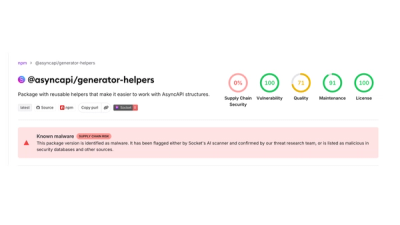
4 compromised asyncapi packages deliver miasma botnet loader on macOS, Linux and Windows.