

Product
PHP and Composer Support Is Now in Beta
Socket’s PHP and Composer support is now in Beta for all customers, with PHP reachability analysis generally available.
By Trevor Norris, Benjamin Barslev - Aug 21, 2026
Provider-neutral OpenDeepThink CLI and MCP server. Population-based reasoning via pairwise judging and Bradley-Terry ranking.
thonk harder, not richer.
DeepThonk implements the OpenDeepThink algorithm (Zhou et al., 2026, arXiv:2605.15177) as a budget-friendly, provider-neutral "deep think / pro mode" wrapper, with first-class DeepSeek support. See Acknowledgments.
DeepThonk runs a population of candidate answers through pairwise judging, Bradley-Terry ranking, critique-guided mutation, elite preservation, and a final dense ranking pass. The CLI and MCP server both call the same TypeScript core engine.
Designed for agents. Every algorithm dimension — population shape (n, k, t, m), regularization (lambda), per-phase temperatures, prompt style, and per-phase prompt templates — is reachable inline through MCP arguments and CLI flags. No filesystem detours required. Every intermediate artifact (candidates, comparisons, scores, per-call usage, status) is exposed as a streaming MCP resource so an agent can inspect any step. See Customization for the full agent-composable surface.
Use it for hard, verifiable reasoning, coding, planning, and synthesis where breadth plus judgment can beat one expensive single shot. Avoid it for highly subjective tasks where judge noise dominates.
Run without installing:
npx -y deepthonk plan --profile paper
npx -y deepthonk run --provider fake --profile quick \
  --task "Find the smallest positive integer divisible by 3, 4, and 5." \
  --out runs/test-quick
npx -y deepthonk inspect runs/test-quick
Or install globally:
npm install -g deepthonk
deepthonk plan --profile paper
The paper profile plans 285 model calls and 8 sequential rounds. Confirm budget and provider pricing before pointing it at paid models. The short alias dt is installed alongside deepthonk. Develop from source: see Development.
v0.1 scope: an independent TypeScript reimplementation of the OpenDeepThink algorithm as a CLI + MCP server. The published algorithm is the load-bearing part; this release is a practical integration layer with explicit limits documented below. Cost guarantees rely on provider pricing being present in config; resume only inspects trace state, it does not replay; the MCP HTTP transport is loopback-only. The included acceptance smoke uses the deterministic fake provider and a toy task — it is not a CF-73 / HLE reproduction; see
docs/and Acknowledgments for the canonical paper and Python reference.
Create a reusable local config:
deepthonk setup \
  --provider deepseek \
  --api-key-env DEEPSEEK_API_KEY \
  --fast-model deepseek-v4-flash \
  --judge-model deepseek-v4-pro
By default this writes ~/.config/deepthonk/config.yaml. deepthonk run loads that file automatically when --config is not supplied. If you pass --api-key, setup stores it in ~/.config/deepthonk/env; otherwise it uses the named environment variable from your shell.
export DEEPSEEK_API_KEY=...
deepthonk run \
  --task task.md \
  --profile paper \
  --provider deepseek \
  --generator-model deepseek-v4-flash \
  --mutator-model deepseek-v4-flash \
  --judge-model deepseek-v4-pro \
  --out runs/task-paper
DeepSeek is implemented as an OpenAI-compatible profile using https://api.deepseek.com/v1. DeepThonk ships default USD pricing for deepseek-v4-flash and deepseek-v4-pro from the official DeepSeek pricing page, including cache-hit/cache-miss input rates. Model names and prices are still editable config because both can change.
Before paid runs, inspect cost shape and resolved config:
deepthonk plan --config ~/.config/deepthonk/config.yaml
deepthonk run --task task.md --config ~/.config/deepthonk/config.yaml --profile quick --dry-run
Start with --profile quick and consider --max-concurrency, --max-input-tokens, --max-output-tokens, --max-usd, and --request-timeout-ms before larger paid profiles. Runtime token/USD budgets are enforced after completed provider calls and can overshoot by at most the active concurrency window. Every completed run summary includes call/token usage, and includes usage.usd when matching model pricing is available.
export DEEPTHONK_API_KEY=...
deepthonk run \
  --task task.md \
  --profile balanced \
  --provider openai-compatible \
  --base-url https://provider.example.com/v1 \
  --api-key-env DEEPTHONK_API_KEY \
  --generator-model cheap-model \
  --judge-model strong-model
The driver calls POST {base_url}/chat/completions and requests JSON mode for comparisons when supported. If a provider returns a 400 with a body that mentions response_format or json, the driver retries without JSON mode and uses robust JSON extraction on the plain text response. Providers that reject JSON mode with a different status code (e.g. 422) surface as a normal provider error — set supportsJsonMode: false in YAML to disable JSON mode up front.
Provider names are flexible. For a custom OpenAI-compatible endpoint, use any provider label with --base-url, --api-key-env, and role-specific model flags. For OpenRouter:
export OPENROUTER_API_KEY=...
deepthonk run \
  --task task.md \
  --profile balanced \
  --provider openrouter \
  --generator-model openrouter/auto \
  --mutator-model openrouter/auto \
  --judge-model openrouter/auto
For mixed-provider runs, use YAML config and override individual roles under providers, especially judge.
Optional finalizer_model / --finalizer-model can post-process the ranked winner. Leave it unset when you want the raw ranked answer as the final artifact.
The MCP server exposes the same engine the CLI runs. Once wired into an MCP host, the host can plan budgets, kick off background runs, poll status, fetch winners, and stream structured trace artifacts — all through MCP tools, resources, and prompts.
Provider API keys come from the host process's environment, not from DeepThonk's config alone. Each host handles env passthrough slightly differently — see the concrete patterns below.
claude mcp add deepthonk \
  -e DEEPSEEK_API_KEY=$DEEPSEEK_API_KEY \
  -- npx -y deepthonk serve-mcp --transport stdio
Use -s user for cross-project scope or -s project to commit registration into .claude/. Verify with claude mcp list. See claude mcp --help for the authoritative flag set.
Config path: ~/Library/Application Support/Claude/claude_desktop_config.json (macOS), %APPDATA%\Claude\claude_desktop_config.json (Windows), ~/.config/Claude/claude_desktop_config.json (Linux). Add:
{
  "mcpServers": {
    "deepthonk": {
      "command": "npx",
      "args": ["-y", "deepthonk", "serve-mcp", "--transport", "stdio"],
      "env": {
        "DEEPSEEK_API_KEY": "sk-..."
      }
    }
  }
}
Restart Claude Desktop after editing.
Project-scoped: .cursor/mcp.json in the workspace. User-global: ~/.cursor/mcp.json. Same JSON shape as Claude Desktop:
{
  "mcpServers": {
    "deepthonk": {
      "command": "npx",
      "args": ["-y", "deepthonk", "serve-mcp", "--transport", "stdio"],
      "env": { "DEEPSEEK_API_KEY": "sk-..." }
    }
  }
}
Any host that speaks MCP stdio launches:
npx -y deepthonk serve-mcp --transport stdio
with the relevant provider env vars set on the process. If you'd rather install globally, npm install -g deepthonk then use command: "deepthonk" directly. Refer to the host's MCP registration docs for the configuration shape.
For local web hosts, or when stdio isn't available:
deepthonk serve-mcp --transport http --port 3333
The server binds 127.0.0.1:3333 only (loopback) and the endpoint is POST http://127.0.0.1:3333/mcp. DNS rebinding protection is on (CVE-2025-66414): requests with Host headers outside 127.0.0.1:3333 / localhost:3333 are rejected. Do not expose this port through a reverse proxy without re-evaluating that trust boundary.
| Tool | Purpose |
|---|---|
deepthonk.plan | Estimate calls and sequential rounds for a profile (no model calls). Use before paid runs. |
deepthonk.start | Start a run in the background; returns run_dir + job_id. |
deepthonk.status | Poll job status from a run_dir. |
deepthonk.result | Return final summary + winner once a job is complete. |
deepthonk.cancel | Request cancellation by writing cancel.json into the run directory. |
deepthonk.run | Blocking convenience: start + await completion in one call. Prefer start + polling for long-running jobs. |
deepthonk.rank | Rank a user-supplied candidate set with pairwise judging + Bradley-Terry (skip generation). |
deepthonk.mutate | Mutate one supplied candidate with critique (one-shot). |
deepthonk.resume | Detect whether a run can be resumed. Reports state only; does not replay yet. |
deepthonk.export | Export run summary or full trace in JSON or markdown. |
All tools accept inline provider/model fields, or config_path pointing at a DeepThonk YAML config.
deepthonk://runs — JSON index of all runs in runs/.deepthonk://runs/{run_id}/summary — run summary (JSON).deepthonk://runs/{run_id}/{candidates|comparisons|scores|trace} — per-phase NDJSON.deepthonk://runs/{run_id}/{winner|final} — text artifacts.deepthonk://runs/{run_id}/status — run state (JSON).deepthonk://jobs/{job_id}/{status|result}?run_dir=... — job-scoped lookup; the run_dir query param is required.Four templates mirror the core loop: deepthonk/generate, deepthonk/compare, deepthonk/mutate, deepthonk/finalize. Hosts can render them directly to drive the algorithm by hand without invoking the tool surface.
MCP Sampling is deferred and not exposed as a provider mode — direct provider mode is the only option in v0.1. deepthonk.resume reports trace state and safe phase boundaries but does not replay interrupted runs. The HTTP transport is loopback-only by design.
Every algorithm dimension is reachable through MCP arguments and CLI flags:
n, k, t, m — override profile defaults inline.lambda, sample_temperature, mutate_temperature, judge_temperature.general or paper-programming.generate, compare, mutate, or finalize with custom system/user templates and variable substitution ({task}, {rubric}, {candidate}, {candidateA}, {candidateB}, {critique}). Unknown variables throw a fail-fast error at run-start.generate, judge, mutate.Example agent call (MCP), no YAML file required:
{
  "task": "Draft a concise non-solicitation clause for a senior sales employee.",
  "profile": "balanced",
  "n": 6, "t": 1,
  "provider": "deepseek",
  "judge_model": "deepseek-v4-pro",
  "prompts": {
    "generate": { "system": "You are an experienced employment-law attorney." },
    "compare":  { "system": "Prefer enforceable clauses under California law. Return strict JSON only." }
  }
}
CLI accepts the same surface, except prompt overrides are loaded from a YAML file via --prompts <yaml> (shell-quoting multi-line templates is hostile). MCP and CLI both merge over any --config/config_path YAML defaults.
See the Customization guide for the complete variable contract, the compare-phase JSON safety rule, and three worked examples. Per-role provider routing (providers.judge.provider = openrouter) and per-model pricing remain YAML-only — they're nested structured config, not inline ergonomics.
A successful run writes:
runs/{run_id}/
  config.json
  events.jsonl
  candidates.jsonl
  comparisons.jsonl
  scores.jsonl
  usage.jsonl
  summary.json
  artifacts/winner.txt
  artifacts/final.txt
status.json is written when the run is launched through MCP deepthonk.start (so async clients can poll). cancel.json is written only when cancellation is requested. A run.lock file is held for the duration of the run.
JSONL writes are streamed as each candidate / comparison / call completes, and all appends go through a per-trace serialization queue. If a run is killed mid-tournament, completed pairs are durable on disk and the JSONL files remain readable.
usage.jsonl carries one row per provider call (generator, judge, mutator, finalizer) with phase/role/provider/model/token/USD/latency/retry. It contains no prompt content. jq over usage.jsonl is the simplest way to break a run's cost down by role.
Prompts and raw model outputs are off by default. API keys are never written. Candidate answers, critiques, scores, and final artifacts are trace data and are stored/exported by design, so do not use a shared run directory for sensitive tasks unless that is acceptable.
pnpm install
pnpm run build
pnpm test
pnpm run lint
This repository is source-only. Generated run traces, paper notes, build output, coverage, logs, and node_modules are intentionally ignored.
Known limits for this release:
maxUsd requires known model pricing; add explicit prices in YAML for custom providers and model IDs. Optional fields longContextThresholdTokens, inputUsdPerMillionLong, and outputUsdPerMillionLong enable tiered pricing for models with a long-context surcharge (e.g., Gemini at 200K input tokens). Cache hit/miss rates remain flat.DeepThonk is an independent TypeScript reimplementation of the OpenDeepThink algorithm. It is not a fork; no source code from the reference implementation is vendored. Credit for the algorithm, the benchmark methodology, and the empirical results belongs to the paper authors.
DeepThonk's contribution is an integration layer: a provider-neutral TypeScript core, an MCP server, a CLI, structured trace artifacts, and budget enforcement. The algorithm itself is theirs.
FAQs
Provider-neutral OpenDeepThink CLI and MCP server. Population-based reasoning via pairwise judging and Bradley-Terry ranking.
The npm package deepthonk receives a total of 51 weekly downloads. As such, deepthonk popularity was classified as not popular.
We found that deepthonk demonstrated a healthy version release cadence and project activity because the last version was released less than a year ago. It has 1 open source maintainer collaborating on the project.
Product
Socket’s PHP and Composer support is now in Beta for all customers, with PHP reachability analysis generally available.
Product
Socket is bringing experimental protection to Firefox, scanning 97,000+ extensions in Mozilla's official directory for malware and risky updates.
Research
/Security News
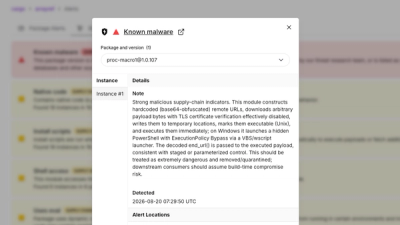
Three compromised Rust crates pulled in a malicious dependency that downloaded and executed cross-platform malware during Cargo builds.