
Research
/Security News
Miasma Mini Shai-Hulud Hits ImmobiliareLabs npm Packages
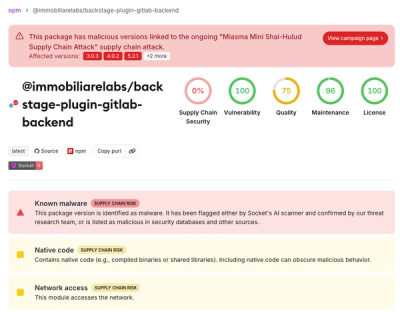
Miasma Mini Shai-Hulud hits @immobiliarelabs Backstage plugins, targeting GitLab and LDAP auth packages on npm.
By Socket Research Team - Jun 26, 2026
devflow-kit
Advanced tools
Agentic Development Toolkit for Claude Code - Enhance AI-assisted development with intelligent commands and workflows
A comprehensive collection of Claude Code commands and configurations designed to enhance developer workflows when working with AI coding assistants.
# Run with npx (recommended - no global install needed)
npx devflow-kit init
That's it! DevFlow is now installed and ready to use in Claude Code.
Skills are model-invoked - Claude automatically activates them based on context, enforcing quality without manual invocation.
| Skill | Purpose | Auto-Triggers When |
|---|---|---|
pattern-check | Architectural pattern validation (Result types, DI, immutability) | Code changes are made, new functions added |
test-design | Test quality enforcement (setup complexity, mocking, behavior vs implementation) | Tests are written or modified |
code-smell | Anti-pattern detection (fake solutions, unlabeled workarounds, magic values) | Features are implemented, code is reviewed |
research | Pre-implementation planning, documentation study, integration strategy | Unfamiliar features requested, architectural decisions needed |
debug | Systematic debugging with hypothesis testing and root cause analysis | Errors occur, tests fail, performance issues detected |
input-validation | Boundary validation enforcement (parse-don't-validate, SQL injection prevention) | API endpoints created, external data handled |
error-handling | Result type consistency and exception boundary enforcement | Error handling code written, functions that can fail |
How Skills Work:
IMPORTANT: Skills are automatically activated by Claude based on context. They cannot be manually invoked like slash commands.
Dual-Mode Pattern: The research and debug skills also exist as slash commands (/research, /debug) for manual control:
/research or /debug when you want explicit control over the workflowThis gives you the best of both worlds: automatic assistance when needed, manual control when preferred.
| Command | Purpose | When to Use |
|---|---|---|
/catch-up | Smart summaries for starting new sessions with status validation | Starting a session |
/devlog | Development log for comprehensive session documentation | Ending a session |
/plan-next-steps | Extract actionable next steps from current discussion | After planning discussion |
/implement | Smart interactive implementation orchestrator with todo triage | After planning, ready to implement todos |
/debug | Systematic debugging workflow with hypothesis testing | When errors occur, tests fail, or investigating issues |
/research | Pre-implementation research and approach analysis | Before implementing unfamiliar features or integrations |
/code-review | Comprehensive code review using specialized sub-agents | Before committing or creating PR |
/commit | Intelligent atomic commit creation with safety checks | When ready to commit |
/release | Automated release workflow with version management and publishing | Creating a new release |
| Sub-Agent | Specialty | Purpose |
|---|---|---|
audit-security | Security Analysis | Expert vulnerability detection and security code review |
audit-performance | Performance | Optimization and bottleneck detection |
audit-architecture | Architecture | Design pattern analysis and code structure review |
audit-tests | Testing | Test quality, coverage, and effectiveness analysis (surgical execution) |
audit-complexity | Complexity | Code complexity and maintainability assessment |
audit-dependencies | Dependencies | Dependency management and security analysis |
audit-database | Database | Database design and optimization review |
audit-documentation | Documentation | Docs-code alignment, API accuracy, comment quality |
catch-up | Context Restoration | Project status and context restoration with validation |
commit | Git Operations | Intelligent commit creation with safety checks |
research | Implementation Planning | Pre-implementation research, approach analysis, and planning |
release | Release Automation | Project-agnostic release workflow with version management |
How Sub-Agents Work:
Invoking Sub-Agents:
# Explicit invocation
"Use the audit-security sub-agent to analyze this authentication code"

# Automatic delegation (Claude Code decides which sub-agent to use)
"Review this code for security issues"
Real-time project context display showing:
DevFlow automatically creates a comprehensive .claudeignore file at your git repository root to:
Protect Sensitive Data:
.env, .env.*, .envrc)*.key, *.pem, SSH keys).aws/, .gcp/, .azure/).npmrc, .pypirc)*.sql, *.db)Optimize Token Usage:
node_modules/, vendor/, venv/)dist/, build/, .next/).vscode/, .idea/)package-lock.json, yarn.lock)Covers patterns for all major languages and operating systems.
/catch-up - Review what was done previouslyresearch skill triggers for unfamiliar features, pattern-check validates architecture/code-review - Review changes before committing/commit - Create intelligent atomic commits/devlog - Document decisions and state/code-review - Review branch before creating PR/commit - Final commits with validation/code-review - Comprehensive branch review/release - Automated release workflow
debug skill triggers on errors/failures with systematic approach.docs/debug/| Command | Purpose | Options |
|---|---|---|
devflow init | Initialize DevFlow for Claude Code | --skip-docs - Skip creating .docs/ structure |
devflow uninstall | Remove DevFlow from Claude Code | --keep-docs - Keep .docs/ directory |
What devflow init does:
~/.claude/commands/devflow/~/.claude/agents/devflow/~/.claude/skills/devflow/~/.devflow/scripts/~/.claude/settings.json (statusline and model).claudeignore at git repository root.docs/ structure for project documentationFirst Run:
devflow init
/devlog      # Document your current project state
/catch-up    # Get oriented with the project
# Extend sub-agents for project-specific patterns
echo "Check for exposed API keys in config files" >> ~/.claude/agents/devflow/audit-security.md
# Share session documentation with team
/devlog
git add .docs/status/
git commit -m "Session status: completed user auth feature"
# Skills auto-activate during development
"Add JWT authentication"  # research skill triggers automatically
"Fix this error"          # debug skill activates and guides systematic approach

# Manual command invocation
/code-review   # Review changes (uncommitted or full branch)
/commit        # Create atomic commits
/release       # Automated release workflow
Modern development increasingly involves AI agents that can read, write, and modify code autonomously. DevFlow provides:
# Clone and build
git clone https://github.com/dean0x/devflow.git
cd devflow
npm install
npm run build

# Test locally
node dist/cli.js init

# Watch mode for development
npm run dev
Project Structure:
src/
├── cli/                   # CLI source code (TypeScript)
│   ├── commands/           # init.ts, uninstall.ts
│   └── cli.ts             # CLI entry point
└── claude/                # Claude Code configuration
    ├── agents/devflow/     # Sub-agent definitions (.md)
    ├── commands/devflow/   # Slash command definitions (.md)
    ├── skills/devflow/     # Auto-activate skill definitions (.md)
    ├── scripts/            # statusline.sh
    └── settings.json       # Claude Code settings
.docs/status/ for recent sessionsMIT
FAQs
Agentic Development Toolkit for Claude Code - Enhance AI-assisted development with intelligent commands and workflows
The npm package devflow-kit receives a total of 59 weekly downloads. As such, devflow-kit popularity was classified as not popular.
We found that devflow-kit demonstrated a healthy version release cadence and project activity because the last version was released less than a year ago. It has 1 open source maintainer collaborating on the project.
Did you know?

Socket for GitHub automatically highlights issues in each pull request and monitors the health of all your open source dependencies. Discover the contents of your packages and block harmful activity before you install or update your dependencies.
Research
/Security News
Miasma Mini Shai-Hulud hits @immobiliarelabs Backstage plugins, targeting GitLab and LDAP auth packages on npm.

Security News
Rolldown paused Rust React Compiler integration after a 5MB binary size increase raised concerns about shipping React-specific code to all Vite users.

Security News
/Research
Mini Shai-Hulud expands into the Go ecosystem after hitting LeoPlatform npm packages and targeting GitHub Actions workflows.