

Company News
AWS Security Hub Adds Socket for Supply Chain Security
Socket is now in the AWS Security Hub Extended plan. Adopt it through AWS, apply committed spend, and block malicious open source packages.
By Feross Aboukhadijeh - Aug 04, 2026
MCP server exposing a live Dwarf Fortress fort to an AI agent as curated, semantic tools
An MCP server that gives an AI agent a live window into your Dwarf Fortress fort — a co-pilot and early-warning advisor, not an autopilot. Point Claude (or any MCP client) at it and ask "how's my fort doing?" — it reads happiness, threats, stocks, jobs, health, and defenses straight from the running game and answers in plain language.
Read-only by default. The 27 sensor and reference tools only observe the game. A handful of actuators that change the fort — queue manager orders, apply quickfort blueprints, assign labor — ship behind an explicit opt-in and stay hidden until you enable them (see Taking action).
Two kinds of tools:
fort_status,
threats, stocks, jobs_and_labor, military, injuries_and_health,
defenses, and more.game_data is your
world's ground truth (its loaded raws), the wiki_* tools are the general
explanation, and identify fuses the two for "what is this creature and how
do I handle it."It returns facts, not advice — already-summarized JSON that reads like a glance at the screen, leaving the judgment to the agent.
The package is published to npm and ships a prebuilt bundle — there is
nothing to build. Point your MCP client at it with npx:
{
  "mcpServers": {
    "dfhack": {
      "command": "npx",
      "args": ["-y", "dfhack-mcp"]
    }
  }
}
That's it for Claude Desktop / Claude Code / any stdio MCP client. npx -y dfhack-mcp fetches and runs the latest release; its runtime dependencies — the
MCP SDK and the
dfhack-remote-node RPC
transport — are pulled from npm automatically.
Then just have your fort running (next section) and ask your agent something like "check on my fort and flag anything urgent."
Prefer a pinned global install?
npm install -g dfhack-mcp # then set "command": "dfhack-mcp", "args": []
localhost:5000. This is on by default whenever DF
runs with DFHack — no config file to edit. (The allow_remote setting only
governs connections from other machines and can stay false; a local MCP
server reaches it either way.) Point elsewhere with DFHACK_HOST / DFHACK_PORT.Your agent picks the tools; you just describe what you want. The tools below are what it has to work with.
No arguments; each reports on the loaded fort.
fort_status() — name, date/season, population, wealth, happiness breakdown, pre-triaged alerts.stocks() — food/drink as days-of-supply, plus critical material counts and notable low/high lists.threats() — dangerous units grouped by type; active vs. contained, great-danger/invader/undead flags, plus each group's decisive traits (trapavoid, flier, fire, webber, building-destroyer, ranged).unmet_needs() — the needs system aggregated: the top unmet needs ranked by how many dwarves are distracted, and how starved each is.jobs_and_labor() — workforce utilization: busy vs. idle adults (children excluded), idle %, and a ranked breakdown of active jobs.military() — squads, enlisted soldiers, filled positions, and readiness against hostiles on the map.injuries_and_health() — wounded / patients / bedridden / unconscious counts, plus the care needed (diagnosis, surgery, suture, …).defenses() — active hostiles with map positions and distance/direction/z-delta to the fort core and nearest drawbridge, plus a controllable-structure inventory (bridges, levers, floodgates, hatches, cage traps, doors).moods() — any active strange mood (fey/secretive/possessed/macabre/fell): the dwarf, driving skill, workshop state, and each demanded material cross-referenced against fort stock — the "demands bones, fort has zero" early warning.mandates_and_justice() — the nobility's overhead: active production mandates and export bans, unmet noble room demands, and justice state (open cases, convictions awaiting punishment, restraint capacity).rooms_and_zones() — the facility inventory, each count paired with its demand-side number: bedrooms, dining halls, the hospital, wells, temples, taverns, libraries, guildhalls, and coffins free vs. dead awaiting burial. The supply-side companion to unmet_needs().trade() — the caravan lifecycle and trade depot: depot existence/completeness and wagon-accessibility, caravans present and their state, broker assignment/presence, and the count and approximate value of goods staged in the depot.environment() — ambient conditions right now: season and weather, surface temperature and whether exposed water is frozen, the embark's biome alignment (evil/good/reanimating), and — for each cavern the fort has already breached — whether it is open or sealed. Fog-of-war honest.find_unit(query) — look up citizens by name fragment or profession; a compact dossier per match (profession, age, stress, job, squad, health flags). Chain into citizen for depth.citizen(unit_id) — the full character sheet for one dwarf: social graph (spouse/parents/children/friends/grudges, each with a unit_id you can walk), worshipped deities, notable personality extremes, skills of note, likes/detests, and recent thoughts tied to current stress.site_history() — the fort's entry in the world saga: founding, the fort name in Dwarven + English with etymology, prior sieges/battles at the site, and notable figures who died here.artifacts_and_engravings() — the fort's masterworks and notable engravings.chronicle() — a scannable recent-events feed for the fort.Spatial (fog-of-war honest — undiscovered tiles never leak):
map_overview() — cheap orientation to run before any per-tile read: map extents, the fort-core coordinate, the surface z-level, the z-levels carrying player activity (digging/construction), and stairways as vertical columns. Fixed-size regardless of fort size.
tile_region(z?, x0?, y0?, x1?, y1?) — a bounded window of one z-level as an ASCII grid plus a self-describing legend. Undiscovered tiles stay ?. All params optional: none → a 60×40 window on the fort core; z alone → that level's centroid; explicit corners otherwise. Hard-capped at 100×100 (oversized requests are clamped, never errored). Renders the map; never designs it.
| glyph | meaning | glyph | meaning |
|---|---|---|---|
? | undiscovered (fog of war) | + | constructed floor |
# | undug stone / wall | ~ | water / brook |
, | undug soil (sand/clay/loam) | % | magma |
. | dug floor / walkable ground | W | workshop / furnace |
F | fortification | S | stockpile |
r | ramp | M | machine (gear/axle/pump/wheel/windmill) |
v | ramp top | n | furniture (bed/chair/table/door/etc) |
< > x | up / down / up-down stair | (space) | open space |
T | tree |
geology(reveal_hidden?) — a one-call geological survey (revealed-info only by default): surface z-level, the exposed layer stack with material names, the aquifer (light vs. heavy, z-range), discovered caverns, whether the magma sea is reached, and surface water. reveal_hidden: true bypasses fog of war (a debug/spoiler switch, default off).
wiki_* are pure HTTP and work without the game; game_data / identify read a
loaded world.
game_data(query, kind?) — your world's raws across six kinds (creature, material, plant, reaction, item, building; default creature). Ground truth for procedural creatures (demons, forgotten beasts, titans) that never reach the wiki. query is a token (DEMON_4, INORGANIC:IRON), a name ("plump helmet"), or — for creatures — a live unit_id. One strong hit → a full dossier; several → a disambiguation list; none → {"match_count":0,"matches":[]}.identify(query) — "what is this creature and how do I handle it" in one call: fuses game_data (your world's raws) with wiki_lookup (strategy). Returns the dossier, a tactics list pairing each decisive trait with a hard-fact implication (e.g. TRAPAVOID → mechanical traps don't work), and 1–2 trimmed wiki excerpts. Reach for it when a threat appears.wiki_search(query) — search the DF wiki for candidate titles + cleaned snippets (biased to the DF2014 namespace).wiki_lookup(title, section?, refresh?) — fetch a wiki article as clean text, pinned to DF2014; follows redirects, honors section fragments, cached ~30 days.By default every tool above only reads the game. The actuators change the
fort, so they ship behind an explicit switch — set DFHACK_MCP_ACTUATORS and they
appear in the tool list; leave it unset and the server is strictly read-only.
{
  "mcpServers": {
    "dfhack": {
      "command": "npx",
      "args": ["-y", "dfhack-mcp"],
      "env": { "DFHACK_MCP_ACTUATORS": "1" }
    }
  }
}
Every actuator uses the same preview → confirm → apply → undo safety loop, so a change is never a surprise:
preview of exactly
what would change — facts, never advice — plus a single-use confirm_token.
Nothing is written. If the operation can't be applied as asked (e.g. a
malformed blueprint), the preview reports why and no token is issued.undo handle and a readback from the matching sensor confirming the
change.Tokens are single-use and target-scoped: an unrelated change elsewhere in the fort does not void them, but a change to the target does. Each actuator names its own reversal path.
Manager work orders
work_order_list(after_id?) — read-only, always available. The fort's manager orders as facts: id, job type, output item/material, amount total/left, repeat frequency, bound workshop, and per-order validation state. Paged (cap 256) with a cursor.work_order_create(job_type, amount, frequency?, material?, item_type?) — queue a new order; the preview flags would_duplicate and manager_present. Reversal: work_order_cancel.work_order_cancel(order_id) — remove one order by id; the undo handle is a recreate spec (with a faithful flag when a workshop binding or conditions can't be fully restored).Quickfort blueprints — designate dig/zone from an agent-drafted quickfort CSV. There's no separate read sensor: blueprint_apply without a token is the preview.
blueprint_apply(csv, anchor_x, anchor_y, anchor_z, mode) — designate from a #dig or #zone blueprint; the top-left cell maps to the anchor. The dry-run parses quickfort's own stats and previews tiles affected, footprint, and fog-of-war tiles under it (a fact, never blocked). A malformed blueprint blocks with no token (quickfort would partially apply). v1 scope: dig + zone only — build/place are rejected. Reversal: blueprint_undo.blueprint_undo(csv, anchor_x, anchor_y, anchor_z, mode) — revert a dig/zone designation via quickfort's native undo (same csv/anchor/mode). The token signs a per-cell digest, so any per-cell drift voids it.Labor via work details
work_details() — read-only, always available. Every work detail (the game's labor groups): name, mode, the labor tokens it enables, and its assigned citizens (id-sorted, capped at 200 with the full member_count).assign_work_detail(unit_id, detail, enabled) — add or remove one citizen to/from one detail. The preview reports currently_member, resulting_members_count, and only_member; an already-satisfied request previews as a no-op. Reversal: the same call with enabled inverted.All optional, set in your MCP client's env for the server:
| Variable | Default | Effect |
|---|---|---|
DFHACK_HOST | 127.0.0.1 | Host where DFHack's Remote RPC is listening. |
DFHACK_PORT | 5000 | Port for DFHack's Remote RPC. |
DFHACK_MCP_ACTUATORS | (unset) | Set to 1 to expose the write actuators (off = strictly read-only). |
DFHACK_MCP_DEV | (unset) | Set to 1 to expose run_lua, a raw DFHack Lua escape hatch (reads and writes game state; for tool authors only). |
{"error":"no fort loaded"} — DFHack is reachable but you're at the title
screen or in the menus. Load a fort in Fortress mode.DFHACK_HOST / DFHACK_PORT match (defaults 127.0.0.1:5000).DFHACK_MCP_ACTUATORS=1 (see Taking action).To hack on the server itself, clone and run the TypeScript entry directly (Node 24+ — it runs the sources via type-stripping, no build step):
git clone https://github.com/alexanderolvera/dfhack-mcp.git
cd dfhack-mcp
npm install        # or: npm run bootstrap  (installs + runs the T0 contract check)
node src/index.ts
Point an MCP client at the checkout with "command": "node", "args": ["/absolute/path/to/dfhack-mcp/src/index.ts"].
All version-fragile DFHack field access lives in real .lua scripts under
src/dfhack-queries/ (one per tool), invoked by name with native argv — so a
DF/DFHack version bump is a localized fix and query parameters are injection-safe
by construction. Each tool is a thin TypeScript wrapper in src/tools/.
Facts, not advice. Tools sense — they return what is true about the fort and the world, the way a player reads a screen. They do not say what to build or how to fight; that judgment is the agent's. A field that says what to do is advice — leave it out.
Every tool is verified against a live fort with the tiered harness (npm run verify:t0 … t2) — never mocks. See CONTRIBUTING.md for the
tool-authoring split and the verification workflow, and
docs/VERIFY.md for the harness tiers.
ISC — see LICENSE.md.
FAQs
MCP server exposing a live Dwarf Fortress fort to an AI agent as curated, semantic tools
The npm package dfhack-mcp receives a total of 75 weekly downloads. As such, dfhack-mcp popularity was classified as not popular.
We found that dfhack-mcp demonstrated a healthy version release cadence and project activity because the last version was released less than a year ago. It has 1 open source maintainer collaborating on the project.
Did you know?

Socket for GitHub automatically highlights issues in each pull request and monitors the health of all your open source dependencies. Discover the contents of your packages and block harmful activity before you install or update your dependencies.
Company News
Socket is now in the AWS Security Hub Extended plan. Adopt it through AWS, apply committed spend, and block malicious open source packages.
Research
/Security News
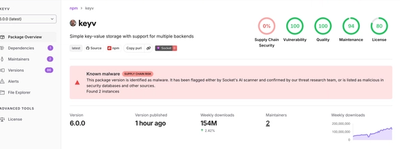
Popular npm packages keyv and cacheable compromised.

Security News
A misconfiguration gave three Anthropic models internet access, and one, believing it was in a simulation, shipped a credential-stealing package to PyPI.