
Product
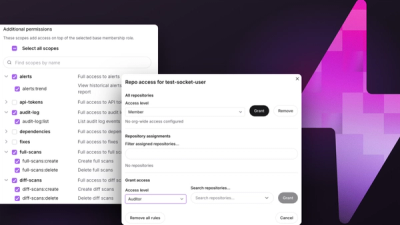
Introducing Repository Access Permissions and Custom Roles
Socket now supports Custom Roles and Repository Access Permissions so organizations can control who can access specific repositories and actions.
By Joe Werle - Jun 19, 2026
digital-chip-design-agents
Advanced tools
Full digital chip design pipeline — 15 Claude Code plugins across 14 domains, from infrastructure setup through tape-out and firmware, with closed-loop verification↔RTL feedback.
Claude Code marketplace plugin — full digital chip design pipeline.
15 plugins · 16 skill files · 13 chip-design domains + infrastructure + pipeline orchestrator · closed-loop verification↔RTL feedback.

With Node.js (≥18), install everything with one command — no clone, no Python:
npx digital-chip-design-agents # detects your AI agents and installs after a confirm
Then just describe your task in natural language:
Run the RTL design flow for my AXI DMA controller block
Analyse timing violations on this routed DEF and suggest ECOs
Build a UVM testbench for my FIFO block
Claude automatically loads the correct skill before executing.
For the install script, selective marketplace install, other AI assistants (Copilot / Gemini / OpenCode / Codex), and all flags, see docs/INSTALL.md.
| Plugin Name | Domain | Invoke When You Want To... |
|---|---|---|
chip-design-architecture | Architecture Evaluation | Explore microarch candidates, estimate PPA, assess risk |
chip-design-rtl | RTL Design (SystemVerilog) | Write, lint, CDC-check, or synthesis-check RTL |
chip-design-verification | Functional Verification (UVM) | Build testbench, write tests, close coverage, run regression |
chip-design-formal | Formal Verification (FPV/LEC) | Prove properties, check equivalence, close formal gaps |
chip-design-synthesis | Logic Synthesis | Set up SDC, run synthesis, verify netlist with LEC |
chip-design-dft | Design for Test | Plan DFT, insert scan, run ATPG, set up JTAG |
chip-design-sta | Static Timing Analysis | Analyse timing, guide ECO closure, sign off timing |
chip-design-hls | High-Level Synthesis | Convert C/C++ to RTL, optimise directives, co-simulate |
chip-design-pd | Physical Design | Full PD flow: floorplan → placement → CTS → routing → sign-off |
chip-design-soc | SoC IP Integration | Qualify IPs, configure bus fabric, run chip-level sim |
chip-design-compiler | Compiler Toolchain | Build LLVM/GCC backend, assembler, linker, runtime for custom ISA |
chip-design-firmware | Embedded Firmware | BSP, HAL drivers, RTOS integration, firmware validation |
chip-design-fpga | FPGA Emulation | Port ASIC to FPGA, bring up hardware, validate SW on prototype |
chip-design-infrastructure | Infrastructure & Memory | Detect EDA tools, deploy wrappers, configure MCP servers, distil domain memory |
chip-design-meta | Pipeline Orchestration | Drive closed-loop verification↔RTL feedback, manage fix_requests, enforce iteration cap |
Each plugin installs two things:
A Skill (plugins/<domain>/skills/<domain>/SKILL.md) — domain knowledge Claude reads
before executing. Contains stage-by-stage rules, QoR metrics, common fixes, and output
requirements.
An Orchestrator Agent (plugins/<domain>/agents/<domain>-orchestrator.md) — a subagent
that manages the full multi-stage flow. It sequences stages, enforces pass/fail criteria,
applies loop-back rules when a stage fails, and escalates clearly when human input is needed.
Skills are loaded autonomously by Claude when you describe a task. Orchestrators are invoked explicitly when you want to run a complete flow end-to-end.
Each orchestrator enforces a strict stage sequence with loop-back rules, and the 13 domains connect into a complete spec→tape-out pipeline. See docs/PIPELINE.md for the flow diagram and loop-back details, and docs/MASTER_INDEX.md for per-domain flow documentation.
Each domain orchestrator reads from and writes to a two-tier persistent memory store under
memory/:
memory/<domain>/knowledge.md — distilled summaries (failure patterns, tool flags, PDK
quirks) read by every orchestrator at session start.memory/<domain>/experiences.jsonl — append-only run records written after every signoff
or escalation.Distil accumulated records back into knowledge.md with the memory-keeper skill, and track
QoR metrics across runs with tools/qor_trends.py. See memory/README.md
for the full schema, distilling workflow, and QoR trend examples.
digital-chip-design-agents/
├── .claude-plugin/marketplace.json   ← Marketplace registry (all 15 plugins)
├── plugins/                          ← One isolated directory per plugin (skill + orchestrator)
├── ides/                             ← IDE-specific config files (Copilot / Gemini / OpenCode / Codex)
├── memory/                           ← Persistent two-tier per-domain memory (see memory/README.md)
├── docs/                             ← Install guide, pipeline map, and per-domain flow docs
├── tools/qor_trends.py               ← QoR metric trending and regression detection
└── .github/workflows/                ← CI (validate.yml) and release (release.yml)
See CONTRIBUTING.md. PRs welcome for:
CI validates all files on every PR — the validate workflow must pass before merge.
MIT — see LICENSE.
FAQs
Full digital chip design pipeline — 15 Claude Code plugins across 14 domains, from infrastructure setup through tape-out and firmware, with closed-loop verification↔RTL feedback.
We found that digital-chip-design-agents demonstrated a healthy version release cadence and project activity because the last version was released less than a year ago. It has 1 open source maintainer collaborating on the project.
Did you know?

Socket for GitHub automatically highlights issues in each pull request and monitors the health of all your open source dependencies. Discover the contents of your packages and block harmful activity before you install or update your dependencies.
Product
Socket now supports Custom Roles and Repository Access Permissions so organizations can control who can access specific repositories and actions.
Product
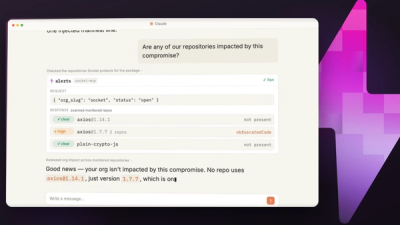
Socket MCP now lets AI assistants review org alerts, investigate threats using the Socket threat feed, and inspect package files in addition to dependency scoring.
Product
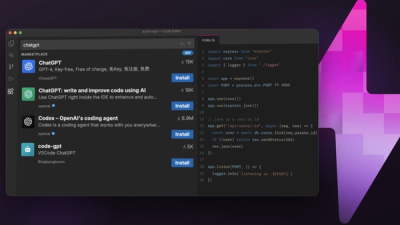
Socket Firewall blocks malicious VS Code and Open VSX extensions before install, protecting developers from compromised editor marketplaces.