

Security News
Federal Audit Finds NIST Wasted Funds With No Plan to Clear NVD Backlog
Federal audit finds NIST lacked a plan to clear the NVD backlog, wasted funds on duplicate work, and delayed use of CISA data.
By Sarah Gooding - Jun 03, 2026
Academic paper revision workflow: Word ↔ Markdown round-trips, DOI validation, reviewer comments





A CLI for writing documents in Markdown while collaborating with Word users.
Write in .md files under version control; build Word or PDF when you need to share. When reviewers return their annotated copy, rev sync pulls the feedback into your markdown sections, where you reply to comments, accept or reject changes, and rebuild. Equations, figures, citations, and cross-references survive both directions.
After a few rounds of feedback, the project directory looks like this:
manuscript_v1.docx
manuscript_v2_john_comments.docx
manuscript_v2_jane_comments.docx
manuscript_v3_merged_final.docx
manuscript_v3_merged_final_REAL.docx
manuscript_v3_merged_final_REAL_submitted.docx
By the third filename, the document has split. One file has Jane's comments, another has John's track changes, a third has your reconciliation, and which one is current depends on what you remember. Reconciliation takes an afternoon and goes wrong every time the Word formatting drifts.
docrev keeps the markdown as the canonical version, under git. The DOCX is rebuilt each time you share; reviewer comments and track changes come back into your section files when you sync, where you reply to or accept them in the terminal.
npm install -g docrev
Requires Node.js 18+. Building DOCX or PDF needs Pandoc. For complex PDFs (math, cross-references, journal styles), LaTeX is also needed; simpler documents can build through pandoc alone with a non-LaTeX engine (e.g. pdf.engine: typst in rev.yaml).
Write in Markdown with citations and cross-references:
Climate change poses significant challenges [@IPCC2021]. As shown in
@fig:temperature, global temperatures have risen steadily.
{#fig:temperature}
The relationship follows $\Delta T = \lambda \cdot \Delta F$ (@eq:forcing).
Build and share:
rev build docx    # → output/paper.docx
rev build pdf     # → output/paper.pdf
When collaborators return the Word doc with track changes:
rev sync reviewed.docx # their comments → your markdown
┌─────────────┐     rev build docx      ┌─────────────┐
│             │ ───────────────────────→│             │
│  Markdown   │                         │    Word     │  → collaborators
│   (you)     │     rev build pdf       │   / PDF     │  → journals
│             │ ───────────────────────→│             │
└─────────────┘                         └─────────────┘
       ↑                                       │
       │              rev sync                 │
       └───────────────────────────────────────┘
              their feedback → your files
rev new my-paper creates the project. It prompts for the section names (default: introduction, methods, results, discussion) or accepts them up front via -s intro,methods,results,discussion. Each name becomes its own .md file. (rev import some.docx is the other entry point — it splits an existing Word document into one section per top-level heading.)
my-paper/
├── rev.yaml          ← config: title, authors, section order, journal profile
├── intro.md          ← section files; named at creation, one per section
├── methods.md
├── results.md
├── discussion.md
├── references.bib    ← BibTeX bibliography
├── figures/          ← images referenced from sections
├── paper.md          ← auto-combined source, regenerated each build
└── output/           ← built artefacts (docx, pdf, tex)
    ├── my-paper.docx
    └── my-paper.pdf
You edit the section files and the config; everything else is generated. paper.md is rebuilt from the section files in the order set by rev.yaml, and output/ holds whatever the last build produced. After rev sync, comments and track changes from the reviewer's Word file appear inline in the section files as CriticMarkup annotations. Set outputDir: null in rev.yaml if you'd rather have outputs land alongside paper.md.
To set your own per-user default sections so future rev new calls skip the prompt:
rev config sections "intro,methods,results,discussion"
When reviewers send back a Word document with track changes and comments:
rev sync reviewed.docx # import feedback into markdown
Track changes appear inline - accept or reject by editing:
The sample size was {--100--}{++150++} participants.
Handle comments without opening Word:
rev comments                      # list all comments
rev reply methods.md -n 1 -m "Added clarification"
rev resolve methods.md -n 1       # mark as resolved
rev build docx --dual             # clean + annotated versions
PDF annotations work the same way:
rev sync annotated.pdf
rev pdf-comments annotated.pdf --append methods.md
When several reviewers return separate files, rev merge reconciles them:
rev merge reviewer_A.docx reviewer_B.docx
Each reviewer's file is compared against .rev/base.docx (auto-saved on every build) to isolate that reviewer's changes; conflicts on the same passage are flagged for interactive resolution.
Create a new project:
rev new my-report
cd my-report
You'll be prompted to enter your section names, or press Enter to use the default structure. You can also specify sections directly:
rev new my-report -s intro,methods,results,discussion
Or set your preferred default sections once:
rev config sections "intro,methods,results,discussion"
This creates the project folder with your section files — edit them, then build:
rev build docx pdf
The output filename comes from title in rev.yaml. Citations are resolved, equations rendered, and cross-references numbered. The directory layout is described above in What's in a Project.
If you have a Word document to convert:
rev import manuscript.docx
This creates a project folder and splits the document into section files. Images are extracted to figures/, equations are converted to LaTeX, and track changes/comments are preserved as markdown annotations.
Layout is controlled in rev.yaml:
title: "My Document"
authors: []
sections:
  - intro.md
  - methods.md
  - results.md
  - discussion.md

# Where built artefacts land (default: output/). Set to null for the
# legacy "outputs alongside paper.md" layout.
outputDir: output

docx:
  reference: template.docx       # your Word template

pdf:
  documentclass: article
  fontsize: 12pt
  engine: pdflatex               # or xelatex/lualatex for Latin-Extended
  # Fonts apply only under xelatex/lualatex (fontspec):
  # mainfont: "TeX Gyre Termes"
  # sansfont: "TeX Gyre Heros"
  # monofont: "TeX Gyre Cursor"
Switch to engine: xelatex (or lualatex) when the manuscript has Czech/Polish/Croatian/Spanish names or species epithets that pdflatex mangles. Under those engines, mainfont/sansfont/monofont are forwarded to pandoc.
Configure your name for comment replies:
rev config user "Your Name"
For PDF output, configure columns that should not wrap:
tables:
  nowrap:
    - Prior              # column headers to keep on one line
    - "$\\widehat{R}$"
Distribution notation in nowrap columns is auto-converted to LaTeX math:
Normal(0, 0.5) → $\mathcal{N}(0, 0.5)$
Mark unfinished spots in a draft with \tofill{X} and they highlight as bold
orange [X] in every output format:
We collected data from \tofill{N sites} between \tofill{date range}.
The macro works in DOCX, PDF, TeX, Beamer, and HTML without any per-project
filter setup. Add custom macros (e.g. \note, \citeNeeded) under macros:
in rev.yaml:
macros:
  - name: note
    default:
      color: "1E40AF"      # 6-digit hex, no '#'
      bold: true
      prefix: "NOTE: "
See docs/configuration.md for the full schema and per-format overrides.
Run custom scripts after output generation:
postprocess:
  pdf: ./scripts/fix-tables.py    # runs after PDF
  docx: ./scripts/add-meta.js     # runs after DOCX
  all: ./scripts/notify.sh        # runs after any format
Scripts receive environment variables: OUTPUT_FILE, OUTPUT_FORMAT, PROJECT_DIR, CONFIG_PATH.
Use --verbose to see script output:
rev build pdf --verbose
Journal profiles provide both validation rules and build formatting defaults. Set in rev.yaml:
journal: nature
Or pass on the command line:
rev build pdf -j nature # applies Nature's CSL style + PDF settings
When a journal is set, its formatting defaults (CSL citation style, font size, margins, line spacing) are applied automatically. Your explicit rev.yaml settings always take priority.
Six profiles include formatting: nature, science, cell, pnas, plos-one, elife. All 21 profiles support validation. Custom profiles can include formatting too — see docs/configuration.md.
rev validate --list          # see all profiles ([formatting] tag = build support)
rev profiles --fetch-csl apa # download a CSL style to cache
rev profiles --list-csl      # list cached CSL styles
Track changes from Word appear as CriticMarkup:
The sample size was {--100--}{++150++} participants.   # deletion + insertion
Data was collected {~~monthly~>weekly~~}.              # substitution
{>>Reviewer 2: Please clarify.<<}                      # comment
Track word count changes between versions:
rev diff                    # compare against last commit
#  methods.md     +142 words  -38 words
#  results.md      +89 words  -12 words
Add references to references.bib (BibTeX format):
@article{Smith2020,
  author = {Smith, Jane},
  title = {Paper Title},
  journal = {Nature},
  year = {2020},
  doi = {10.1038/example}
}
Cite with [@Smith2020] or [@Smith2020; @Jones2021] for multiple sources.
Equations use LaTeX: inline $E = mc^2$ or display $$\sum_{i=1}^{n} x_i$$.
Cross-references: @fig:label, @tbl:label, @eq:label → "Figure 1", "Table 2", "Equation 3".
| Task | Command |
|---|---|
| Create project | rev new my-project |
| Create LaTeX project | rev new my-project --template latex |
| Import Word document | rev import manuscript.docx |
| Extract Word equations | rev equations from-word doc.docx |
| Build DOCX | rev build docx |
| Build PDF | rev build pdf |
| Build clean + annotated | rev build docx --dual |
| Build with visible track changes | rev build docx --show-changes |
| Sync Word feedback | rev sync reviewed.docx |
| Sync PDF comments | rev sync annotated.pdf |
| Extract PDF comments | rev pdf-comments annotated.pdf |
| Extract with highlighted text | rev pdf-comments file.pdf --with-text |
| Project status | rev status |
| Next pending comment | rev next |
| List pending comments | rev todo |
| Filter by author | rev comments file.md --author "Reviewer 2" |
| Accept all changes | rev accept file.md -a |
| Reject change | rev reject file.md -n 1 |
| Reply to comment | rev reply file.md -n 1 -m "response" |
| Reply to all pending | rev reply file.md --all -m "Addressed" |
| Resolve comment | rev resolve file.md -n 1 |
| Show contributors | rev contributors |
| Lookup ORCID | rev orcid 0000-0002-1825-0097 |
| Merge reviewer feedback | rev merge reviewer_A.docx reviewer_B.docx |
| Archive reviewer files | rev archive |
| Check DOIs | rev doi check references.bib |
| Find missing DOIs | rev doi lookup references.bib |
| Add citation from DOI | rev doi add 10.1038/example |
| Word count | rev wc |
| Pre-submission check | rev check |
| Check for updates | rev upgrade --check |
Run rev help to see all commands, or rev help <command> for details on a specific command.
Full command reference: docs/commands.md
Install the docrev skill for Claude Code:
rev install-cli-skill      # install to ~/.claude/skills/docrev
rev uninstall-cli-skill    # remove
Once installed, Claude understands docrev commands and can help navigate comments, draft replies, and manage your revision cycle.
Pandoc handles document conversion.
| Platform | Command |
|---|---|
| macOS | brew install pandoc |
| Windows | winget install JohnMacFarlane.Pandoc |
| Debian/Ubuntu | sudo apt install pandoc |
| Fedora | sudo dnf install pandoc |
Other platforms: pandoc.org/installing
| Platform | Command |
|---|---|
| macOS | brew install --cask mactex |
| Windows | winget install MiKTeX.MiKTeX |
| Debian/Ubuntu | sudo apt install texlive-full |
| Fedora | sudo dnf install texlive-scheme-full |
Alternatively, TinyTeX provides a minimal distribution that downloads packages on demand.
MIT
FAQs
Academic paper revision workflow: Word ↔ Markdown round-trips, DOI validation, reviewer comments
We found that docrev demonstrated a healthy version release cadence and project activity because the last version was released less than a year ago. It has 1 open source maintainer collaborating on the project.
Did you know?

Socket for GitHub automatically highlights issues in each pull request and monitors the health of all your open source dependencies. Discover the contents of your packages and block harmful activity before you install or update your dependencies.
Security News
Federal audit finds NIST lacked a plan to clear the NVD backlog, wasted funds on duplicate work, and delayed use of CISA data.
Research
/Security News
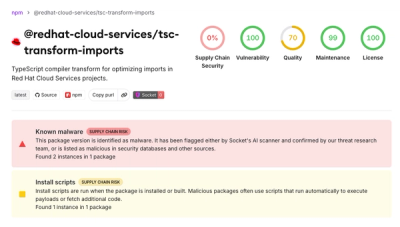
A mini Shai-Hulud campaign compromised Red Hat Cloud Services npm packages to steal developer and CI/CD secrets during installation.
Research
/Security News
The North Korean malware loader hides in a Packagist-listed package and its GitHub branch to fetch and execute remote code in a likely Contagious Interview-style lure.