
Research
/Security News
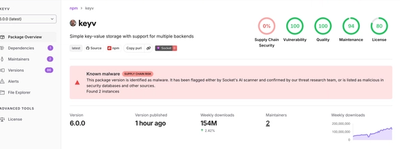
Popular npm Packages in the keyv and Cacheable Namespaces Compromised in Active Supply Chain Attack
Popular npm packages keyv and cacheable compromised.
By Socket Research Team - Aug 04, 2026
npx shim for dreamd MCP server — downloads the right prebuilt Rust binary for your OS/arch
Node shim for the dreamd MCP server. Downloads the right prebuilt binary for your OS/arch and starts the MCP server over stdio.
Requires a project root sentinel (.git/, Cargo.toml, package.json, or pyproject.toml).
# 1. Scaffold .agent/ and wire your harness's MCP config
npx -y dreamd-mcp setup

# 2. Start a shared daemon (recommended when multiple agents write)
npx -y dreamd-mcp watch

# 3. Reload the harness — it now spawns the MCP server itself
npx -y dreamd-mcp
setup prompts when it has a TTY; in scripts pass --yes with --harness claude|cursor|both|none. It writes each MCP config as 2-space pretty-printed JSON with a trailing newline and does not preserve your original formatting, so an existing .mcp.json / .cursor/mcp.json can come back reformatted — other MCP servers in the file are kept. npx -y dreamd-mcp init remains the scaffold-only primitive (store, no harness config), same as setup --no-write-mcp.
Leave
npx dreamd-mcpfloating — don't pin. On a fresh spawn, npx re-resolves thelatestdist-tag from the registry, so a floating config always starts the current version. Two caveats: a running MCP server ordreamd watchdaemon keeps the version it started with until you restart it, and an offline run falls back to the last-cached binary. A hard version pin (dreamd-mcp@0.1.0-rc.3) is the one form that never picks up new releases.
No Rust installation required. Prebuilt binaries are available for Linux x86_64 and macOS x86_64/aarch64 (see manifest.json). Native Windows is out of scope for v0.1 — use WSL2 or a Linux/macOS host (Windows support is planned for v0.1.1).
Adapter quickstarts: Claude Code · Cursor
npx -y dreamd-mcp auto-connects to a shared daemon if one is running, and otherwise runs a standalone in-process server. Sequential use across tools is safe. If you point several agents at the same project simultaneously, start one shared daemon per machine with npx -y dreamd-mcp watch (or the native dreamd watch) so every agent routes through a single serialized writer. See the project README for the full footprint and crash-safety notes.
.agent/ contractserver.json holds the metadata for the official MCP Registry entry io.github.botzrDev/dreamd. The registry serves metadata only — it points at the npm package, so the matching version must already be public on npm before publishing.
Anyone (including CI) can check the metadata. Validation is non-mutating: it neither authenticates nor writes to the registry.
# from packages/dreamd-mcp
mcp-publisher validate server.json
Publication is owner-only. mcp-publisher login github must authenticate as a GitHub identity authorized for the botzrDev namespace — the registry derives the io.github.botzrDev/* namespace from that identity and rejects the publish otherwise.
mcp-publisher login github
mcp-publisher publish server.json
curl "https://registry.modelcontextprotocol.io/v0.1/servers?search=io.github.botzrDev%2Fdreamd"
The curl query is read-only and confirms the entry is live. Publishing is deliberately not automated in CI — no workflow holds registry credentials.
Set DREAMD_BIN=/path/to/dreamd to skip download and use a local build instead of the cached release binary. Because this bypasses sha256 verification, you must also set DREAMD_BIN_ALLOW_UNVERIFIED=1 to confirm — DREAMD_BIN on its own is refused.
Warning: when DREAMD_BIN is set, sha256 verification is skipped. Use this only for local development — never point production MCP configs at an unverified binary.
Build from source (Linux / macOS only — native Windows is out of scope for v0.1):
cargo install --path crates/dreamd-cli
export DREAMD_BIN=~/.cargo/bin/dreamd
export DREAMD_BIN_ALLOW_UNVERIFIED=1
npx -y dreamd-mcp
First run prompts once — press
y, or usenpx -y dreamd-mcp.
dreamd-mcp is never installed globally — it runs straight from the npx cache and
downloads the native binary into a per-version cache. npm uninstall -g dreamd-mcp
is therefore a no-op. There is no dreamd reset --all — use dreamd uninstall.
Order: run uninstall (or the manual cleanup steps) → remove the
dreamdblock from your MCP client config → reload the client.
npx -y dreamd-mcp uninstall # or, with a native binary: dreamd uninstall
One command: stops local dreamd mcp / dreamd watch processes, removes the
daemon socket, unregisters the current project from the registry (skipped with a
benign note when run outside a project root), and clears the native binary cache
(~/.cache/dreamd-mcp) plus the dreamd-mcp-scoped entries under ~/.npm/_npx.
Safe to run twice — a second run succeeds with nothing left to do.
| Flag | Effect |
|---|---|
--keep-caches | Skip the cache clears |
--all-npx | Loud: wipe the entire ~/.npm/_npx (every npx-cached package, not just dreamd). Prints a warning before deleting. |
--quiet / -q | Suppress non-essential output |
Left in place: ~/.agent/registry.toml, ~/.agent/dreamd.log, and every
project's .agent/ memory store. To wipe a project's store entirely, see
Full fresh store
in the troubleshooting guide — delete .agent/ and re-run dreamd init. That is
destructive; back up first if the store has value.
Then remove the client config entry. Delete the dreamd MCP server block from
your harness config (.mcp.json, Cursor settings, Cline
cline_mcp_settings.json, …) and reload the client. Until that entry is gone, the
harness keeps respawning dreamd on the next session — uninstall does not edit
harness configs.
npx -y dreamd-mcp update # or: dreamd update
Prints the current version, stops local servers, removes the socket, and clears
~/.cache/dreamd-mcp, then prints the restart contract:
dreamd mcp / dreamd watch if running — update does this
for you on every non-dry run, and reports whether anything matched.npx -y dreamd-mcp — the floating npx spawn re-resolves latest
and fetches the new binary. Keep the pin floating; a hard version pin never
picks up new releases.update never relaunches anything for you — no OS service, no auto-respawn.
| Flag | Effect |
|---|---|
--dry-run | Print the current version and the restart contract as a plan; change nothing |
--restart | Explicitly stop local dreamd mcp / dreamd watch and say so. Same stop that already runs by default — the flag makes the step loud, and is a no-op if nothing is running |
--quiet / -q | Suppress non-essential output. Version lines and a one-line reload + re-run reminder still print |
update does not touch ~/.npm/_npx. If you built from source with
cargo install --path crates/dreamd-cli, clearing the cache does not replace that
binary — rebuild it instead.
Prefer npx -y dreamd-mcp uninstall above — it does all of this in one command.
If you want the steps by hand, run the cleanup below (stop processes, remove the
socket, unregister the project, clear caches), then remove the dreamd block
from your MCP client config and reload the client — the same order as
Uninstall:
# 1. Stop processes + remove the socket
pkill -f 'dreamd mcp' || true
pkill -f 'dreamd watch' || true
rm -f ~/.agent/dreamd.sock

# 2. Unregister the project from the registry (run from the project root)
dreamd init --uninstall-project

# 3. Native binary cache
rm -rf ~/.cache/dreamd-mcp                  # macOS/Linux
#   Windows: Remove-Item -Recurse "$env:LOCALAPPDATA\dreamd-mcp\cache"

# 4. npx shim cache — delete only _npx dirs whose package.json references
#    dreamd-mcp. npm writes these manifests without a "name" field — the
#    requested package appears as a dependencies key, e.g.
#    {"dependencies":{"dreamd-mcp":"^0.1.0-rc.6"}} — so match the quoted
#    package key, and check each manifest before deleting anything.
for d in ~/.npm/_npx/*/; do
  [ -f "$d/package.json" ] && grep -q '"dreamd-mcp"' "$d/package.json" && rm -rf "$d"
done
# Windows / WSL with Windows Node — same pattern under:
#   "$LOCALAPPDATA/npm-cache/_npx"
Warning:
rm -rf ~/.npm/_npxdeletes every npx-cached package on your machine, not just dreamd. Use the scoped loop — ordreamd uninstall, which scopes by default — unless you intend a full npx reset.
Apache-2.0
FAQs
npx shim for dreamd MCP server — downloads the right prebuilt Rust binary for your OS/arch
We found that dreamd-mcp demonstrated a healthy version release cadence and project activity because the last version was released less than a year ago. It has 1 open source maintainer collaborating on the project.
Did you know?

Socket for GitHub automatically highlights issues in each pull request and monitors the health of all your open source dependencies. Discover the contents of your packages and block harmful activity before you install or update your dependencies.
Research
/Security News
Popular npm packages keyv and cacheable compromised.

Security News
A misconfiguration gave three Anthropic models internet access, and one, believing it was in a simulation, shipped a credential-stealing package to PyPI.

Security News
/Company News
Socket has joined the new Composer and Packagist sponsorship program as a launch sponsor, supporting the team that keeps PHP's package ecosystem secure.