
Research
/Security News
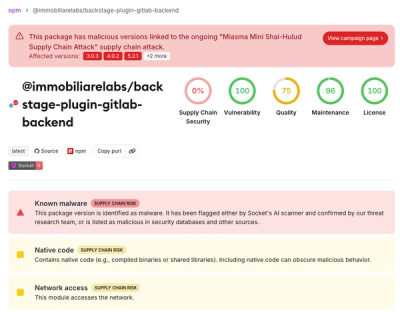
Miasma Mini Shai-Hulud Hits ImmobiliareLabs npm Packages
Miasma Mini Shai-Hulud hits @immobiliarelabs Backstage plugins, targeting GitLab and LDAP auth packages on npm.
By Socket Research Team - Jun 26, 2026
dropflow_fork
Advanced tools
<img height=50 src=assets/logo.png>
Dropflow is a CSS layout engine created to explore the reaches of the foundational CSS standards (that is: inlines, blocks, floats, positioning and eventually tables, but not flexbox or grid). It has a high quality text layout implementation and is capable of displaying many of the languages of the world. You can use it to generate PDFs or images on the backend with Node and node-canvas or render rich, wrapped text to a canvas in the browser.
floath()) API with styles as objects in addition to accepting HTML and CSSFollowing are rules that work or will work soon. Shorthand properties are not listed. If you see all components of a shorthand (for example, border-style, border-width, border-color) then the shorthand is assumed to be supported (for example border).
| Property | Values | Status |
|---|---|---|
color | rgba(), rgb(), #rrggbb, #rgb, #rgba | ✅ Works |
direction | ltr, rtl | ✅ Works |
font-family | ✅ Works | |
font-size | em, px, smaller etc, small etc, cm etc | ✅ Works |
font-stretch | condensed etc | ✅ Works |
font-style | normal, italic, oblique | ✅ Works |
font-variant | 🚧 Planned | |
font-weight | normal, bolder, lighter light, bold, 100-900 | ✅ Works |
letter-spacing | 🚧 Planned | |
line-height | normal, px, em, %, number | ✅ Works |
tab-size | 🚧 Planned | |
text-align | start, end, left, right, center | ✅ Works |
text-decoration | 🚧 Planned | |
unicode-bidi | 🚧 Planned | |
vertical-align | baseline, middle, sub, super, text-top, text-bottom, %, px etc, top, bottom | ✅ Works |
white-space | normal, nowrap, pre, pre-wrap, pre-line | ✅ Works |
word-breakoverflow-wrap,word-wrap | break-word, normalanywhere, normal | ✅ Works |
| Property | Values | Status |
|---|---|---|
clear | left, right, both, none | ✅ Works |
float | left, right, none | ✅ Works |
writing-mode | horizontal-tb, vertical-lr, vertical-rl | 🏗 Partially done1 |
1Implemented for BFCs but not IFCs yet
| Property | Values | Status |
|---|---|---|
background-clip | border-box, content-box, padding-box | ✅ Works |
background-color | rgba(), rgb(), #rrggbb, #rgb, #rgba | ✅ Works |
border-color | rgba(), rgb(), #rrggbb, #rgb, #rgba | ✅ Works |
border-style | solid, none | ✅ Works |
border-width | em, px, cm etc | ✅ Works |
top, right, bottom, left | em, px, %, cm etc | ✅ Works |
box-sizing | border-box, content-box | ✅ Works |
display | block | ✅ Works |
display | inline | ✅ Works |
display | inline-block | ✅ Works |
display | flow-root | ✅ Works |
display | none | ✅ Works |
display | table | 🚧 Planned |
height | em, px, %, cm etc, auto | ✅ Works |
margin | em, px, %, cm etc, auto | ✅ Works |
max-height, max-width,min-height, min-width | em, px, %, cm etc, auto | 🚧 Planned |
padding | em, px, %, cm etc | ✅ Works |
position | absolute | 🚧 Planned |
position | fixed | 🚧 Planned |
position | relative | ✅ Works |
transform | 🚧 Planned | |
overflow | hidden, visible | ✅ Works |
width | em, px, %, cm etc, auto | ✅ Works |
z-index | number, auto | ✅ Works |
zoom | number, % | ✅ Works |
Dropflow works off of a DOM with inherited and calculated styles, the same way
that browsers do. You create the DOM with the familiar h() function, and
specify styles as plain objects.
import * as flow from 'dropflow';
import {createCanvas} from 'canvas';
import fs from 'node:fs';

// Register fonts before layout. This is a required step.
// It is only async when you don't pass an ArrayBuffer
await flow.registerFont(new URL('fonts/Roboto-Regular.ttf', import.meta.url));
await flow.registerFont(new URL('fonts/Roboto-Bold.ttf', import.meta.url));

// Always create styles at the top-level of your module if you can.
const divStyle = flow.style({
  backgroundColor: {r: 28, g: 10, b: 0, a: 1},
  textAlign: 'center',
  color: {r: 179, g: 200, b: 144, a: 1}
});

// Since we're creating styles directly, colors are numbers
const spanStyle = flow.style({
  color: {r: 115, g: 169, b: 173, a: 1},
  fontWeight: 700
});

// Create a DOM
const rootElement = flow.dom(
  flow.h('div', {style: divStyle}, [
    'Hello, ',
    flow.h('span', {style: spanStyle}, ['World!'])
  ])
);

// Layout and paint into the entire canvas (see also renderToCanvasContext)
const canvas = createCanvas(250, 50);
flow.renderToCanvas(rootElement, canvas, /* optional density: */ 2);

// Save your image
canvas.createPNGStream().pipe(fs.createWriteStream(new URL('hello.png', import.meta.url)));

This API is only recommended if performance is not a concern, or for learning purposes. Parsing adds extra time (though it is fast thanks to @fb55) and increases bundle size significantly.
import * as flow from 'dropflow/with-parse.js';
import {createCanvas} from 'canvas';
import fs from 'node:fs';

await flow.registerFont(new URL('fonts/Roboto-Regular.ttf', import.meta.url));
await flow.registerFont(new URL('fonts/Roboto-Bold.ttf', import.meta.url));

const rootElement = flow.parse(`
  <div style="background-color: #1c0a00; color: #b3c890; text-align: center;">
    Hello, <span style="color: #73a9ad; font-weight: bold;">World!</span>
  </div>
`);

const canvas = createCanvas(250, 50);
flow.renderToCanvas(rootElement, canvas, 2);

canvas.createPNGStream().pipe(fs.createWriteStream(new URL('hello.png', import.meta.url)));
Performance is a top goal and is second only to correctness. Run the performance examples in the examples directory to see the numbers for yourself.
perf-1.ts)perf-2.ts)perf-3.ts)The fastest performance can be achieved by using the hyperscript API, which creates a DOM directly and skips the typical HTML and CSS parsing steps. Take care to re-use style objects to get the most benefits. Reflows at different widths are faster than recreating the layout tree.
The first two steps are:
Then, you can either render the DOM into a canvas using its size as the viewport:
Or, you can use the lower-level functions to retain the layout, in case you want to re-layout at a different size, choose not to paint (for example if the layout isn't visible) or get intrinsics:
registerFontasync function registerFont(url: URL, options?: {paint: boolean}): Promise<void>;
async function registerFont(buffer: ArrayBuffer, url: URL, options?: {paint: boolean}): Promise<void>;
Registers a font to be selected by the font properties. Dropflow does not search system fonts, so you must do this with at least one font.
When a URL is passed, don't forget to await this. If an ArrayBuffer is passed, there is no need to await. In that function signature, the URL is only used to provide a unique name for the font.
The URL must always be unique.
In the browser, make sure the font is also loaded into page so that the paint backend can reference it with ctx.font. In node-canvas, you should either use registerFont from canvas for this font, or pass {paint: true} for options, which will try to load node-canvas and call its registerFont.
[!NOTE] This will soon be replaced with an API that looks more like the
document.fontsAPI in the browser.
loadNotoFontsasync function loadNotoFonts(root: HTMLElement): Promise<URL[]>;
Fetches and registers subsetted Noto Sans fonts that, together, can display all characters in the document. The fonts are published by FontSource and hosted by jsDelivr. Nothing needs to be done with the return value, but you can use it to unregister the fonts.
For Latin, italic fonts are registered. For all scripts, one normal (400) weight and one bold (700) is registered.
Since dropflow cannot use system fonts, this is similar to having fallback fonts for many languages available on your operating system.
[!NOTE] While this will make the vast majority of text renderable, some scripts should be displayed with fonts made specifically for the language being displayed. For example, Chinese, Korean, and Japanese share common Unicode code points, but can render those characters differently. There is also a small cost to inspecting every character in the document. It is always better to use specific fonts when possible.
unregisterFontfunction unregisterFont(url: URL): void;
Removes a font from the internal list so that it won't be picked by the font properties. This does not remove it from the paint target.
The hyperscript API is the fastest way to generate a DOM. The DOM is composed of HTMLElements and TextNodes. The relevant properties of them are shown below. More supported properties are described in the [#dom-api](DOM API section).
stylefunction style(properties: DeclaredStyleProperties): DeclaredStyle;
Use the style function to create a style for passing to the attributes of an element later. DeclaredStyleProperties is defined in style.ts.
htype HsChild = HTMLElement | string;
class HTMLElement {
children: (HTMLElement | TextNode)[];
}
class TextNode {
text: string;
}
interface HsData {
style?: DeclaredStyle | DeclaredStyle[];
attrs?: {[k: string]: string};
}
function h(tagName: string): HTMLElement;
function h(tagName: string, data: HsData): HTMLElement;
function h(tagName: string, children: HsChild[]): HTMLElement;
function h(tagName: string, text: string): HTMLElement;
function h(tagName: string, data: HsData, children: HsChild[] | string): HTMLElement;
Creates an HTMLElement. Use styles from the previous section. Currently the only attribute used is x-dropflow-log, which, when present on a paragraph, logs details about text shaping.
tfunction t(text: string): TextNode;
Creates a TextNode. Normally you don't need to do this, just pass a string as an HsChild to flow.h. If you need to build a DOM breadth-first, such as in a custom parser, you can use this and mutate the text property on the returned value.
domtype HsChild = HTMLElement | string;
function dom(el: HsChild | HsChild[]): HTMLElement
Calculates styles and wraps with <html> if the root tagName is not "html".
The entire h tree to render must be passed to this function before rendering.
This part of the API brings in a lot more code due to the size of the HTML and CSS parsers. Import it like so:
import flow from 'dropflow/with-parse.js';
Note that only the style HTML attribute is supported at this time. class does not work yet.
parsefunction parse(str: string): HTMLElement;
Parses HTML. If you don't specify a root <html> element, content will be wrapped with one.
This is only for simple use cases. For more advanced usage continue on to the next section.
function renderToCanvas(rootElement: HTMLElement, canvas: Canvas): void;
Renders the whole layout to the canvas, using its width and height as the viewport size.
generatefunction generate(rootElement: HTMLElement): BlockContainer
Generates a box tree for the element tree. Box trees roughly correspond to DOM trees, but usually have more boxes (like for anonymous text content between block-level elements (divs)) and sometimes fewer (like for display: none).
BlockContainer has a repr() method for logging the tree.
Hold on to the return value so you can lay it out many times in different sizes, paint it or don't paint it if it's off-screen, or get intrinsics to build a higher-level logical layout (for example, spreadsheet column or row size even if the content is off screen).
layoutfunction layout(root: BlockContainer, width = 640, height = 480);
Position boxes and split text into lines so the layout tree is ready to paint. Can be called over and over with a different viewport size.
In more detail, layout involves:
clearingdirection and text directionfloat, inline-block, and absolutesposition)This step paints the layout to a target. Painting can be done as many times as needed (for example, every time you render your scene to the canvas).
Canvas and SVG are currently supported. If you need to paint to a new kind of surface, contributions are welcome. It is relatively easy to add a new paint target (see the PaintBackend interface in src/paint.ts).
There is also a toy HTML target that was used early on in development, and kept around for fun.
paintToCanvasfunction paintToCanvas(root: BlockContainer, ctx: CanvasRenderingContext2D): void;
Paints the layout to a browser canvas, node-canvas, or similar standards-compliant context.
paintToSvgfunction paintToSvg(root: BlockContainer): string;
Paints the layout to an SVG string, with @font-face rules referencing the URL you passed to registerFont.
paintToSvgElementsfunction paintToSvgElements(root: BlockContainer): string;
Similar to paintToSvg, but doesn't add <svg> or @font-face rules. Useful if you're painting inside of an already-existing SVG element.
paintToHtmlfunction paintToHtml(root: BlockContainer): string;
Paint to HTML! Yes, this API can actually be used to go from HTML to HTML. It generates a flat list of a bunch of absolutely positioned elements. Probably don't use this, but it can be useful in development and is amusing.
The root HTMLElement you get from the Hyperscript and Parse APIs has methods you can use to find other HTMLElements in your tree. Like the browser's querySelector APIs, you can search by tag name, id attribute, or classes from the class attribute.
This allows you to get the render boxes associated with the element so you can do more sophisticated things like paint custom content or do hit detection.
queryclass HTMLElement {
query(selector: string): HTMLElement | null;
}
queryAllclass HTMLElement {
queryAll(selector: string): HTMLElement[];
}
boxesHTMLElements can have more than one render box, but will normally have just one. The two main types of boxes are BlockContainers (roughly <div>) and Inlines (roughly <span>s).
The only time you'll see more than one Box for an element is if the element has mixed inline and block content. In that case, the inline content gets wrapped with anonymous BlockContainers.
A BlockContainer is generated for absolutely positioned elements, floated elements, inline-blocks, and block-level elements. For those elements, you can use its contentArea, borderArea, and paddingArea.
Most of the time you can assume it's a BlockContainer:
const dom = flow.parse('<div id="d" style="width: 100px; height: 100px;"></div>');
const root = flow.generate(dom);
flow.layout(root, 200, 200);
const [box] = dom.query('#d')!.boxes as flow.BlockContainer[];
box.contentArea.width; // 100
box.contentArea.height; // 100
The supported interfaces of the classes follow:
class HTMLElement {
  boxes: Box[];
}
class Box {
  isInline(): this is Inline;
  isBlockContainer(): this is BlockContainer;
}
class BlockContainer extends Box {
  public borderArea: BoxArea;
  public paddingArea: BoxArea;
  public contentArea: BoxArea;
}
class Inline extends Box;
class BoxArea {
  public x: number;
  public y: number;
  public width: number;
  public height: number;
}
staticLayoutContributionfunction staticLayoutContribution(box: BlockContainer): number;
Returns the inline size in CSS pixels taken up by the layout, not including empty space after lines or the effect of any width properties. layout must be called before this.
The intended usage is this: after laying out text into a desired size, use staticLayoutContribution to get the size without any remaining empty space at the end of the lines, then layout again into that size to get a tightly fitting layout.
Glyph layout is performed by HarfBuzz compiled to WebAssembly. This allows for a level of correctness that isn't possible by using the measureText API to position spans of text. If you color the "V" in the text "AV" differently in Google Sheets, you will notice kerning is lost, and the letters appear further apart than they should be. That's because two measureText and fillText calls were made on the letters, so contextual glyph advances were lost. Dropflow uses HarfBuzz on more coarse shaping boundaries (not when color is changed) so that the font is more correctly supported.
HarfBuzz compiled to WebAssembly can achieve performance metrics similar to CanvasRenderingContext2D's measureText. It's not as fast as measureText, but it's not significantly slower (neither of them are the dominators in a text layout stack) and measureText has other correctness drawbacks. For example, a measureText-based text layout implementation must use a word cache to be quick, and this is what GSuite apps do. But a word cache is not able to support fonts with effects across spaces, and to support such a font would have to involve a binary search on the paragraph's break indices, which is far slower than passing the whole paragraph to HarfBuzz. Colored diacritics are not possible in any way with measureText either.
dropflow doesn't have any package.json dependencies, but the work of many others made it possible. Javascript dependencies have been checked in and modified to varying degrees to fit this project, maintain focus, and rebel against dependency-of-dependency madness. Here are the projects I'm grateful for:
FAQs
A small CSS2 document renderer built from specifications
The npm package dropflow_fork receives a total of 1 weekly downloads. As such, dropflow_fork popularity was classified as not popular.
We found that dropflow_fork demonstrated a not healthy version release cadence and project activity because the last version was released a year ago. It has 1 open source maintainer collaborating on the project.
Did you know?

Socket for GitHub automatically highlights issues in each pull request and monitors the health of all your open source dependencies. Discover the contents of your packages and block harmful activity before you install or update your dependencies.
Research
/Security News
Miasma Mini Shai-Hulud hits @immobiliarelabs Backstage plugins, targeting GitLab and LDAP auth packages on npm.

Security News
Rolldown paused Rust React Compiler integration after a 5MB binary size increase raised concerns about shipping React-specific code to all Vite users.

Security News
/Research
Mini Shai-Hulud expands into the Go ecosystem after hitting LeoPlatform npm packages and targeting GitHub Actions workflows.