


Security News
Deno Goes the Way of the Dinosaur
Cloudflare is acquiring Deno’s team, which will provide another year of bug fixes and security updates before ending support for the runtime.
By Sarah Gooding - Oct 16, 2026
dsh-auto-review
Advanced tools
Second-model AI auto-review for DeepSeek Harness approval requests: a read-only reviewer subagent decides allow/deny on the approval answerer chain, with fail-closed fallback and full session-log audit.

Second-model AI approval for DeepSeek Harness — a read-only reviewer subagent decides allow/deny on the approval chain, fail-closed by default.
When an action crosses the sandbox boundary, a second model reads the evidence and returns a verdict with a reason — so humans approve nothing while nothing unsafe slips through.
Official repository. This is the only official repository of dsh-auto-review, maintained by PerryLink. Same-name repositories under other accounts are not affiliated.








English · 简体中文 · Español · Português · हिन्दी
dsh plugin --profile <name> add dsh-auto-review
📖 Ecosystem knowledge base — measured data, not marketing: plugin development guide · plugin-selection data · maintenance criteria.
main): dsh plugin --profile web add github:PerryLink/dsh-auto-review — the isolated prepare build needs the single allowBuilds: { esbuild: true } key the dsh CLI prints for dsh-auto-review.dsh plugin --profile web add dsh-auto-review.npm i -g dsh1024 once, then dsh1024 plugin --profile web add dsh-auto-review (counts toward the deepseek1024.com install ranking).pnpm pack in this repo, then dsh plugin --profile web add ./dsh-auto-review-<version>.tgz.dsh plugin --profile web remove dsh-auto-review (or remove the row from the profile patch).dsh plugin add stops at ERR_PNPM_IGNORED_BUILDS for koffi / node-pty (pulled in by the eval harness), run pnpm approve-builds to approve those build scripts.这个插件是 DSH 插件家族的一员(95 个,全部 Apache-2.0)。如果你在用,给个 star —— 它不会解锁任何功能,但会让下一个人在搜索里更容易找到它。
English: part of a 95 plugin family for DeepSeek Harness. If it is useful, a star helps the next person find it — nothing is gated behind it.
Second-model AI approval for DeepSeek Harness — a read-only reviewer subagent decides allow/deny on the approval chain, fail-closed by default.
When an action crosses the sandbox boundary, a second model reads the evidence and returns a verdict with a reason — so humans approve nothing while nothing unsafe slips through.
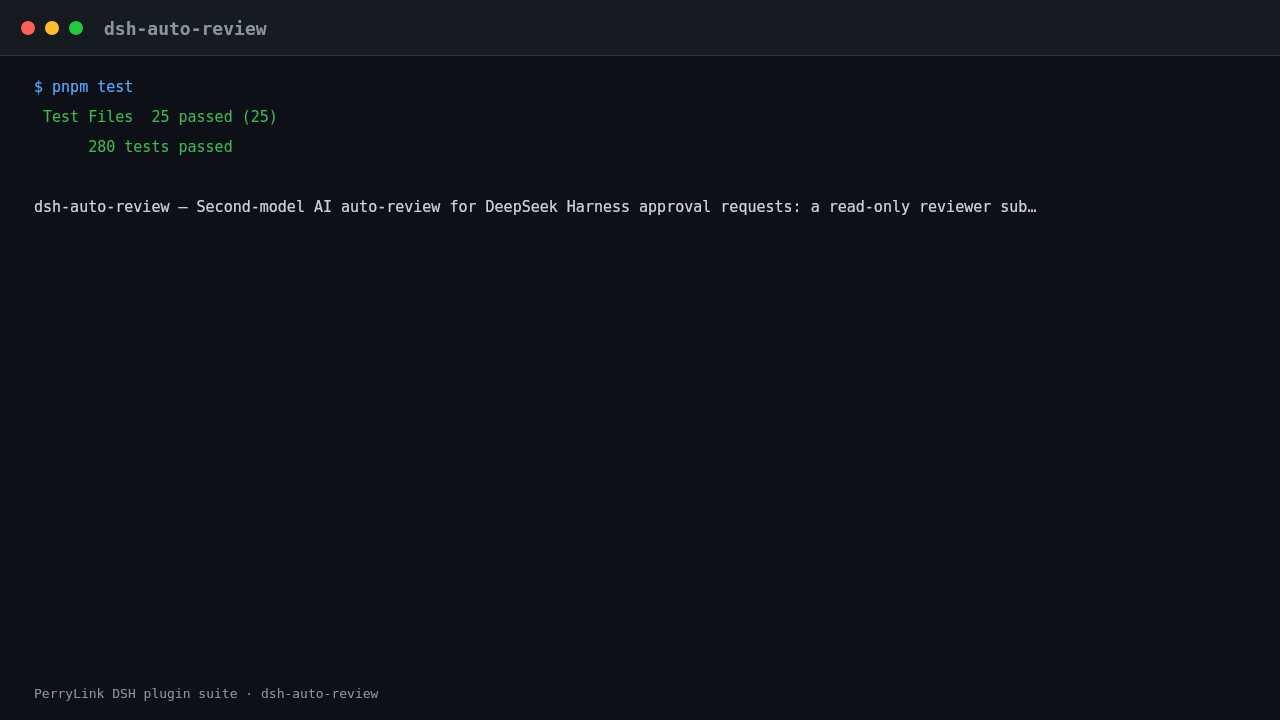

The same run, animated.
| Surface | Status |
|---|---|
| Harness | DeepSeek Harness dsh-v0.2.1-rc.2 (verified 2026-10-18): engines.dsh >=0.2.1-0 <0.3.0; the P0 compatibility paths have regression tests. |
| Node | ^22.19.0 || >=24.0.0 |
| Platforms | All (host answerer; optional Web review panel via the session-projection capability) |
| Model | Any (the reviewer inherits the session agent's route; reviewerModel overrides) |
dsh-auto-review puts a second model on the approval/request answerer chain:
ai policy) and delegates everything else via next(); the human approval flow is never short-circuited.read/glob/grep tool allow-list returns a structured verdict { decision, reason, riskLevel }. Reviewer asks are recognized by identity and delegated; maxDepth + the allow-list keep the reviewer non-delegating.fallbackPolicy (default rejected); a deny verdict feeds its reason back to the calling model.ai/human/never) plus regex risk rules, all changeable from cordis.yml.never-policy rejections inject auditable markers too ([auto-review] / [auto-review-fallback] / [auto-review-never]).autoReview/verdict + autoReview/rejection session events (envelope ignorable: true) plus an optional invariant companion enforcing marker ⟺ event./auto-review approve override, and a never-policy hard disable that explains itself to the model.contextBudget) plus a Codex-style Markdown ruling policy (reviewerPolicyText).Every decision reconstructs from the session log: approval/asked → autoReview/verdict (or autoReview/rejection) → approval/decided.
Pattern-based auto-approvers decide before dispatch, with no evidence. dsh-auto-review gives the decision to a reviewer subagent that reads the actual workspace (through its read-only tool face), the already-streamed tool-call arguments (sensitive values redacted), the request reason, and your risk rules — then returns a structured verdict. A deny verdict feeds its reason back to the calling model, so the agent learns why instead of retrying blindly.
dsh plugin --profile web add github:PerryLink/dsh-auto-review
# 1. install the bundle into your profile
dsh plugin --profile web add github:PerryLink/dsh-auto-review

# or from npm (published releases)
dsh plugin --profile web add dsh-auto-review

# 2. restart and verify the row
dsh --profile web --dump-config | grep -A4 'id: auto-review'
Out of the box the shipped patch AI-reviews bash and write; every other tool (including edit — in-place modification) delegates to the human chain. Add edit: ai explicitly if you accept in-place edits without a human in the loop.
All tunables are Schemastery Config fields (changeable from cordis.yml). An id-targeted override replaces the whole row — restate every key you need.
| Key | Default | Meaning |
|---|---|---|
enableByDefault | true | Sessions start with auto-review enabled; /auto-review on|off writes a durable override that beats this |
toolsPolicy.default | human | Policy for unlisted tools (delegate to the human answerer) |
toolsPolicy.overrides | {} | Per-tool policy: ai / human / never |
riskRules | [] | {pattern, policy, field?} matched before the tool table; field selects reason (default), toolName, or arguments |
reviewerProvider | fork | Subagent provider for the reviewer (in-process fork backend) |
reviewerPreset | (none) | Read-only Agent Preset id; required when the host exposes startActivation (0.2.1+) instead of toolFilter |
reviewerModel | (inherit) | Reviewer model id; unset inherits the session agent's route |
reviewerModelProvider | (inherit) | LLM provider route for reviewerModel; unset inherits the session agent's provider |
reviewerTimeoutMs | 60000 | Verdict deadline; on expiry the fallback policy applies |
reviewerTools | [read, glob, grep] | The reviewer child's tool allow-list (must be non-empty) |
fallbackPolicy | rejected | Reviewer failure: rejected (fail closed) / delegate / allow-once |
maxReviewsPerTurn | 10 | Real AI-verdict budget per open turn; beyond it, requests delegate |
maxFailuresPerTurn | 10 | Reviewer-failure budget per open turn |
reasonMaxChars | 2000 | Cap for reviewer reasons and the redacted argument preview |
reviewerGuidance | (none) | Optional advisory guidance appended to the reviewer prompt |
reviewerPolicyText | (none) | Markdown ruling policy injected into the reviewer prompt (Codex-style) |
denyGuidance | (anti-circumvention text) | Guidance appended to every injected deny reason |
contextBudget | {turns: 2, maxChars: 4000} | Compact transcript budget for the reviewer prompt (the open turn plus the one before it); turns: 0 disables the section — and a blind reviewer denies user-authorized actions, so the runtime warns when 0 meets an ai policy. The character budget is spent on the most recent lines |
riskPolicy | {maxAutoAllow: high, onHighRisk: delegate} | allow verdicts above maxAutoAllow delegate or deny |
circuitBreaker | {consecutiveDenies: 3, windowDenies: 6, windowSize: 10, action: delegate} | Rejection circuit breaker |
overrideTtlMs | 300000 | How long a /auto-review approve override stays usable |
verdictCacheTtlMs | 60000 | Reuse a recent verdict for an identical tool + arguments fingerprint; 0 disables the cache. Only applies with contextBudget.turns: 0 — a transcript-dependent verdict is not replayable from tool + arguments alone |
verdictCacheMaxEntries | 256 | Maximum cached fingerprints before oldest-eviction |
language | en | UI language of the /auto-review command output (en | zh) |
allowUnmarkedAudit | false | Force session-log audit on hosts that drop the ignorable marker or fail-closed on unknown event types (host 0.1.2-rc.1+) (dangerous: unmarked events make sessions unresumable elsewhere); default is detect-and-degrade (adapted 2026-09-02, re-verified against 0.1.5-rc.2 on 2026-09-11): the session envelope keeps its ignorable field for stored-log read compatibility only - Session.append still cannot stamp it, so audit-gate behavior is unchanged. |
Example (annotated full form: fixtures/config/config-full.yaml):
- insert:
    - id: auto-review
      name: dsh-auto-review
      config:
        toolsPolicy:
          overrides: { bash: ai, write: ai }
        riskRules:
          - pattern: '([Rr][Mm]\s+(-[a-z]+\s+)*/|[Gg][Ii][Tt]\s+push\s+--force)'
            policy: never
          - pattern: 'write'
            policy: never
            field: toolName
        reviewerTimeoutMs: 30000
        fallbackPolicy: delegate
        riskPolicy: { maxAutoAllow: medium, onHighRisk: delegate }
        circuitBreaker: { consecutiveDenies: 3, windowDenies: 6, windowSize: 10, action: delegate }
~/.dsh/settings.yaml is NOT a config source for this plugin. An auto-review: block there has no effect and produces no warning: like every DSH function plugin, dsh-auto-review receives its Config from the row the loader mounts it with — the profile's cordis patch layer. (Some other DSH plugins additionally read the settings service, so the inconsistency is easy to trip over, and the symptom is indistinguishable from the reviewer simply denying.)
Put the configuration in your profile's cordis.patch.yml. An id-targeted override replaces the whole config row, so restate every key you need — dropping toolsPolicy silently returns bash/write to the schema default human and the reviewer stops running at all:
- id: auto-review
  config:
    toolsPolicy:
      overrides: { bash: ai, write: ai }
    contextBudget: { turns: 4, maxChars: 8000 }
| Surface | Kind | Notes |
|---|---|---|
auto-review | answerer | approval/request waterfall answerer — claims ai-policy requests, delegates the rest via next() |
/auto-review | command | on|off|status|approve [n] — durable per-session override, budgets, and cumulative statistics |
| deny-reason injection | listener | tools/post-execute — verdict / fallback / never reasons fed back to the denied tool result |
autoReview | session projection | Folded from the log-only autoReview/* events |
| Web review panel | client | Session-header action: switch, budgets, statistics, recent verdicts, one-shot approve |
dsh-eval | CLI | YAML-driven agent evaluation engine (bin/dsh-eval.mjs) |
| invariant companion | invariant | dsh-auto-review/invariant (optional; needs the invariants service) |
/auto-review on|off|status|approve [n]
on/off append the durable autoReview/state override (the fold survives restart/resume — replay IS the state) and inject a switch notice the model sees (logged as a user/message event). status reports the effective state, both per-turn budgets (AI verdicts and reviewer failures), a tripped circuit breaker when one is active, and the session's cumulative statistics (allows/denies/fallbacks/never rejects, mean duration, recent verdicts). approve [n] records a single-use autoReview/override for the n-th most recent denial (1 = most recent): the next same-tool review within overrideTtlMs carries the authorization as reviewer context — the reviewer still decides, and the override is consumed by that review regardless of its outcome.
In the Web GUI (web profile), the package contributes a session-header action (AI Review) that opens a panel with the session's auto-review state: the switch with on/off buttons (they execute /auto-review on|off), both per-turn budgets, cumulative statistics (including hard-disable rejections and cache hits), the circuit trip, the recent verdicts, and one-shot approve buttons for recent denials (they execute /auto-review approve [n]).
How it is wired:
autoReview session projection (folded from the log-only autoReview/* events) and serves it through the session-projection channel.dsh.client declaration) registered on the conversation.session.header.actions seat.The panel reads only whole projection values — it never receives the raw session event stream.
                       approval/request waterfall (answerer chain)
                        │
┌───────────────────────┴──────────────────────┐
│ dsh-auto-review answerer                     │
│  · session enabled?  · policy = ai?         │   no ── next() ──▶ human answerer (UI)
│  · risk rules → toolsPolicy → default       │
└───────────────────────┬──────────────────────┘
                        │ yes
                        ▼
        ┌───────────────────────────────────┐
        │ reviewer subagent (fork, one-shot)│
        │  · toolFilter: read/glob/grep     │
        │  · outputSchema: {decision,       │
        │    reason, riskLevel}             │
        │  · timeout + req.signal abort     │
        └───────────────┬───────────────────┘
                        │ verdict / failure (fail-closed fallback)
                        ▼
 allow → allowed-once        deny → rejected + reason injected into the
                                       denied tool result (callId-linked)
                        │   never → rejected + [auto-review-never] feedback
                        │            (hard disable, no reviewer runs)
                        ▼
 audit: approval/asked → autoReview/verdict | autoReview/rejection
        → approval/decided (session events, log-only, invariant-checked)
Composition order. The answerer runs at its registration position in the waterfall: if a human UI answerer is composed BEFORE the auto-review row, humans answer first and the reviewer only sees what is delegated downstream. Verify with dsh --profile <name> --dump-config and place the auto-review row before your human answerer rows when you want ai-policy tools routed to the reviewer first.
Beyond the approval reviewer, dsh-auto-review ships dsh-eval: a YAML-driven agent evaluation platform that runs real headless DSH sessions (one isolated agent + scratch workspace per case, the official Minimal persona as the baseline system prompt), collects the tool-call trace from the session event log, and evaluates structured assertions plus an optional second-model review — the same reviewer seam as the approval answerer.
# eval/cases/demo.yaml (abridged)
suite:
  name: my-suite
  cases:
    - id: math-output
      input: Solve 17 × 24 and reply with only the final number, nothing else.
      expect:
        output: { contains: "408" }
    - id: glob-trace
      seedFrom: '.'
      input: Use the glob tool with pattern "src/**" to list the source files…
      expect:
        toolCalls: [{ tool: glob, arguments: { contains: { pattern: "src" } } }]
        results: [{ tool: glob, contains: "index.ts" }]
Run it (a DeepSeek API key must be in the environment):
dsh-eval eval/cases --model deepseek-flash --timeout-ms 240000 --out .eval-reports
The expect block supports six assertion families; each assertion is evaluated independently and reports its own pass/fail with expected/actual values, so a failing case explains itself without a rerun.
| Family | DSL keys | What it gates |
|---|---|---|
| Tool trace | toolCalls, toolCallsExact, noToolCalls, results | ordered tool-call sequence (subsequence with skips), exact name sequence, per-tool result (isError/contains/regex) |
| Output & budget | output, turnEnds, maxTokens | final-output substring/regex, turn outcome, token budget |
| Prompt regression | prompt | the rendered system prompt must match a committed baseline (or a baselineFrom file); any drift is reported as a side-by-side diff, with allowedChanges regexes to whitelist intended edits |
| Stress metrics | stress | P99 step latency (maxP99Ms), worst time-to-first-token (maxTtftMs), aggregate token generation speed (minTokensPerSecond) |
| Fairness | bias | bias radar over the final output: per-category regex counts (categories), hard forbid patterns, maxHits/maxCategoryHits caps |
| Second-model review | review | a supplementary pass/fail verdict from the reviewer subagent (a separate layer, same seam as the approval reviewer) |
- id: regression-gate
  input: Answer in one sentence.
  expect:
    prompt:
      baseline: "You are a helpful software engineer assistant."
      allowedChanges: ["copyright-year"]
    stress:
      maxP99Ms: 8000
      maxTtftMs: 3000
      minTokensPerSecond: 20
    bias:
      categories: { gender: ["[Hh]e is (un)?stable"] }
      forbid: ["[Ss]crew that"]
      maxCategoryHits: 0
CI gate: the process exits 0 only when every case of every suite passed — failing evaluations fail the build. Each case leaves a replayable session JSONL and a trace JSON beside report.md/report.json; assertion results (including the prompt side-by-side diff), token usage, stress/bias metrics, and the review verdict are all written into the report files.
- name: dsh-eval
  run: npx dsh-eval eval/cases --model deepseek-flash --timeout-ms 240000 --out .eval-reports
  env:
    DEEPSEEK_API_KEY: ${{ secrets.DEEPSEEK_API_KEY }}
dsh-eval differs from openai/codex-research: codex-research scores agent trajectories for research comparison; dsh-eval is a declarative pass/fail regression harness — YAML cases, structured trace/prompt/stress/bias assertions, an optional second-model review, and a CI exit code — for gating any DSH agent, not research ranking.
dsh-auto-review also ships a stdio MCP server (dsh-auto-review-mcp) so external MCP clients (Claude, Codex, …) can consume a deterministic review path without a harness. It speaks JSON-RPC 2.0 over newline-delimited JSON (NDJSON) — one JSON object per line, no Content-Length framing.
Boundary. The full reviewer needs the harness subagent seam and a second model, which a separate stdio process cannot reach. The standalone server is therefore deterministic rules + cache, no model review:
review_action reuses the same-fingerprint verdict cache (src/cache.ts) and the risk-rule / tool-policy resolution (src/config.ts): a never rule → deny; a cache hit on an identical tool + arguments fingerprint replays that verdict; anything else (ai needs a model, human needs a human) → fail-closed deny with reason: "standalone path, no model". It never allows an action a model did not already allow.cache_stats reports hit/store counts and the TTL status.| Tool | Purpose |
|---|---|
review_action | {tool, args?, reason?} → {decision, reason, riskLevel} — deterministic deny / cache replay |
cache_stats | {} → {hits, stores, size, ttlMs, enabled} |
Run it directly:
# risk rules come from environment variables
export DSH_AUTO_REVIEW_RISK_RULES='[{"pattern":"rm -rf","policy":"never","field":"arguments"}]'
node bin/dsh-auto-review-mcp.mjs
# or, after npm install: npx dsh-auto-review-mcp
Environment config: DSH_AUTO_REVIEW_RISK_RULES (JSON array of {pattern, policy, field?}), DSH_AUTO_REVIEW_TOOLS_POLICY (JSON {default?, overrides?}), DSH_AUTO_REVIEW_CACHE_TTL_MS, DSH_AUTO_REVIEW_CACHE_MAX_ENTRIES.
Claude Desktop (claude_desktop_config.json) example:
{
  "mcpServers": {
    "dsh-auto-review": {
      "command": "npx",
      "args": ["-y", "dsh-auto-review-mcp"],
      "env": {
        "DSH_AUTO_REVIEW_RISK_RULES": "[{\"pattern\":\"rm -rf\",\"policy\":\"never\",\"field\":\"arguments\"}]"
      }
    }
  }
}
The server is read-only and deterministic: no network, no model, no writes.
session:append, approval:answer, subagent:spawn, command:register, and tools:observe.autoReview/* events carry reviewer identity, verdict, reason, risk, and duration — appended with the envelope's ignorable: true marker so any build loads the log. Hosts whose Session.append predates the marker (every released rc line through 0.1.1-rc.2 — no release stamps it yet) are detected before the first append (peer-version pre-check); hosts 0.1.2-rc.1, 0.1.3-alpha.2, and 0.1.5-rc.2 keep the ignorable field on the envelope but Session.append offers no way to stamp it (its third parameter is SurfaceIntent for surface events only), and the persistence read path refuses unmarked unknown event types, so those lines — and unresolvable versions — also fail closed before any append. Audit then degrades to an in-memory mirror with marker-free feedback, so sessions stay loadable everywhere.human/never rules for irreversible operations.completed stop reason, missing/malformed verdict, audit-correlation failure) resolves through fallbackPolicy, default rejected — and the rejection feeds an auditable reason back to the model. allow-once grants unconditionally; it exists only for unattended deployments whose admin accepts that risk.toolFilter allow-list (read/glob/grep) cannot write, edit, run bash, fetch the network, or delegate (maxDepth = its own depth). Its session log is persisted and auditable.agent/pre-step seam: only its own prompt and its own read-only tool results enter them. Workspace instruction files (AGENTS.md / CLAUDE.md) and context-injecting plugins are dropped from the step this seam controls. The host's own runtime-context snapshot is re-admitted by the loop after agent/pre-step; the firewall does not remove it, so the reviewer sees it. This holds under EITHER subagent provider. The filter is an allow-list over message SOURCES, so a plugin that declares a new source kind is dropped too.token, password, api_key, Authorization, credentials, private keys …) before entering the reviewer prompt, and a free-form string argument additionally passes an inline heuristic that masks the KEY=VALUE / KEY: VALUE / --flag VALUE spellings and Bearer/Basic schemes — which is how a secret usually appears in a shell call. The plugin never executes the reviewed arguments. Both passes are best-effort, not a secret scanner: a bare secret with no key next to it stays visible, so do not AI-review tools whose argument values you cannot afford to show a model.never tool or risk rule rejects deterministically AND records a log-only autoReview/rejection event, then injects a [auto-review-never] marker into the denied tool result — the model learns the action is hard-disabled instead of retrying it (invariant-checked: marker ⟺ event).consecutiveDenies / windowDenies inside windowSize), recorded as a log-only autoReview/circuit event; later requests follow its action (delegate / reject / abort-turn).contextBudget feeds already-presented session content to the reviewer. With the default same-route reviewer model that content stays inside one provider; configure reviewerModel to a different provider only if you accept presenting that transcript to it.never is one-way at this layer. A never tool or risk rule rejects before the human chain sees the request — a lockdown knob, not a default.reviewerProvider: fork and reviewerProvider: spawn; the host runtime-context snapshot is re-admitted after the pre-step seam and is explicitly out of the firewall's claim — measured byte-identical across both on the same request. The agent/pre-step source filter closes the workspace/third-party half under either provider; it does not remove the host snapshot, which is re-admitted after the seam. spawn alone does NOT keep workspace instructions out of the reviewer. Separately, fork seeds the child with the delegating session's completed turns: that history is already the child's own log rather than a message entering a step, so the filter cannot touch it and only spawn avoids it, with the reviewer prompt's untrusted-transcript fence as the mitigation in between. In the two traces above the seeding produced no additional messages, so its practical impact is unquantified.fallbackPolicy — never a silent grant.reviewerTools names must exist as global tools in the profile; an unknown name fails the reviewer child loudly at the earliest point and falls back.reason, the toolName, or the redacted call arguments per their field; other conditions belong in toolsPolicy.overrides./auto-review approve override authorizes the next same-tool review, not the exact historical call; a different action on the same tool consumes it.autoReview projection (the raw event stream never reaches browser plugins).autoReview/state and autoReview/verdict are appended with the envelope's ignorable: true marker on hosts that honor it, so any harness build loads the log — readers that do not know the out-of-repo types simply skip those records. On released rc hosts (rc.1–rc.8) the runtime detects the dropped marker and never writes these events (the in-memory mirror keeps the command, budgets, breaker, and approve working for the session); sessions already polluted by pre-0.5.1 versions can be repaired with scripts/repair-session-logs.mjs from dsh-permission-rules (its default target set covers all five autoReview/* event types).allowBuilds key the dsh CLI prints for dsh-auto-review itself. The repo ships its own pnpm-workspace.yaml with allowBuilds: { esbuild: true }; typescript + tsdown are regular dependencies.invariants service (agent-spine compositions such as headless/ACP); the plain web profile does not provide it, so the row ships commented out in the bundle patch.tools/pre-execute waterfall with file-log audit. dsh-auto-review deliberately differs: official answerer chain, always delegates what it does not own, read-only second model with a structured verdict, deny reasons fed back to the model, session-log audit.dsh-auto-review is session- and tool-policy-scoped for the interactive harness; it never infers durable grants.pnpm install # node ^22.19 || >=24
pnpm run typecheck # tsc: src + tests against the local harness checkout
pnpm test # vitest: 25 spec files
pnpm run build # tsc declarations + tsdown bundles (lib/, incl. the client bundle)
pnpm run verify:self-contained
pnpm pack # the published tarball
Repository layout: src/index.ts (plugin contract) · src/config.ts (Schemastery schema + resolution) · src/runtime.ts (answerer, command, deny-reason injection) · src/review.ts (reviewer orchestration, prompt, sanitization) · src/events.ts (session-event vocabulary + folds) · src/audit.ts (host ignorable-marker capability detection) · src/projection.ts + src/projection-types.ts (the autoReview session projection) · src/invariant.ts (invariant companion) · src/eval/ (the dsh-eval engine) · eval/ (shipped evaluation composition) · bin/dsh-eval.mjs (CLI launcher) · src/client/ (browser half) · test/ · fixtures/.
Verified against DSH 0.2.0-rc.2 (the runtime this README ships for) and the high-star plugin set surveyed on 2026-10-05.
This plugin does not interfere with other plugins, including the widely installed high-star ones:
autoReviewRuntime; that key is not a built-in seam and is not provided by any surveyed high-star plugin.shadows-shipped-ui seat.webServer prefix.inserts its own row; it never overrides a built-in row's config.process.env, or replace the global fetch dispatcher.Shared event listeners are non-interfering by construction. It observes the ordering-sensitive events agent/pre-step, approval/request, tools/post-execute with ctx.on() — Cordis's broadcast registration, where every listener runs and none can starve another. Every listener here delegates through next(), so the chain is never short-circuited, and a mutation is applied to the value next() produced rather than returned in its place:
agent/pre-step — also used by dsh-routing-suite (7000★, 7 listeners), modlens (4122★), dsh-purge (3317★), dsh-agent-teams (1923★), dsh-context (1849★).tools/post-execute — also used by cc-safety-net (1576★).Static evidence: dsh-plugin-doctor K10–K13 report pass for every check on this repository.
deepseek-harness, dsh, dsh-plugin, cordis, approval, auto-review, second-model, ai-safety, sandbox, subagent
reviewerProvider / reviewerModel.This project is one of the 87 actively maintained DeepSeek Harness plugins from PerryLink. The family roster is 95 plugins in total — 5 frozen, 3 retired — and stays collapsed below so every README keeps a short first screen. Expand it to see every row, with the reason in the Status column.
| Plugin | One-liner | Status |
|---|---|---|
| dsh-aqua-input-check | 水产养殖投入品记录核对(按投入品用量、休药期与起捕间隔核对记录自洽,仅提示差异,不作出定性结论) | |
| dsh-archive-check | 档案归档完整性与保管期限核对(依据《档案法》及配套规定,仅提示差异,不作出定性结论) | |
| dsh-auto-review | Second-model auto-review on the approval chain, fail-closed by default | |
| dsh-autotier | Automatic strong/cheap model-tier routing with deterministic risk guards and a /tier command | |
| dsh-background-agents | Durable background child agents with a Web UI sidebar, messaging and interrupt | 🚫 RETIRED — see the repo README |
| dsh-bid-ca-precheck | 投标文件符合性预检(按招标文件逐条核对响应情况,仅提示差异,不作出定性结论) | |
| dsh-bid-qual-check | 投标人资格条件核对(按资格条件与证明材料核对逐条响应,仅提示差异,不作出定性结论) | |
| dsh-budget | Cost governance for DeepSeek Harness: budgets, carbon, and latency in one panel. | 🧊 FROZEN — see the repo README |
| dsh-cert-mcp | Read-only MCP server exposing the certification registry: grades, snapshots and five-dimension evidence | |
| dsh-checkpoint-rewind | Claude Code /rewind-equivalent: snapshots, session forks, one-shot restore | |
| dsh-claude-move | Migrate Claude Code sessions, memory, skills and CLAUDE.md into DSH | 🧊 FROZEN — see the repo README |
| dsh-click | Cross-platform native desktop control for DeepSeek Harness — Windows first. | |
| dsh-composer-history | Terminal-style input history for the web composer: arrows, Ctrl+R search | |
| dsh-contract-stance | 合同条款立场台账核对(按立场、风险等级与退让底线核对台账自洽,仅提示差异,不作出定性结论) | |
| dsh-customs-doc-check | 报关单证一致性核对(按公开的报关单填制规范核对单证间字段一致性,仅提示差异,不作出定性结论) | |
| dsh-data-quality | Dataset quality checks and citation cross-checks (the optional numeric bridge consumed here) | |
| dsh-defend | Prompt-injection, jailbreak, and secret-leak defense for DeepSeek Harness. | 🧊 FROZEN — see the repo README |
| dsh-demurrage-ledger | 滞箱费台账核对(按免箱期与费率核对超期天数与金额的自洽性,仅提示差异,不作出定性结论) | |
| dsh-doublecheck | Engineering-discipline guard: requirements grill, test gates, adversary review | |
| dsh-draw | Unified static-image generation routing for DeepSeek Harness. | 🧊 FROZEN — see the repo README |
| dsh-drill-script-check | 应急演练脚本核对(按阶段、响应分级、指挥与资源要素核对脚本齐备,仅提示差异,不作出定性结论) | |
| dsh-eia-guide-check | 环评导则适用性核对(按要素、导则名称与执行标准核对台账自洽,仅提示差异,不作出定性结论) | |
| dsh-emergency-plan | 应急预案要素齐备性与条款级页码定位(依据 GB/T 29639-2020 等公开文件,仅提示差异,不作出定性结论) | |
| dsh-essay-rubric-check | 作文量表评分核对(按评分项、原文定位与分值算术核对评分自洽,仅提示差异,不作出定性结论) | |
| dsh-evidence-check | 证据清单齐备性核对(按待证事实与证据要素核对清单自洽,仅提示差异,不作出定性结论) | |
| dsh-export-ctl-check | 出口管制物项核对(按管制清单、最终用途与许可证核对台账齐备,仅提示差异,不作出定性结论) | |
| dsh-fast | Read-only performance diagnostics for DeepSeek Harness. | |
| dsh-fmea-table-check | FMEA 分析表要素齐备性与风险顺序数一致性核对(按公开的 FMEA 方法标准核对表内自洽,仅提示差异,不作出定性结论) | |
| dsh-forecast-penalty | 预测准确率考核核对(按准确率、门槛与考核单价核对考核费用的算术自洽,仅提示差异,不作出定性结论) | |
| dsh-fund-research | Deterministic research reports for Chinese public mutual funds | |
| dsh-github | GitHub PR/issues integration for DSH, every write gated by approval | |
| dsh-gongwen-flow-check | 公文流转与办理时限核对(按公开的公文处理规范核对环节完整性与时限,仅提示差异,不作出定性结论) | |
| dsh-gongwen-word-check | 公文格式要素核对(按公开的党政机关公文格式标准核对版头与主体要素,仅提示差异,不作出定性结论) | |
| dsh-guard-plan-qc | 劳动保护与安全防护用品配置表核对(按公开的配备标准核对品名规格与配置数量,仅提示差异,不作出定性结论) | |
| dsh-hazchem-check | 危险化学品临界量与重大危险源辨识核对(按储存量与临界量核对台账自洽,仅提示差异,不作出定性结论) | |
| dsh-hazplan-check | HAZOP 分析表要素齐备性与偏差推导一致性核对(依据公开的危险与可操作性分析标准,仅提示差异,不作出定性结论) | |
| dsh-hidden-risk-map | 安全隐患台账→《工贸企业重大事故隐患判定标准》(应急管理部令第10号)条款映射提示(仅提示差异,不作出定性结论) | |
| dsh-hs-classify | 商品归类层级一致性核对(按章、品目、子目与商品编号的层级关系核对自洽,仅提示差异,不作出定性结论) | |
| dsh-icd-rule-check | ICD 合并编码与星剑号配对提示(依据 GB/T 14396-2016 与公开的 ICD 使用说明,仅提示差异,不作出定性结论) | |
| dsh-industry-research | Industry research orchestration that seals its deliverables through this plugin's ctx.researchReport.assemble | |
| dsh-lawcite-adapter | 法条引用与文书要素核对(按名称、条号、原文与效力状态核对引用可核验性,仅提示差异,不作出定性结论) | |
| dsh-laya | Laya typed decisions (noul/choice/score) as a first-class Cordis service and model-visible tools | |
| dsh-lc-doc-check | 信用证单据条款核对(按单据种类、份数、期限与不符点核对交单自洽,仅提示差异,不作出定性结论) | |
| dsh-learning-gap-check | 能力差距与培养计划核对(按能力等级差、培养措施与完成期限核对台账闭环,仅提示差异,不作出定性结论) | |
| dsh-library | Local document knowledge base for DeepSeek Harness. | |
| dsh-local-ai | Local-model (Ollama) integration for DeepSeek Harness. | |
| dsh-lsp-actions | LSP diagnostics, formatting, completion, code actions and rename over language servers | |
| dsh-mask | PII masking middleware: anonymize at the model boundary, restore at the display layer | |
| dsh-mcp-panel | Read-only MCP runtime panel: /mcp command + Settings tab with status, tools and errors | |
| dsh-medrec-qc | 病案首页形式质控与逻辑矛盾提示(依据国卫办医发〔2016〕24号等公开文件,仅提示差异,不作出定性结论) | |
| dsh-memento | Approval-gated cross-session memory: ctx.memory seam + SQLite + memory tool | |
| dsh-nsfc-form-check | 国家自然科学基金申请书形式审查与匿名化提示(依据《国家自然科学基金条例》与申请人导入的当年指南,仅提示差异,不作出定性结论) | |
| dsh-nurse-record-check | 护理记录时限、签名与评估表完整性校验(依据《病历书写基本规范》等公开文件,仅提示差异,不作出定性结论) | |
| dsh-observe | OpenTelemetry and Langfuse observability exporter for DeepSeek Harness. | |
| dsh-origin-rvc-check | 原产地区域价值成分核对(按 RVC 定义式与门槛核对原产地判定自洽,仅提示差异,不作出定性结论) | |
| dsh-ota-review-check | 在线点评回复台账核对(按回复时限、问题分类与整改状态核对台账闭环,仅提示差异,不作出定性结论) | |
| dsh-output-styles | Claude Code outputStyles-equivalent runtime style switching | |
| dsh-paper-doc-adapter | 试卷解析结构核对(按题型、答案、分值与 yotta 标识核对试卷结构自洽,仅提示差异,不作出定性结论) | |
| dsh-permission-rules | Claude Code-style declarative allow/deny/ask permission rules with audit | |
| dsh-permit-report-check | 行政许可办理核对(按申请材料、法定时限与决定记录核对台账闭环,仅提示差异,不作出定性结论) | |
| dsh-pipeline-check | 项目全流程文件链条核对(按环节先后与金额口径核对链条自洽,仅提示差异,不作出定性结论) | |
| dsh-pleading-draft | 起诉状要素齐备性核对(按诉请、事实、证据、法条四要素核对文书齐备,仅提示差异,不作出定性结论) | |
| dsh-plugin-doctor | Zero-dependency static + sandbox smoke detector for DSH plugins | |
| dsh-plugin-guide | Plugin-development knowledge base as an on-demand agent skill | |
| dsh-plugin-kit | Shared zero-runtime-dependency toolkit for the PerryLink DSH plugins | |
| dsh-plugin-upgrade | One-package, one-corridor-index plugin upgrade skill: routes a repository to the matching closed corridor card | |
| dsh-policy-brief-draft | 政策专报要素核对(按观点、依据、出处与建议核对专报齐备,仅提示差异,不作出定性结论) | |
| dsh-power-loss-split | 线损电量拆分与考核表核对(依据公开的线损计算口径,仅提示差异,不作出定性结论) | |
| dsh-power-ticket-check | 电力工作票要素齐备性与签发许可顺序核对(依据现行电力安全工作规程,仅提示差异,不作出定性结论) | |
| dsh-ppap-check | PPAP 提交要素齐备性核对(按公开的 PPAP 手册与提交等级核对要素齐备与版本填写,仅提示差异,不作出定性结论) | |
| dsh-protest-deadline | 质疑与投诉期限核对(按公开的政府采购质疑投诉规定核对期限与台账自洽,仅提示差异,不作出定性结论) | |
| dsh-railway-window | 铁路施工天窗台账核对(按时间窗、时长算术与命令号核对台账自洽,仅提示差异,不作出定性结论) | |
| dsh-reach | Multi-channel approval/question bridge: WeChat/Telegram/Feishu, session console | 🧊 FROZEN — see the repo README |
| dsh-repair-order-qc | 维修工单结算核对(按项目金额、配件工时合计与结算总额核对算术自洽,仅提示差异,不作出定性结论) | |
| dsh-research-report | Verifiable research-report engine: content-addressed evidence ledger and sealed versions | |
| dsh-review-reply-check | 审稿意见逐条回应覆盖核对(按意见与回应一一对应核对覆盖完整性,仅提示差异,不作出定性结论) | |
| dsh-rulefile-check | 规则库文件自检核对(按条款引用纪律与效力上限核对规则库自身合规,仅提示差异,不作出定性结论) | |
| dsh-safety-brief-check | 安全技术交底记录要素齐备性与签字闭环核对(依据公开的安全生产法规与检查标准,仅提示差异,不作出定性结论) | |
| dsh-score | Multi-dimensional quality scoring for DeepSeek Harness plugins. | |
| dsh-session-pin | Pin sessions in the Web sidebar with durable ordering | 🚫 RETIRED — see the repo README |
| dsh-session-sync | Cross-device session sync for DeepSeek Harness — a dedicated git mirror of your session store. | |
| dsh-site-log-check | 监理日志跨日连续性与旁站覆盖提示(依据 GB/T 50319-2013 等公开文件,仅提示差异,不作出定性结论) | |
| dsh-skill-pack-security | Security-audit skill pack: secret scan, dependency and supply-chain review | |
| dsh-soe-decision-check | 三重一大决策台账核对(按前置研究、会议审议与决议记录核对程序留痕,仅提示差异,不作出定性结论) | |
| dsh-soilwater-check | 土壤与地下水监测台账核对(按点位、监测项目、限值与超标判定核对台账自洽,仅提示差异,不作出定性结论) | |
| dsh-sop-sync-check | 作业规程与 FMEA/控制计划一致性核对(按编号与版本核对三份文件是否同步,仅提示差异,不作出定性结论) | |
| dsh-spc-gbt-adapter | 控制图常数与过程能力指数核对(按 GB/T 4091 的常规控制图常数表核对控制限与 Cp/Cpk 的自洽性,仅提示差异,不作出定性结论) | |
| dsh-talk | Voice-first session loop for DeepSeek Harness: talk to it, hear it answer. | |
| dsh-team-rooms | Cross-session team rooms: shared message bus, task board and timeline | 🚫 RETIRED — see the repo README |
| dsh-tender-extract | 招标文件条款摘录核对(按出处与原文逐字核对摘录完整性,仅提示差异,不作出定性结论) | |
| dsh-tender-matrix | 评标因素评分矩阵核对(按分值上限与合计核对矩阵自洽,仅提示差异,不作出定性结论) | |
| dsh-test-drive | Isolated install-and-smoke test drives for DeepSeek Harness plugins. | |
| dsh-ticktick | TickTick/Dida365 task bridge: session-header panel + 11 tools | |
| dsh-translate | Vendor parameter translation and deterministic JSON repair for DeepSeek Harness. | |
| dsh-warranty-calc | 质保期与索赔金额核对(按质保期月数与里程、索赔金额算式核对自洽,仅提示差异,不作出定性结论) |
All PerryLink plugins are browsable in the built-in DSH Desktop Market: Market → Sources → add source → paste https://perrylink-dsh-catalog.perrylink.workers.dev/catalog-source.json → select it. Installation still goes through the Market's npm-identity verification and your confirmation.
Apache License 2.0 © 2026 dsh-auto-review contributors
FAQs
Second-model AI auto-review for DeepSeek Harness approval requests: a read-only reviewer subagent decides allow/deny on the approval answerer chain, with fail-closed fallback and full session-log audit.
The npm package dsh-auto-review receives a total of 337 weekly downloads. As such, dsh-auto-review popularity was classified as not popular.
We found that dsh-auto-review demonstrated a healthy version release cadence and project activity because the last version was released less than a year ago. It has 1 open source maintainer collaborating on the project.
Security News
Cloudflare is acquiring Deno’s team, which will provide another year of bug fixes and security updates before ending support for the runtime.

Security News
Anthropic’s free OSS Scanner uses Mythos and other Claude models to find open source vulnerabilities and send maintainers reports with proposed fixes.

Security News
On Front Lines’ Early Adopters: CISO podcast, Andrew Becherer shares lessons from Datadog, weighs the long-term costs of AI-built tools, and explains how founders can actually gain a CISO’s trust.