

Security News
Deno Goes the Way of the Dinosaur
Cloudflare is acquiring Deno’s team, which will provide another year of bug fixes and security updates before ending support for the runtime.
By Sarah Gooding - Oct 16, 2026
dsh-autotier
Advanced tools
Automatic strong/cheap model-tier routing for DeepSeek Harness: intent-gated tier landing on the agent/request waterfall, plan-mode handoff (strong plans, cheap implements), deterministic high-risk guards on tools/pre-execute, failure escalation with TTL
English | 简体中文 | Español | Português | हिन्दी
Automatic model-tier routing for DeepSeek Harness: one user instruction enters, one tier decision comes out — no manual model switching.







Complex intent (architecture, planning, debugging, multi-step engineering) is planned on the strong tier and then implemented on the cheap tier. Simple intent (questions, retrieval, batch chores, daily work) is designed and implemented on the cheap tier directly. While the cheap tier executes, high-risk tool calls are denied by a deterministic guard, and repeated failures escalate to the strong tier with a TTL fallback.
dsh-autotier (bare, unscoped)📖 Ecosystem knowledge base — measured data, not marketing: plugin development guide · plugin-selection data · maintenance criteria.
这个插件是 DSH 插件家族的一员(40+ 个,全部 Apache-2.0)。如果你在用,给个 star —— 它不会解锁任何功能,但会让下一个人在搜索里更容易找到它。
English: part of a 40+ plugin family for DeepSeek Harness. If it is useful, a star helps the next person find it — nothing is gated behind it.
npm channel
git channel
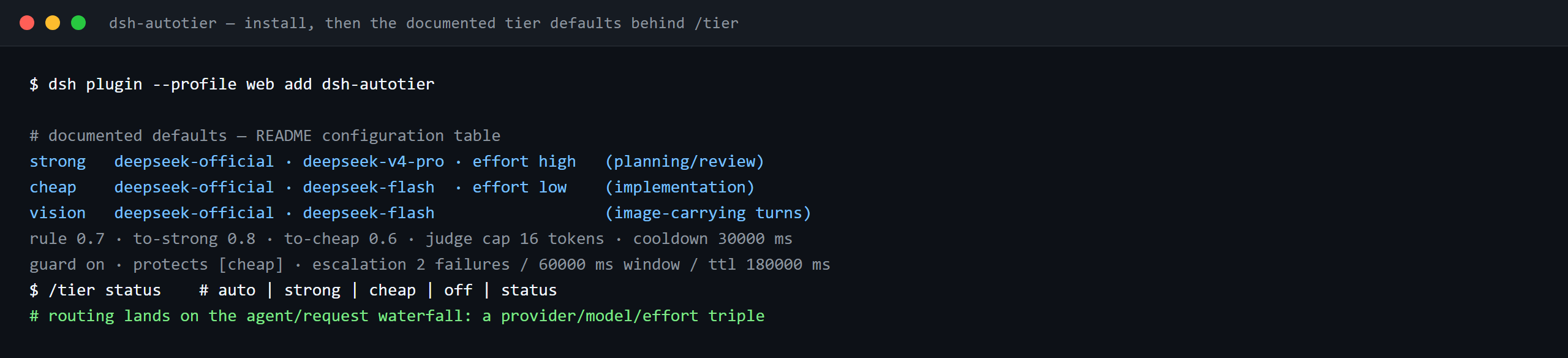

The same run, animated.
| Harness | Status |
|---|---|
@deepseek-ai/dsh 0.1.2-rc.1 | no longer supported; that line predates the SettingsForms contract this plugin now targets |
@deepseek-ai/dsh 0.1.5-rc.2 | no longer supported; the settings.register / settings/updated contract it exposes was removed upstream |
@deepseek-ai/dsh 0.1.6-alpha.2 | no longer supported; same removal, first line to ship SettingsForms |
@deepseek-ai/dsh 0.1.7-rc.2 | required; verified against the matching checkout (typecheck) and the published packages (typecheck:ci, 214 tests) |
@deepseek-ai/cordis ^4.0.3, @deepseek-ai/cosmokit ^1.8.4, @deepseek-ai/schemastery ^3.18.3 | peer baseline |
Peer ranges name all published lines explicitly (>=0.1.6-0 <0.2.0 || >=0.2.0-0 <0.3.0 || >=0.2.1-0 <0.3.0), because a semver range whose only prerelease
comparator sits on an earlier version tuple does not admit a later alpha.
They are refreshed per published wave. The declared range is deliberately wider
than the verified one: it documents what the manifest accepts, not what has been
tested.
This release is a breaking adaptation. The 0.1.6-generation harness
removed the settings provider seam this plugin was built on: the
@deepseek-ai/dsh-settings-file package is gone, ctx.settings is now
SettingsForms (a schema→form projector, with no register), and
settings/updated no longer exists. There is no shared surface that lets one
plugin observe another plugin's settings document, so no version of this plugin
can support both contracts at once. Configuration now flows through the host's
volatile-config mechanism, and the per-session routing mode — the setting that
actually changes behaviour at runtime — is unchanged.
The plugin is host-plane only. It needs no agent preset of its own: the host row applies to every session. A one-line prompt section in your preset is optional and only makes the router's decisions visible to the model (see Install & uninstall).
agent/request waterfall by returning a replacement provider/model/effort
triple. Sampling scalars the session already chose (temperature, maxTokens,
stop) are preserved.rm -rf, sudo, mkfs, git push --force, credential-file writes, …) are
denied with a corrective message telling the model to escalate instead./tier auto|strong|cheap|off and the
tier_status / tier_route tools. Setting routingMode: delegated (or
/tier off) stops routing for a session that must keep its own model.ctx.autotier service — a small read surface (status) plus the
autotier/route veto waterfall and autotier/tier-changed event, so other
plugins can observe or override a decision.dsh plugin --profile web add github:PerryLink/dsh-autotier
dsh plugin --profile web add dsh-autotier
npm i -g dsh1024
dsh1024 plugin --profile web add dsh-autotier
Then start (or restart) the harness. The row is appended to your profile's
cordis.patch.yml; routing starts on the next turn with no further setup.
npm channel
dsh plugin --profile web add dsh-autotier
npm i -g dsh1024
dsh1024 plugin --profile web add dsh-autotier
git channel
dsh plugin --profile web add github:PerryLink/dsh-autotier
git clone https://github.com/PerryLink/dsh-autotier.git
cd dsh-autotier && pnpm install && pnpm run build
dsh plugin --profile web add .
Optional preset prompt section. The router works without it. To let the
model know which tier it is running on, add one row to your agent preset
(docs/preset-row.md has the exact block):
- insert:
    - id: autotier-prompt
      name: '@deepseek-ai/dsh-system-prompt'
      # sections: [...]  — see docs/preset-row.md
Uninstall
dsh plugin --profile web remove dsh-autotier
The row, its command, its tools and its listeners are all removed with the plugin. Configuration a user saved through the Plugins page lives in the active profile patch and belongs to that profile, not to this plugin; removing the row leaves it there untouched.
Every key is validated at load time; an invalid value fails loudly instead of
silently disabling routing. cordis.patch.yml in this repository documents the
same keys inline.
| Key | Default | Meaning |
|---|---|---|
tiers.strong.provider | deepseek-official | Provider for the planning/review tier. |
tiers.strong.model | deepseek-v4-pro | Catalog id of the strong model. |
tiers.strong.effort | high | Adapter vocabulary off | low | high | max. |
tiers.strong.followSession | false | false = this tier's effort overrides the session's. |
tiers.strong.fallback | [] | Ordered provider/model landings when the tier is unavailable. |
tiers.cheap.provider | deepseek-official | Provider for the implementation tier. |
tiers.cheap.model | deepseek-flash | Catalog id of the cheap model. |
tiers.cheap.effort | low | Adapter vocabulary off | low | high | max. |
tiers.cheap.followSession | true | true = inherit the session's effort so an explicit choice wins. |
tiers.cheap.fallback | [] | Ordered provider/model landings when the tier is unavailable. |
tiers.vision.provider | deepseek-official | Provider for image-carrying turns. |
tiers.vision.model | deepseek-flash | The catalog's image-capable model. |
intent.ruleThreshold | 0.7 | Confidence at or above which the rule layer decides alone. |
intent.attemptBand.enabled | false | Start the middle band on the cheap tier and escalate on a signal. |
intent.attemptBand.tauLow | 0.45 | Lower bound of the attempt-first band. |
intent.hysteresis.toStrong | 0.8 | Score that switches a cheap turn to strong. |
intent.hysteresis.toCheap | 0.6 | Score below which a strong turn returns to cheap. |
intent.rules | [] | Declarative rule table (when.patterns / when.tools / when.cwd, tier, priority). |
intent.judge.enabled | true | Allow the low-confidence judge. |
intent.judge.model | '' | Judge model id; empty = first catalog model containing flash. |
intent.judge.temperature | 0 | Judge sampling temperature. |
intent.judge.maxTokens | 16 | Judge output cap (it answers with one word). |
intent.judge.cooldownMs | 30000 | Minimum gap between two judge calls. |
intent.judge.timeoutMs | 2000 | Judge call timeout. |
intent.judge.unavailableSkip | 2 | Consecutive judge failures after which the turn skips it. |
intent.scenarios | all true | Per-scenario switches: coding, review, planning, retrieval, batch, daily, longText, multimodal. |
intent.costMode | balanced | Ambiguity arbitration: cost-first | quality-first | balanced. |
guard.enabled | true | Enable the deterministic high-risk guard. |
guard.tiers | [cheap] | Tiers the guard protects. |
guard.whitelist | [] | Commands, tools or path prefixes that never trip the guard. |
guard.protectedPaths | ['.dsh','AGENTS.md','package.json','.github/workflows'] | Self-modification surfaces that force strong-tier review. |
guard.interopDefend | auto | Relationship with dsh-defend: auto audits coexistence, none stays silent. |
escalation.threshold | 2 | Failures within the window that raise the tier. |
escalation.windowMs | 60000 | Failure-counting window. |
escalation.ttlMs | 180000 | How long an escalation stays in effect. |
escalation.fallbackTtlMs | 300000 | TTL used after a fallback landing was taken. |
escalation.signature | true | Count same-signature recurrences instead of every failure. |
routingMode | auto | auto | strong | cheap | delegated | off. |
All keys can also be edited live from the plugin's card on the Plugins page; the
Host validates the new value against the schema and commits it with
loader/volatile-update, and this plugin then re-judges the whole configuration
through the same cross-field judge the mount path uses. A value that violates a
cross-field requirement (two tiers landing on the same route, a hysteresis pair
that cannot stop flapping, a rule with neither a pattern nor a tool) leaves the
last good policy routing instead of swapping in something unroutable.
routingMode is the one key that is not live: it is the composition
default, and the runtime switch is the session-scoped override written by
/tier, the composer pill and the card's selector. Making it live as well would
give the same behaviour two owners.
| Surface | Kind | Purpose |
|---|---|---|
/tier | command | auto | strong | cheap | off | status; session-scoped override. |
tier_status | tool | Current tier, mode, escalation TTL and guard state. |
tier_route | tool | Route one intent string without sending a request (dry run). |
ctx.autotier | service | status() read surface for other plugins. |
autotier/route | serial event | Third parties may veto a proposed tier. |
autotier/tier-changed | emit event | Observability when the effective tier changes. |
ctx.llm path and the configured provider.autotier/tier-changed bus event;
the only append it makes is the plan/mode fallback when the plan-mode
service is absent. Custom event types are fail-closed on 0.1.2-alpha.1 and
later, so no durable plugin-owned record is written.dsh-defend, the approval service,
or the sandbox policy. Keep those enabled.guard.tiers (cheap by default).
A strong-tier turn is not blocked by design: the strong model is the reviewer./tier off disables routing entirely; the harness then behaves exactly as it
did before the plugin was installed.auto.docs/supporting-lanes.md).followSession: true on the cheap tier means an explicit session model choice
wins; in that case the cheap tier cannot force its own model.agent-default-model document, so switching models there does
not by itself stop routing — use routingMode: delegated or /tier off.intent.attemptBand.enabled
stays false until the calibration corpus and its metric gate land (v0.2).pnpm install
pnpm run typecheck # against the local harness checkout type faces
pnpm run typecheck:ci # against the published 0.1.7-rc.2 faces (what CI runs)
pnpm test
pnpm run build
pnpm run verify:self-contained
pnpm run verify:artifacts
pnpm pack
pnpm run build emits lib/types (tsc declarations) and lib/index.js
(tsdown bundle). Tests use the published host packages directly — real
Context, real session/tools/commands services — plus one real Loader
composition over a temporary cordis.yml. The settings service is the one
stand-in: the host's real SettingsForms binds to configEditor,
profileContext and the Loader's fiber graph, none of which this plugin
consumes, while the plugin's whole contract with it is configure({ auto })
plus the Loader's loader/volatile-update event.
Verified against DSH 0.2.0-rc.2 (the runtime this README ships for) and the high-star plugin set surveyed on 2026-10-05.
This plugin does not interfere with other plugins, including the widely installed high-star ones:
autotier; that key is not a built-in seam and is not provided by any surveyed high-star plugin.shadows-shipped-ui seat.webServer prefix.inserts its own row; it never overrides a built-in row's config.process.env, or replace the global fetch dispatcher.Shared event listeners are non-interfering by construction. It observes the ordering-sensitive events agent/created, agent/request, agent/request-error, tools/pre-execute with ctx.on() — Cordis's broadcast registration, where every listener runs and none can starve another. Every listener here delegates through next(), so the chain is never short-circuited, and a mutation is applied to the value next() produced rather than returned in its place:
agent/request — also used by dsh-agent-teams (1923★), which short-circuits by throwing without calling next().tools/pre-execute — also used by cc-safety-net (1576★).Static evidence: dsh-plugin-doctor K10–K13 report pass for every check on this repository.
dsh, dsh-plugin, deepseek-harness, deepseek, cordis, router,
model-tier, cost, auto.
PerryLink. Issues and pull requests are welcome at https://github.com/PerryLink/dsh-autotier/issues.
Applicable DSH version: verified against dsh-v0.2.1-alpha.1 (the host release this build targets); requires >=0.1.7-alpha.1 <0.2.0.
This project is one of the 33 actively maintained DeepSeek Harness plugins from PerryLink — the roster is 42, of which 6 are frozen and 3 retired; every one keeps its row below, with the reason in the Status column. If this one helps you, the others likely will too:
| Plugin | One-liner | Status |
|---|---|---|
| dsh-auto-review | Second-model auto-review on the approval chain, fail-closed by default | |
| dsh-autotier | Automatic strong/cheap model-tier routing with deterministic risk guards and a /tier command | |
| dsh-background-agents | Durable background child agents with a Web UI sidebar, messaging and interrupt | 🚫 RETIRED — see the note above |
| dsh-budget | Cost governance for DeepSeek Harness: budgets, carbon, and latency in one panel. | 🧊 FROZEN — see the repo README |
| dsh-catalog | DSH Desktop Market standard catalog source for the PerryLink family | |
| dsh-cert-mcp | Read-only MCP server exposing the certification registry: grades, snapshots and five-dimension evidence | |
| dsh-checkpoint-rewind | Claude Code /rewind-equivalent: snapshots, session forks, one-shot restore | |
| dsh-claude-move | Migrate Claude Code sessions, memory, skills and CLAUDE.md into DSH | 🧊 FROZEN — see the repo README |
| dsh-click | Cross-platform native desktop control for DeepSeek Harness — Windows first. | |
| dsh-composer-history | Terminal-style input history for the web composer: arrows, Ctrl+R search | |
| dsh-data-quality | Dataset quality checks and citation cross-checks (the optional numeric bridge consumed here) | |
| dsh-defend | Prompt-injection, jailbreak, and secret-leak defense for DeepSeek Harness. | 🧊 FROZEN — see the repo README |
| dsh-doublecheck | Engineering-discipline guard: requirements grill, test gates, adversary review | |
| dsh-draw | Unified static-image generation routing for DeepSeek Harness. | 🧊 FROZEN — see the repo README |
| dsh-fast | Read-only performance diagnostics for DeepSeek Harness. | |
| dsh-fund-research | Deterministic research reports for Chinese public mutual funds | |
| dsh-github | GitHub PR/issues integration for DSH, every write gated by approval | |
| dsh-industry-research | Industry research orchestration that seals its deliverables through this plugin's ctx.researchReport.assemble | |
| dsh-laya | Laya typed decisions (noul/choice/score) as a first-class Cordis service and model-visible tools | |
| dsh-library | Local document knowledge base for DeepSeek Harness. | |
| dsh-local-ai | Local-model (Ollama) integration for DeepSeek Harness. | |
| dsh-lsp-actions | LSP diagnostics, formatting, completion, code actions and rename over language servers | |
| dsh-mask | PII masking middleware: anonymize at the model boundary, restore at the display layer | |
| dsh-mcp-panel | Read-only MCP runtime panel: /mcp command + Settings tab with status, tools and errors | |
| dsh-memento | Approval-gated cross-session memory: ctx.memory seam + SQLite + memory tool | 🧊 FROZEN — see the repo README |
| dsh-observe | OpenTelemetry and Langfuse observability exporter for DeepSeek Harness. | |
| dsh-output-styles | Claude Code outputStyles-equivalent runtime style switching | |
| dsh-permission-rules | Claude Code-style declarative allow/deny/ask permission rules with audit | |
| dsh-plugin-certification | Community certification registry with repro-checkable grades and badges | |
| dsh-plugin-doctor | Zero-dependency static + sandbox smoke detector for DSH plugins | |
| dsh-plugin-guide | Plugin-development knowledge base as an on-demand agent skill | |
| dsh-plugin-kit | Shared zero-runtime-dependency toolkit for the PerryLink DSH plugins | |
| dsh-plugin-upgrade | One-package, one-corridor-index plugin upgrade skill: routes a repository to the matching closed corridor card | |
| dsh-plugin-upgrade-015 | Merged 0.1.3-alpha.1 → 0.1.5-rc.1 upgrade corridor card plus a zero-dependency seam scanner | 🚫 RETIRED — corridors carried by dsh-plugin-upgrade |
| dsh-reach | Multi-channel approval/question bridge: WeChat/Telegram/Feishu, session console | 🧊 FROZEN — see the repo README |
| dsh-research-report | Verifiable research-report engine: content-addressed evidence ledger and sealed versions | |
| dsh-score | Multi-dimensional quality scoring for DeepSeek Harness plugins. | |
| dsh-session-pin | Pin sessions in the Web sidebar with durable ordering | 🚫 RETIRED — see the note above |
| dsh-session-sync | Cross-device session sync for DeepSeek Harness — a dedicated git mirror of your session store. | |
| dsh-skill-pack-security | Security-audit skill pack: secret scan, dependency and supply-chain review | |
| dsh-talk | Voice-first session loop for DeepSeek Harness: talk to it, hear it answer. | |
| dsh-team-rooms | Cross-session team rooms: shared message bus, task board and timeline | 🚫 RETIRED — see the note above |
| dsh-test-drive | Isolated install-and-smoke test drives for DeepSeek Harness plugins. | |
| dsh-ticktick | TickTick/Dida365 task bridge: session-header panel + 11 tools | |
| dsh-translate | Vendor parameter translation and deterministic JSON repair for DeepSeek Harness. |
Apache-2.0. See LICENSE and THIRD_PARTY_NOTICES.md.
FAQs
Automatic strong/cheap model-tier routing for DeepSeek Harness: intent-gated tier landing on the agent/request waterfall, plan-mode handoff (strong plans, cheap implements), deterministic high-risk guards on tools/pre-execute, failure escalation with TTL
The npm package dsh-autotier receives a total of 0 weekly downloads. As such, dsh-autotier popularity was classified as not popular.
We found that dsh-autotier demonstrated a healthy version release cadence and project activity because the last version was released less than a year ago. It has 1 open source maintainer collaborating on the project.
Security News
Cloudflare is acquiring Deno’s team, which will provide another year of bug fixes and security updates before ending support for the runtime.

Security News
Anthropic’s free OSS Scanner uses Mythos and other Claude models to find open source vulnerabilities and send maintainers reports with proposed fixes.

Security News
On Front Lines’ Early Adopters: CISO podcast, Andrew Becherer shares lessons from Datadog, weighs the long-term costs of AI-built tools, and explains how founders can actually gain a CISO’s trust.