


Security News
Deno Goes the Way of the Dinosaur
Cloudflare is acquiring Deno’s team, which will provide another year of bug fixes and security updates before ending support for the runtime.
By Sarah Gooding - Oct 16, 2026
dsh-observe
Advanced tools
OpenTelemetry and Langfuse observability exporter for DeepSeek Harness: turn/step/tool/LLM spans, token and cost metrics, and sanitized LLM prompt/completion capture from the session/event stream, with async batching, bounded offline buffering, and retry
npm i -g dsh1024 once, then dsh1024 plugin --profile web add dsh-observe (counts toward the deepseek1024.com install ranking).

OpenTelemetry and Langfuse observability exporter for DeepSeek Harness.
Turn session events into OTLP traces and Langfuse observations — sanitized, buffered, off by default.








📖 Ecosystem knowledge base — measured data, not marketing: plugin development guide · plugin-selection data · maintenance criteria.
这个插件是 DSH 插件家族的一员(40+ 个,全部 Apache-2.0)。如果你在用,给个 star —— 它不会解锁任何功能,但会让下一个人在搜索里更容易找到它。
English: part of a 40+ plugin family for DeepSeek Harness. If it is useful, a star helps the next person find it — nothing is gated behind it.
OpenTelemetry and Langfuse observability exporter for DeepSeek Harness.
Turn session events into OTLP traces and Langfuse observations — sanitized, buffered, off by default.

The same run, animated.
| Surface | Status |
|---|---|
| Harness | DeepSeek Harness dsh-v0.2.1-alpha.1 (adapted 2026-10-04): session format V4 represents a tool result as a first-class role: 'tool' message carrying top-level toolCallId + content + optional isError — the V3 tool-result content block is gone from the host's ContentBlockMap, and this plugin reads only the V4 shape (a pre-upgrade V3 log still projects through a read-only compatibility path). Session format V3's other traits carry over: the assistant stream is embedded in assistant/message / assistant/attempt, and the system prompt is surface node 0 (system/message); the plugin consumes only the live event stream and never reads session log files. The peer range >=0.1.2-rc.1 <0.2.0 || >=0.1.5-alpha.1 <0.2.0 || >=0.1.6-0 <0.2.0 || >=0.1.7-0 <0.2.0 keeps every published line installable (full local gate chain; the compat workflow covers the profile install smoke). |
| Node | ^22.19.0 || >=24.0.0 |
| Backends | OpenTelemetry OTLP/HTTP (traces + metrics, JSON encoding) and Langfuse (LLM observability) — either or both |
| Model | Model-agnostic: it exports the session/event stream; no model calls are made |
dsh-observe turns the harness's session/event stream into standard observability protocols:
ctx.tokenMeter.observe/status, observe/setEnabled) lets a settings page stop and resume exporting without unmounting.enabled: true plus at least one backend is an explicit opt-in; nothing is captured or exported otherwise.session/event stream
│ collector (turn/step/tool/llm spans, metrics)
│ sanitize (keys, secrets, budgets)
├──▶ pipeline "otlp" ── queue ── flush ──▶ OTLP /v1/traces + /v1/metrics
│ └─ retry/backoff ─┐
├──▶ pipeline "langfuse" ── queue ── flush ──▶ Langfuse ingestion
│ └─ retry/backoff ─┤
└────────── durable spool (offline buffer, bounded) ◀┘
dsh plugin --profile web add github:PerryLink/dsh-observe
# 1. install the bundle into your profile
dsh plugin --profile web add github:PerryLink/dsh-observe

# or from npm (published releases)
dsh plugin --profile web add dsh-observe

# 2. configure a backend in your profile patch (cordis.yml) and restart
dsh --profile web
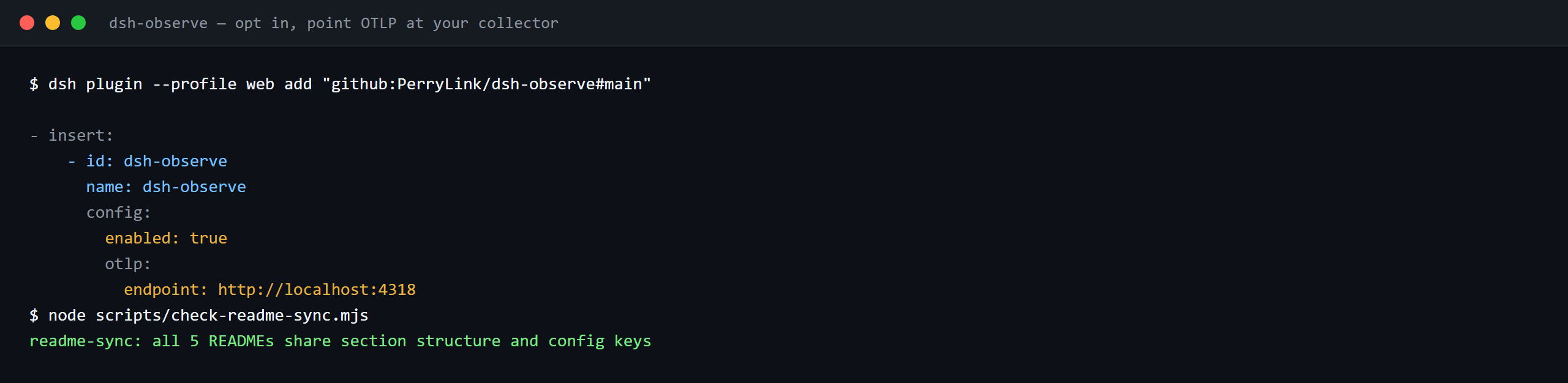
Minimal OTLP configuration (the row ships commented out in cordis.patch.yml):
- insert:
    - id: dsh-observe
      name: dsh-observe
      config:
        enabled: true
        otlp:
          endpoint: http://localhost:4318
Then verify the row mounts:
dsh --profile web --dump-config | grep -A2 'id: dsh-observe'
main): dsh plugin --profile web add github:PerryLink/dsh-observe — the prepare script builds with production dependencies only.dsh plugin --profile web add dsh-observe.pnpm pack in this repo, then dsh plugin --profile web add ./dsh-observe-<version>.tgz.dsh plugin --profile web remove dsh-observe (or remove the row from the profile patch).If pnpm reports
ERR_PNPM_IGNORED_BUILDSfor this package (esbuild's harmless platform-binary validation), addallowBuilds: { esbuild: true }to yourpnpm-workspace.yaml— thedshCLI prints the exact snippet.
All tunables are Schemastery Config fields (changeable from cordis.yml). An id-targeted override replaces the whole row — restate every key you need. cordis.patch.yml documents each key inline.
| Key | Default | Meaning |
|---|---|---|
enabled | false | Master switch; true plus at least one backend is the explicit opt-in |
otlp | null | OTLP backend config, or null to disable it |
otlp.endpoint | (required) | OTLP base URL; /v1/traces and /v1/metrics are appended |
otlp.serviceName | deepseek-harness | service.name resource attribute |
otlp.serviceVersion | (none) | service.version resource attribute |
otlp.headers | {} | Extra headers merged into every export request |
otlp.timeoutMs | 10000 | Per-request timeout |
langfuse | null | Langfuse backend config, or null to disable it |
langfuse.baseUrl | https://cloud.langfuse.com | Langfuse base URL |
langfuse.publicKey | (required) | Project public key |
langfuse.secretKey | (required) | Project secret key |
langfuse.release | (none) | Release tag stamped onto traces |
langfuse.traceName | session {session} turn {turn} | Trace-name template; {session}/{turn} interpolate per trace |
langfuse.tags | [] | Static tags stamped onto every trace |
langfuse.timeoutMs | 10000 | Per-request timeout |
capture.turns | true | Turn lifecycle spans |
capture.steps | true | Step lifecycle spans |
capture.tools | true | Tool-call spans with sanitized arguments/results |
capture.llm | true | LLM generation spans |
llm.prompt | true | Capture the sanitized request prompt (false = sizes only) |
llm.completion | true | Capture the sanitized completion (false = sizes only) |
metadata.sessionId | true | Session id attribute |
metadata.cwd | false | Session working directory (a local path — off by default) |
metadata.agentPreset | true | Agent preset id attribute |
metadata.model | true | Provider/model attributes |
metrics.tokens | true | Per-provider/model token counters |
metrics.cost | true | USD cost counters (need pricing rules to match) |
metrics.contextTokens | true | Context-pressure gauge (needs ctx.tokenMeter) |
pricing | [] | Pricing table, first match wins: { provider?, model, inputPerToken, outputPerToken, cacheReadPerToken?, cacheWritePerToken? } |
sanitize.enabled | true | Redaction master switch (false disables redaction, never truncation) |
sanitize.redactKeys | [] | Extra key-name substrings (key/token/secret/password/authorization/credential/apiKey are always included) |
sanitize.redactPatterns | [] | Extra secret regular expressions |
sanitize.truncatePromptChars | 4000 | Prompt character budget |
sanitize.truncateCompletionChars | 4000 | Completion character budget |
sanitize.truncateToolInputChars | 2000 | Tool argument character budget |
sanitize.truncateToolOutputChars | 2000 | Tool result character budget |
sanitize.truncateAttributeChars | 512 | Span attribute string budget |
batch.maxRecords | 256 | Flush once the queue holds this many records |
batch.flushIntervalMs | 5000 | Timer flush interval |
batch.maxQueueRecords | 2000 | In-memory queue bound; excess spills to the buffer |
batch.maxBufferRecords | 10000 | Durable offline buffer bound; oldest records drop first |
batch.bufferRetryIntervalMs | 30000 | Offline buffer retry interval |
retry.maxAttempts | 5 | Attempts per batch, including the first try |
retry.baseDelayMs | 1000 | First backoff delay |
retry.factor | 2 | Backoff multiplier per consecutive failure |
retry.maxDelayMs | 60000 | Backoff ceiling |
remote.enabled | false | Mount the observe Typert remote (kill switch) |
This plugin registers no model tools — it is a background exporter. Its surfaces:
session/event (span/metric collection), session/flush (best-effort export kick — the durability checkpoint never waits on a remote backend), and session/disposed.observe — observe/status returns the kill-switch state, configured backends, queue depths, and buffer occupancy; observe/setEnabled stops and resumes exporting at runtime.network:outbound to the endpoints you configure, session:read for the event stream, storage:write for the offline buffer; no native code, no filesystem access.@deepseek-ai/dsh@0.1.7-rc.2 (devDeps and CI's primary ruler); the peer range >=0.1.2-rc.1 <0.2.0 || >=0.1.5-alpha.1 <0.2.0 || >=0.1.6-0 <0.2.0 || >=0.1.7-0 <0.2.0 keeps every published line installable, and the second ruler (typecheck:ci) plus the compat workflow cover the older baselines.observe/* records are audit-only: on the current host line the session append gate admits surface events, so no observe/* event is written to the session log, and the plugin does not fake one with an unmarked append (that would make sessions unreadable). Treat /observe status output and the OTLP/Langfuse backends as the audit surface.capture.* switches and batch.maxBufferRecords for high-volume sessions.pnpm install # node ^22.19 || >=24
pnpm run typecheck # tsc: src + tests against the 0.1.7-rc.2 devDeps (no tsconfig paths)
pnpm run typecheck:ci # tsc against the published line (no paths)
pnpm run check:ruler-live # canary: must fail to compile, proving the ruler is live
pnpm test # vitest: 126 tests, 18 suites (real Context/Session/storage seam)
pnpm run test:coverage # coverage gate (90/80/90/90)
pnpm run build # tsdown bundle + tsc declarations (lib/)
pnpm run verify:self-contained # dependency specs resolve from the registry
pnpm run verify:artifacts # built ESM face + bundle patch present
node scripts/check-readme-sync.mjs # five-language README sync gate
pnpm pack # the published tarball
dsh, dsh-plugin, deepseek-harness, deepseek, cordis, observability, opentelemetry, otlp, langfuse, tracing
This project is one of the 33 actively maintained DeepSeek Harness plugins from PerryLink — the roster is 42, of which 6 are frozen and 3 retired; every one keeps its row below, with the reason in the Status column. If this one helps you, the others likely will too:
| Plugin | One-liner | Status |
|---|---|---|
| dsh-auto-review | Second-model auto-review on the approval chain, fail-closed by default | |
| dsh-autotier | Automatic strong/cheap model-tier routing with deterministic risk guards and a /tier command | |
| dsh-background-agents | Durable background child agents with a Web UI sidebar, messaging and interrupt | 🚫 RETIRED — see the note above |
| dsh-budget | Cost governance for DeepSeek Harness: budgets, carbon, and latency in one panel. | 🧊 FROZEN — see the repo README |
| dsh-catalog | DSH Desktop Market standard catalog source for the PerryLink family | |
| dsh-cert-mcp | Read-only MCP server exposing the certification registry: grades, snapshots and five-dimension evidence | |
| dsh-checkpoint-rewind | Claude Code /rewind-equivalent: snapshots, session forks, one-shot restore | |
| dsh-claude-move | Migrate Claude Code sessions, memory, skills and CLAUDE.md into DSH | 🧊 FROZEN — see the repo README |
| dsh-click | Cross-platform native desktop control for DeepSeek Harness — Windows first. | |
| dsh-composer-history | Terminal-style input history for the web composer: arrows, Ctrl+R search | |
| dsh-data-quality | Dataset quality checks and citation cross-checks (the optional numeric bridge consumed here) | |
| dsh-defend | Prompt-injection, jailbreak, and secret-leak defense for DeepSeek Harness. | 🧊 FROZEN — see the repo README |
| dsh-doublecheck | Engineering-discipline guard: requirements grill, test gates, adversary review | |
| dsh-draw | Unified static-image generation routing for DeepSeek Harness. | 🧊 FROZEN — see the repo README |
| dsh-fast | Read-only performance diagnostics for DeepSeek Harness. | |
| dsh-fund-research | Deterministic research reports for Chinese public mutual funds | |
| dsh-github | GitHub PR/issues integration for DSH, every write gated by approval | |
| dsh-industry-research | Industry research orchestration that seals its deliverables through this plugin's ctx.researchReport.assemble | |
| dsh-laya | Laya typed decisions (noul/choice/score) as a first-class Cordis service and model-visible tools | |
| dsh-library | Local document knowledge base for DeepSeek Harness. | |
| dsh-local-ai | Local-model (Ollama) integration for DeepSeek Harness. | |
| dsh-lsp-actions | LSP diagnostics, formatting, completion, code actions and rename over language servers | |
| dsh-mask | PII masking middleware: anonymize at the model boundary, restore at the display layer | |
| dsh-mcp-panel | Read-only MCP runtime panel: /mcp command + Settings tab with status, tools and errors | |
| dsh-memento | Approval-gated cross-session memory: ctx.memory seam + SQLite + memory tool | 🧊 FROZEN — see the repo README |
| dsh-observe | OpenTelemetry and Langfuse observability exporter for DeepSeek Harness. | |
| dsh-output-styles | Claude Code outputStyles-equivalent runtime style switching | |
| dsh-permission-rules | Claude Code-style declarative allow/deny/ask permission rules with audit | |
| dsh-plugin-certification | Community certification registry with repro-checkable grades and badges | |
| dsh-plugin-doctor | Zero-dependency static + sandbox smoke detector for DSH plugins | |
| dsh-plugin-guide | Plugin-development knowledge base as an on-demand agent skill | |
| dsh-plugin-kit | Shared zero-runtime-dependency toolkit for the PerryLink DSH plugins | |
| dsh-plugin-upgrade | One-package, one-corridor-index plugin upgrade skill: routes a repository to the matching closed corridor card | |
| dsh-plugin-upgrade-015 | Merged 0.1.3-alpha.1 → 0.1.5-rc.1 upgrade corridor card plus a zero-dependency seam scanner | 🚫 RETIRED — corridors carried by dsh-plugin-upgrade |
| dsh-reach | Multi-channel approval/question bridge: WeChat/Telegram/Feishu, session console | 🧊 FROZEN — see the repo README |
| dsh-research-report | Verifiable research-report engine: content-addressed evidence ledger and sealed versions | |
| dsh-score | Multi-dimensional quality scoring for DeepSeek Harness plugins. | |
| dsh-session-pin | Pin sessions in the Web sidebar with durable ordering | 🚫 RETIRED — see the note above |
| dsh-session-sync | Cross-device session sync for DeepSeek Harness — a dedicated git mirror of your session store. | |
| dsh-skill-pack-security | Security-audit skill pack: secret scan, dependency and supply-chain review | |
| dsh-talk | Voice-first session loop for DeepSeek Harness: talk to it, hear it answer. | |
| dsh-team-rooms | Cross-session team rooms: shared message bus, task board and timeline | 🚫 RETIRED — see the note above |
| dsh-test-drive | Isolated install-and-smoke test drives for DeepSeek Harness plugins. | |
| dsh-ticktick | TickTick/Dida365 task bridge: session-header panel + 11 tools | |
| dsh-translate | Vendor parameter translation and deterministic JSON repair for DeepSeek Harness. |
All PerryLink plugins are browsable in the built-in DSH Desktop Market: Market → Sources → add source → paste https://perrylink-dsh-catalog.perrylink.workers.dev/catalog-source.json → select it. Installation still goes through the Market's npm-identity verification and your confirmation.
Apache License 2.0 © 2026 dsh-observe contributors
FAQs
OpenTelemetry and Langfuse observability exporter for DeepSeek Harness: turn/step/tool/LLM spans, token and cost metrics, and sanitized LLM prompt/completion capture from the session/event stream, with async batching, bounded offline buffering, and retry
The npm package dsh-observe receives a total of 533 weekly downloads. As such, dsh-observe popularity was classified as not popular.
We found that dsh-observe demonstrated a healthy version release cadence and project activity because the last version was released less than a year ago. It has 1 open source maintainer collaborating on the project.
Security News
Cloudflare is acquiring Deno’s team, which will provide another year of bug fixes and security updates before ending support for the runtime.

Security News
Anthropic’s free OSS Scanner uses Mythos and other Claude models to find open source vulnerabilities and send maintainers reports with proposed fixes.

Security News
On Front Lines’ Early Adopters: CISO podcast, Andrew Becherer shares lessons from Datadog, weighs the long-term costs of AI-built tools, and explains how founders can actually gain a CISO’s trust.