


Security News
Deno Goes the Way of the Dinosaur
Cloudflare is acquiring Deno’s team, which will provide another year of bug fixes and security updates before ending support for the runtime.
By Sarah Gooding - Oct 16, 2026
dsh-output-styles
Advanced tools
Claude Code outputStyles-equivalent runtime output-style switching for DeepSeek Harness
npm i -g dsh1024 once, then dsh1024 plugin --profile web add dsh-output-styles (counts toward the deepseek1024.com install ranking).

Claude Code outputStyles for DeepSeek Harness — switch the model's output style at runtime, per session, durably.
/style concise — and every reply from now on is terse. /style off — back to the project default.
Official repository. This is the only official repository of dsh-output-styles, maintained by PerryLink. Same-name repositories under other accounts are not affiliated.







📖 Ecosystem knowledge base — measured data, not marketing: plugin development guide · plugin-selection data · maintenance criteria.
这个插件是 DSH 插件家族的一员(40+ 个,全部 Apache-2.0)。如果你在用,给个 star —— 它不会解锁任何功能,但会让下一个人在搜索里更容易找到它。
English: part of a 40+ plugin family for DeepSeek Harness. If it is useful, a star helps the next person find it — nothing is gated behind it.
/style concise — and every reply from now on is terse. /style off — back to the project default.

The same run, animated.
| Surface | Status |
|---|---|
| Harness | DeepSeek Harness dsh-v0.2.1-rc.2 (adapted 2026-09-09): the session envelope keeps its ignorable field for stored-log read compatibility only - Session.append still cannot stamp it, so audit-gate behavior is unchanged. Verified 2026-09-11 against the dsh-v0.2.1-rc.2 checkout (full gate chain + profile install smoke). |
| Node | `^22.19.0 |
| Platforms | All (host + web client) |
| Model | Any (system-prompt injection) |
dsh-output-styles is the Claude Code outputStyles equivalent for DeepSeek Harness: a /style command that switches the model's output style at runtime, persisted per session, injected at every prompt assembly.
styles/*.md); frontmatter for metadata, body = the model directive. Six built-ins ship in the box (concise, explanatory, formal, learning, proactive, step-by-step), including Claude Code-parity proactive and learning./style command — no argument lists styles (with descriptions) plus the current selection; /style <name> switches; /style off restores the project default.output_style storage domain, keyed by sessionId, and survives restarts.systemPrompt.section() contribution (order sectionOrder) injects the current session's style body at every assembly, truncated at a configurable budget.keep-coding-instructions, force-for-plugin (force alias), outputStyles JSON compatibility, layered stylesDir directories, hot reload, and a project-default fallback that is live-editable from the Web Plugins page.output.render.*) — ctx.outputRenderers lets any plugin register a pure presenter, applied through the output.render/before waterfall; built-in renderers concise and step-by-step.rules: [{ match: { tool: 'bash' }, style: 'concise' }] name the renderer for matching requests; live-editable from the Web Plugins page./transcript — render the current session to Markdown or sanitized HTML through the render pipeline; --save <path> writes the sanitized document to that workspace path after user approval. Every render keeps the original text beside the rendered one.dsh plugin --profile web add github:PerryLink/dsh-output-styles
# 1. install the bundle into your profile
dsh plugin --profile web add github:PerryLink/dsh-output-styles

# or from npm (published releases)
dsh plugin --profile web add dsh-output-styles

# 2. restart and verify the row
dsh --profile web --dump-config | grep -A3 'id: output-styles'
You > /style
      output style off
      concise — Terse, direct answers — minimal prose, no preamble. (Daily coding work, tool-heavy sessions, or when prompt length matters.)
      explanatory — Educational answers with short "Insights" that teach as you work. (Learning a codebase, onboarding, …)
      formal — Formal, precise prose with complete sentences and defined terms. (Reports, documentation, release notes, …)
      learning — Collaborative learn-by-doing mode with short "Insights" and small hands-on steps for the user. (Pairing, onboarding, …)
      proactive — Execute immediately, assume reasonable defaults, and prefer action over planning. (Routine multi-step work, …)
      step-by-step — Numbered reasoning steps with explicit intermediate results. (Debugging, design decisions, …)

You > /style concise
      switched to concise

You > 请只用一句话介绍你自己。
AI  > 我是运行在 DeepSeek Harness 插件化平台上、基于 deepseek-v4-pro 模型的 AI 编码代理。
flowchart LR
    U[You type /style concise] --> C[command registry]
    C -->|command/run logged| L[(session log)]
    C -->|put {style, source}| D[(output_style domain)]
    D --> R[OutputStyleRuntime]
    R -->|body at every assembly| S[systemPrompt section order 90]
    S --> M[Model request]
    M -->|full system prompt| H[system/message logged]
Everything the model sees is reconstructable from the session log — no new session event type, no agent-loop changes. The style name comes from command/run, the exact injected text from system/message, and the provenance marker { kind: 'dsh-output-styles' } rides in the domain record. Styles apply to the main conversation only; subagent sessions keep their own prompts (matching Claude Code).
main): dsh plugin --profile web add github:PerryLink/dsh-output-styles — the prepare script builds with production dependencies only.dsh plugin --profile web add dsh-output-styles.pnpm pack in this repo, then dsh plugin --profile web add ./dsh-output-styles-<version>.tgz.dsh plugin --profile web remove dsh-output-styles.All tunables are Schemastery Config fields (changeable from cordis.yml). Invalid values fail the load.
defaultStyle and rules are declared volatile(), so on a host that composes the settings forms seam they are live, Web-editable fields: edit them under Plugins → dsh-output-styles in the Web UI and the running plugin adopts the new value without a remount. Every other field stays composition-only and needs a reload. A committed value is validated before it is applied — an invalid one is rejected and the running values are left unchanged.
| Key | Default | Web-editable | Meaning |
|---|---|---|---|
stylesDir | [] | no | Style-library directories, resolved against cwd; later entries override earlier ones. [] = the bundled styles/ only |
maxStyleChars | 4000 | no | Style-body budget (≥ 1); longer bodies are truncated with a marker |
defaultStyle | '' | yes | Style for sessions that never selected one; '' = no style. A name that is not in the live library is refused rather than injected |
compatJson | true | no | Load Claude Code outputStyles JSON entries (single objects or arrays) |
sectionOrder | 90 | no | Order of the injected section (0 = persona, 100–199 = tool guidance) |
truncationMarker | "\n\n[style truncated]" | no | Marker appended at the truncation point |
includeBuiltins | true | no | Include the package's bundled styles/ as the lowest-priority layer |
watchStyles | true | no | Reload the library when a style file changes on disk |
rules | [] | yes | Per-session/per-tool render rules: [{ match: { tool?, contentType?, session? }, style, priority? }] |
enableExport | true | no | Register the /transcript command (Markdown/HTML session export, renderer-aware; --save writes with approval) |
respectCoreOutputStyles | true | no | When a core outputStyles service is detected, skip this plugin's prompt injection (keep hot-switch / rules / export) |
Migrating from 0.1.6 or earlier. Those versions kept two plugin-owned settings
sections, output-style (style) and output-style-rules (rules). The 0.1.7
host deleted the API they were built on, so both sections are gone. Move any value
you had there into the corresponding Config field — output-style.style →
defaultStyle, output-style-rules.rules → rules — in your profile patch
(cordis.yml), or set it on the Plugins page. Per-session choices made with
/style are unaffected: they live in the output_style storage domain.
| Surface | Kind | Notes |
|---|---|---|
/style | command | List styles, switch, or restore the project default |
/transcript | command | Render the current session to Markdown or sanitized HTML; --save writes with approval |
output_style | storage domain | Session-scoped style choice, keyed by sessionId |
systemPrompt.section() | contribution | Injects the current style body at every assembly |
output.render.* | renderer registry | ctx.outputRenderers + the output.render/before waterfall |
style | projection | { options, currentValue } folded from settled commands |
| Web picker | client entry | dsh-output-styles/client decorates /style with a popup picker |
| Input | Outcome |
|---|---|
/style | List the current selection + one line per style (name — description) |
/style concise | Switch (durable write), switched to concise |
/style Diagrams first | Multi-word names are the whole remainder |
/style off | Restore the project default (settings default, then defaultStyle) |
/style nope | error: unknown output style "nope" (available: …) |
/transcript | Render the current session to Markdown through the renderer pipeline |
/transcript md | Render to Markdown (md is the shorthand for markdown) |
/transcript html | Render to sanitized HTML |
/transcript --renderer=concise | Render with one renderer forced (rules bypassed) |
/transcript md --save report.md | Render, then write the sanitized document to report.md after approval |
One Markdown file per style; frontmatter for metadata, body = the model directive. name defaults to the file name and may contain spaces (Diagrams first).
| Field | Default | Meaning |
|---|---|---|
name | file name | Switch target; letters, digits, spaces, and hyphens (off is reserved) |
description | — (required) | One sentence shown in listings and the picker |
whenToUse | — | Optional guidance appended to listings |
keep-coding-instructions | false | Keep the harness prompt when true; replace it when false (Claude Code semantics) |
force-for-plugin | false | Apply unconditionally, overriding any session selection; force is an alias, at most one style may set it |
With compatJson: true, Claude Code outputStyles JSON entries ({ name, description, prompt }) load beside Markdown styles; unparseable entries are skipped with a warning.
The output.render.* protocol turns presentation into an extension point. A renderer is a pure presenter — presenter(text, context) maps args to display data, never touches the DOM — matched by tool name and content type, ordered by priority.
output.render/before ({ text, context }); listeners must call next().rules: [{ match: { tool: 'bash' }, style: 'concise' }] names the renderer for matching requests; ties break by priority, then rule order.concise (whitespace compaction + budget truncation) and step-by-step (consistent step numbering).{ original, rendered, rendererId, changed }; the rendered text is what surfaces, the original stays reconstructable from the session log.The dsh.client entry decorates the host /style command's bare invocation with a popup picker: an "off" row plus one row per library style (description · whenToUse), the active row marked. Picking submits /style <name> through the command Remote, so every switch keeps the host's durable command lifecycle. The picker follows the Web UI's shipped zh/en locale pair.
| Claude Code | dsh-output-styles | |
|---|---|---|
| Style files | .claude/output-styles at user/project/managed levels | stylesDir directories + bundled styles/, later directory wins |
| Custom styles | Markdown, frontmatter name/description/keep-coding-instructions/force-for-plugin | Same fields (force-for-plugin accepted verbatim, force as alias) + whenToUse |
| Legacy JSON | outputStyles array in settings.json | Loaded verbatim (compatJson: true) |
| Taking effect | After /clear or a new session | Immediately — the system prompt re-assembles per request |
| Subagents | Styles do not apply | Same — subagent sessions keep their own prompts |
| Switching | /config menu or outputStyle setting (the /output-style command was removed in v2.1.91) | /style command + Web picker + the defaultStyle field on the Web Plugins page |
Screened against the DSH ecosystem before development (2026-08 snapshot): no style/output-style repository under topic:dsh-plugin, no output-style category in the four major awesome lists, and no entry in the dsh-hub catalog. The closest neighbors — dsh-soul-md (persona) and dsh-claude-marketplace (output styles explicitly deferred to v0.2+) — are adjacent, not conflicting.
fs:read, fs:write, fs:watch, storage:read, storage:write, and settings:read in its workshop manifest.output_style storage domain (keyed by sessionId); no other state is persisted, no network requests.command/run, the exact injected text from system/message; the provenance marker { kind: 'dsh-output-styles' } rides in the domain record.systemPrompt, commands, storage, and settings; no engine / agent-loop / apiproxy / official-UI changes./transcript) keeps the original text beside the rendered one; sanitized HTML is used for HTML export./transcript --save writes only after the approval service grants it, and the written content passes through the sanitizeText pure function first; without an approval or fs service it writes nothing (fail-closed).outputStyles capability lands, this plugin detects its outputStyles service and degrades to the incremental surface (hot-switch, rules, /transcript) while leaving prompt injection to the core — see docs/COEXISTENCE.md and the exported detectCoreOutputStyles / coexistenceReport functions. Degraded mode is stated where you can see it: every /style switch and /style off reply carries a degraded coexistence mode note, and the style session projection exposes promptInjection: 'enabled' | 'disabled', so no surface implies the style is in force when it is not. (Before 0.7.0 the only trace was a ctx.logger.info line, which never reaches the session transcript.)maxStyleChars are truncated with a marker.pnpm install
pnpm run typecheck # both tsc projects
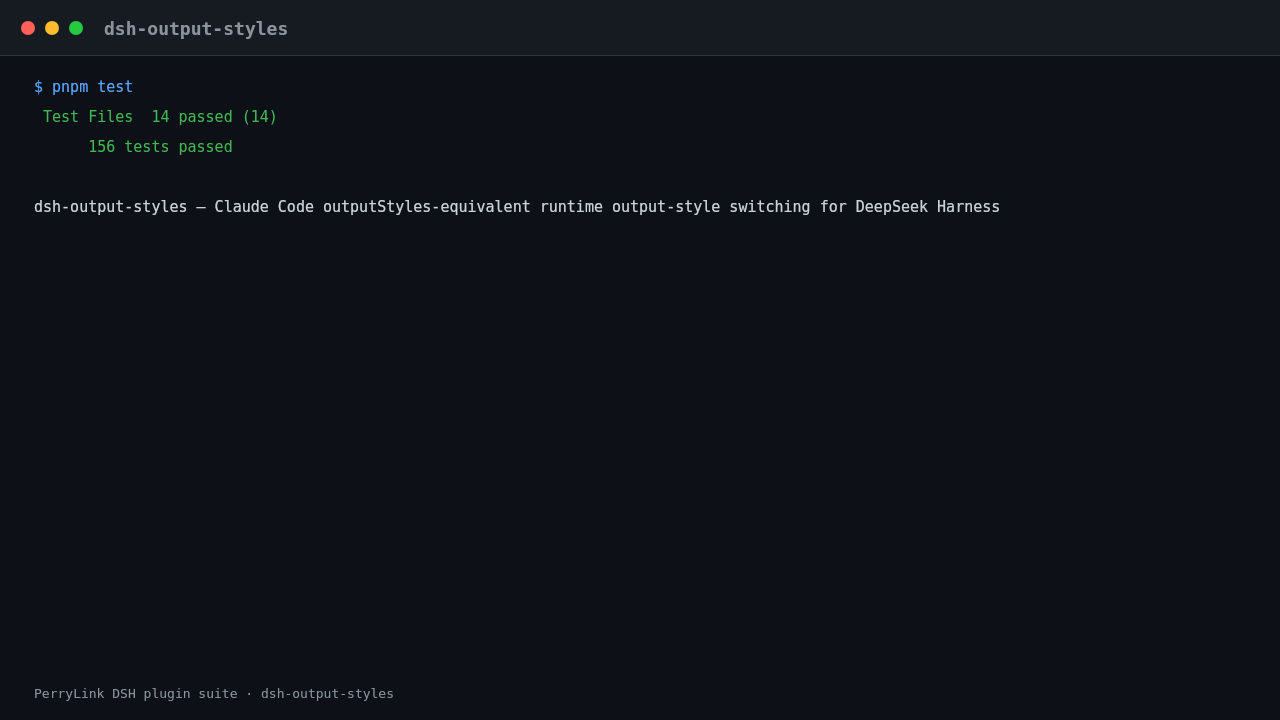
pnpm test # vitest — 156 tests
pnpm run verify # typecheck + tests + self-contained (the prepublishOnly gate)
pnpm run build # lib/ artifacts (host + client bundles)
pnpm pack # tarball for dsh plugin add
Releases: pushing a v* tag whose suffix matches the package.json version triggers the Publish workflow — full verification, then an npm publish with provenance.
Verified against DSH 0.2.0-rc.2 (the runtime this README ships for) and the high-star plugin set surveyed on 2026-10-05.
This plugin does not interfere with other plugins, including the widely installed high-star ones:
outputRenderers; that key is not a built-in seam and is not provided by any surveyed high-star plugin.shadows-shipped-ui seat.webServer prefix.inserts its own row; it never overrides a built-in row's config.process.env, or replace the global fetch dispatcher.Shared event listeners are non-interfering by construction. It observes the ordering-sensitive event system-prompt/assemble with ctx.on() — Cordis's broadcast registration, where every listener runs and none can starve another. Every listener here delegates through next(), so the chain is never short-circuited, and a mutation is applied to the value next() produced rather than returned in its place:
system-prompt/assemble — also used by dsh-routing-suite (7000★, 13 listeners).Static evidence: dsh-plugin-doctor K10–K13 report pass for every check on this repository.
deepseek-harness, dsh, dsh-plugin, output-style, output-styles, claude-code
This project is one of the 34 actively maintained DeepSeek Harness plugins from PerryLink — the roster is 42, of which 5 are frozen and 3 retired; every one keeps its row below, with the reason in the Status column. If this one helps you, the others likely will too:
| Plugin | One-liner | Status |
|---|---|---|
| dsh-auto-review | Second-model auto-review on the approval chain, fail-closed by default | |
| dsh-autotier | Automatic strong/cheap model-tier routing with deterministic risk guards and a /tier command | |
| dsh-background-agents | Durable background child agents with a Web UI sidebar, messaging and interrupt | 🚫 RETIRED — see the note above |
| dsh-budget | Cost governance for DeepSeek Harness: budgets, carbon, and latency in one panel. | 🧊 FROZEN — see the repo README |
| dsh-catalog | DSH Desktop Market standard catalog source for the PerryLink family | |
| dsh-cert-mcp | Read-only MCP server exposing the certification registry: grades, snapshots and five-dimension evidence | |
| dsh-checkpoint-rewind | Claude Code /rewind-equivalent: snapshots, session forks, one-shot restore | |
| dsh-claude-move | Migrate Claude Code sessions, memory, skills and CLAUDE.md into DSH | 🧊 FROZEN — see the repo README |
| dsh-click | Cross-platform native desktop control for DeepSeek Harness — Windows first. | |
| dsh-composer-history | Terminal-style input history for the web composer: arrows, Ctrl+R search | |
| dsh-data-quality | Dataset quality checks and citation cross-checks (the optional numeric bridge consumed here) | |
| dsh-defend | Prompt-injection, jailbreak, and secret-leak defense for DeepSeek Harness. | 🧊 FROZEN — see the repo README |
| dsh-doublecheck | Engineering-discipline guard: requirements grill, test gates, adversary review | |
| dsh-draw | Unified static-image generation routing for DeepSeek Harness. | 🧊 FROZEN — see the repo README |
| dsh-fast | Read-only performance diagnostics for DeepSeek Harness. | |
| dsh-fund-research | Deterministic research reports for Chinese public mutual funds | |
| dsh-github | GitHub PR/issues integration for DSH, every write gated by approval | |
| dsh-industry-research | Industry research orchestration that seals its deliverables through this plugin's ctx.researchReport.assemble | |
| dsh-laya | Laya typed decisions (noul/choice/score) as a first-class Cordis service and model-visible tools | |
| dsh-library | Local document knowledge base for DeepSeek Harness. | |
| dsh-local-ai | Local-model (Ollama) integration for DeepSeek Harness. | |
| dsh-lsp-actions | LSP diagnostics, formatting, completion, code actions and rename over language servers | |
| dsh-mask | PII masking middleware: anonymize at the model boundary, restore at the display layer | |
| dsh-mcp-panel | Read-only MCP runtime panel: /mcp command + Settings tab with status, tools and errors | |
| dsh-memento | Approval-gated cross-session memory: ctx.memory seam + SQLite + memory tool | |
| dsh-observe | OpenTelemetry and Langfuse observability exporter for DeepSeek Harness. | |
| dsh-output-styles | Claude Code outputStyles-equivalent runtime style switching | |
| dsh-permission-rules | Claude Code-style declarative allow/deny/ask permission rules with audit | |
| dsh-plugin-certification | Community certification registry with repro-checkable grades and badges | |
| dsh-plugin-doctor | Zero-dependency static + sandbox smoke detector for DSH plugins | |
| dsh-plugin-guide | Plugin-development knowledge base as an on-demand agent skill | |
| dsh-plugin-kit | Shared zero-runtime-dependency toolkit for the PerryLink DSH plugins | |
| dsh-plugin-upgrade | One-package, one-corridor-index plugin upgrade skill: routes a repository to the matching closed corridor card | |
| dsh-plugin-upgrade-015 | Merged 0.1.3-alpha.1 → 0.1.5-rc.1 upgrade corridor card plus a zero-dependency seam scanner | 🚫 RETIRED — corridors carried by dsh-plugin-upgrade |
| dsh-reach | Multi-channel approval/question bridge: WeChat/Telegram/Feishu, session console | 🧊 FROZEN — see the repo README |
| dsh-research-report | Verifiable research-report engine: content-addressed evidence ledger and sealed versions | |
| dsh-score | Multi-dimensional quality scoring for DeepSeek Harness plugins. | |
| dsh-session-pin | Pin sessions in the Web sidebar with durable ordering | 🚫 RETIRED — see the note above |
| dsh-session-sync | Cross-device session sync for DeepSeek Harness — a dedicated git mirror of your session store. | |
| dsh-skill-pack-security | Security-audit skill pack: secret scan, dependency and supply-chain review | |
| dsh-talk | Voice-first session loop for DeepSeek Harness: talk to it, hear it answer. | |
| dsh-team-rooms | Cross-session team rooms: shared message bus, task board and timeline | 🚫 RETIRED — see the note above |
| dsh-test-drive | Isolated install-and-smoke test drives for DeepSeek Harness plugins. | |
| dsh-ticktick | TickTick/Dida365 task bridge: session-header panel + 11 tools | |
| dsh-translate | Vendor parameter translation and deterministic JSON repair for DeepSeek Harness. |
All PerryLink plugins are browsable in the built-in DSH Desktop Market: Market → Sources → add source → paste https://perrylink-dsh-catalog.perrylink.workers.dev/catalog-source.json → select it. Installation still goes through the Market's npm-identity verification and your confirmation.
Apache License 2.0 © 2026 dsh-output-styles contributors
FAQs
Claude Code outputStyles-equivalent runtime output-style switching for DeepSeek Harness
The npm package dsh-output-styles receives a total of 560 weekly downloads. As such, dsh-output-styles popularity was classified as not popular.
We found that dsh-output-styles demonstrated a healthy version release cadence and project activity because the last version was released less than a year ago. It has 1 open source maintainer collaborating on the project.
Security News
Cloudflare is acquiring Deno’s team, which will provide another year of bug fixes and security updates before ending support for the runtime.

Security News
Anthropic’s free OSS Scanner uses Mythos and other Claude models to find open source vulnerabilities and send maintainers reports with proposed fixes.

Security News
On Front Lines’ Early Adopters: CISO podcast, Andrew Becherer shares lessons from Datadog, weighs the long-term costs of AI-built tools, and explains how founders can actually gain a CISO’s trust.