📖 Ecosystem knowledge base — measured data, not marketing: plugin development guide · plugin-selection data · maintenance criteria.
Install & uninstall
dsh plugin --profile web add dsh-score
dsh plugin --profile web remove dsh-score
⭐ 如果它帮到了你
这个插件是 DSH 插件家族的一员(95 个,全部 Apache-2.0)。如果你在用,给个 star —— 它不会解锁任何功能,但会让下一个人在搜索里更容易找到它。
English: part of a 95 plugin family for DeepSeek Harness. If it is useful, a star helps the next person find it — nothing is gated behind it.
What is dsh-score?
Multi-dimensional quality scoring for DeepSeek Harness plugins.
Five dimensions, real gh/npm evidence, one weighted risk card and leaderboard.

Workflow overview: question → sealed sources → report. The examples below use the real command surface.
Comparison
Compatibility
| DeepSeek Harness | dsh-v0.2.1-rc.2 (GitHub tag). The engines.dsh gate is >=0.2.1-0 <0.3.0; dev/test pins and the typecheck:ci ruler measure 0.2.1-rc.2. The ctx.jobs seam uses the SessionId contract. |
| Node.js | ^22.19.0 || >=24.0.0 |
| Package manager | pnpm@11.7.0 |
| Platform | Windows / macOS / Linux (host-only plugin) |
| External tools | gh CLI on PATH (authenticated for API reads), npm CLI on PATH |
What you get
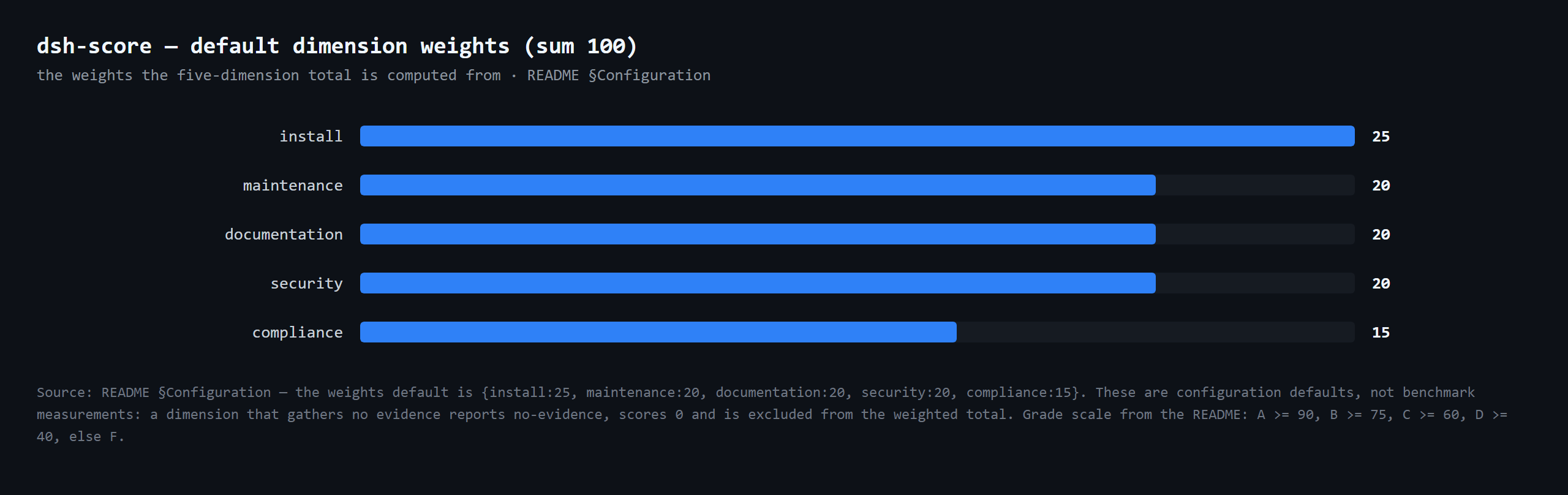
score tool — one target through the five-dimension pipeline; returns the structured risk card, or { kind: 'background', jobId } with background: true./score command — batch scoring of a whitespace/comma-separated target list as a score-batch background job over ctx.jobs, producing a leaderboard snapshot (JSON + Markdown).score_report tool — fetch any stored score card (sc_...), leaderboard (lb_...), or the latest leaderboard.score_badge tool — an embeddable README badge (shields.io flat SVG + endpoint URL) and the five-dimension JSON for one scored target.- Five dimensions (weights configurable, defaults sum to 100): install success
25, maintenance 20, documentation 20, security 20, compliance 15.
- Evidence discipline — every dimension records its audit links (
source, sanitized detail, observedAt); a dimension without evidence reports no-evidence (score 0, excluded from the weighted total), never a fabricated number.
- Structured results — every record carries
schema: "dsh-score/v1" with first-class fields; this is the machine-readable contract downstream tooling consumes.
Quick start
Git channel
dsh plugin --profile web add github:PerryLink/dsh-score
The first add fails because pnpm blocks the package's prepare build; copy the exact key pnpm printed into the profile's pnpm-workspace.yaml and re-run:
allowBuilds:
  'dsh-score': true
npm channel
dsh plugin --profile web add dsh-score
Prebuilt packages need no build allowance. Restart the profile, then use score / /score from a session.
Examples
These are the plugin's real entry points; install once, then call one.
Detailed example
Command
score({ target: "owner/repo" })
Output
# Score sc_65e817eec8cd71ed

- Target: `owner/repo` (repo)
- Grade: **B** — total 88/100
- Verdict: healthy (weighted total 88/100)

| Dimension | Status | Score | Weight | Summary |
|---|---|---|---|---|
| Install success | ⬜ no-evidence | 0 | 25 | no dsh-test-drive result recorded for this target (install success unmeasured) |
| Maintenance | ✅ pass | 100 | 20 | active (2026-08-15T00:00:00.000Z; 0 open issues) |
| Documentation | 🟠 warn | 70 | 20 | 1/4 language READMEs + CHANGELOG + SECURITY |
| Security | ✅ pass | 100 | 20 | license MIT |
| Protocol compliance | ✅ pass | 81 | 15 | dsh.bundle.patch declared |
Observed from README.md:141-149,169-191; tests/tools.spec.ts:64-65; tests/score.spec.ts:50-55; src/report.ts:40-53
Failure branch
Input
{"id":"sc_nope"}
Output
isError=true; error.message=dsh-score: no score recorded with id sc_nope
Observed from plugins/dsh-score/src/tools.ts:351-354 (throw); plugins/dsh-score/tests/tools.spec.ts:95-99 (unknown id); plugins/dsh-score/README.md:179-181 (score_report); exercised through plugins/dsh-score/tests/harness.ts
Brief examples
Configuration
All keys are optional (defaults shown); invalid values fail loudly at load.
probeTimeoutMs | 60000 | Deadline for one gh/npm probe command. |
outputTailBytes | 8000 | Cap on the sanitized output tail recorded per probe. |
cacheMaxAgeMs | 86400000 | How long a cached score card is reused before re-scoring (0 disables the cache). |
staleCommitWarnDays | 90 | Commit/publish age at which maintenance drops to warn. |
staleCommitFailDays | 365 | Commit/publish age at which maintenance drops to fail. |
staleIssueWarnDays | 30 | Oldest-open-issue age (response proxy) at which maintenance drops to warn. |
staleIssueFailDays | 180 | Oldest-open-issue age at which maintenance drops to fail. |
maxBatchTargets | 20 | /score batch cap. |
batchConcurrency | 1 | Batch concurrency (serial avoids API-rate contention). |
weights | {install:25, maintenance:20, documentation:20, security:20, compliance:15} | Per-dimension weights (each 0–100; at least one must be > 0). |
Tools & surfaces
score
score(target: string, refresh?: boolean, background?: boolean)
target — a GitHub repo (github:owner/repo, owner/repo, a git/https URL) or an npm package name.refresh: true bypasses the score cache and re-gathers evidence.background: true starts a score-batch job and returns its id.
/score <targets...>
Starts one background batch job; progress streams through the job output, and the final line names the leaderboard id for score_report.
score_report(id?)
Returns a score card (sc_...), a leaderboard (lb_...), or — with no id — the latest leaderboard.
score_badge(target? | id?, refresh?)
Generates an embeddable README badge and the five-dimension JSON for one target:
target — score a GitHub repo or npm package (through the cache) and badge it; mutually exclusive with id.id — badge a stored score card (sc_...) without re-scoring.refresh: true — bypass the score cache (only applies to target).
Returns the badge (SVG + endpoint + Markdown embed) and the compact five-dimension JSON — see Badge & JSON API.
Structured result sample
{
  "schema": "dsh-score/v1",
  "scoreId": "sc_8f1c2e4a9b3d7f01",
  "target": { "kind": "repo", "spec": "github:owner/dsh-click#abc123" },
  "scoredAt": "2026-08-16T00:00:00.000Z",
  "durationMs": 3210,
  "pluginVersion": "0.2.22",
  "dimensions": {
    "install": { "dimension": "install", "status": "no-evidence", "score": 0, "weight": 25,
                 "summary": "no dsh-test-drive result recorded for this target (install success unmeasured)",
                 "evidence": [{ "source": "test-drive", "detail": "no test-drive record found in the test_drive domain", "observedAt": "2026-08-16T00:00:00.000Z" }] },
    "maintenance": { "dimension": "maintenance", "status": "pass", "score": 100, "weight": 20,
                     "summary": "active (2026-08-10T00:00:00Z; 0 open issues)",
                     "evidence": [{ "source": "gh-api", "detail": "last activity 2026-08-10T00:00:00Z", "observedAt": "2026-08-16T00:00:00.000Z" }] }
  },
  "total": 88,
  "grade": "B",
  "verdict": "healthy (weighted total 88/100)"
}
Scoring: the total is a weighted average over dimensions that gathered evidence (no-evidence dimensions are excluded and renormalized); A ≥ 90, B ≥ 75, C ≥ 60, D ≥ 40, else F, and N/A when nothing had evidence.
Badge & JSON API
score_badge generates an embeddable README badge and the five-dimension JSON for one scored target.
Badge
Three forms, all derived from the same settled score card:
- Endpoint — a documented shields.io static URL, paste-ready for a README image (zero self-hosting).
- SVG — a self-contained shields.io flat-style SVG (
badge.svg field / renderScoreBadge) for offline or self-hosted READMEs.
- Markdown — the embed snippet combining both.
Embed the total badge in any README:

Five-dimension JSON
The same call returns the compact JSON API envelope (schema: "dsh-score/badge/v1"):
{
  "schema": "dsh-score/badge/v1",
  "target": { "kind": "repo", "spec": "github:owner/dsh-click#abc123" },
  "scoredAt": "2026-08-16T00:00:00.000Z",
  "total": 84,
  "grade": "B",
  "dimensions": {
    "install":      { "label": "install", "status": "no-evidence", "score": 0,  "weight": 25, "summary": "no dsh-test-drive result recorded" },
    "maintenance":  { "label": "maintenance", "status": "pass", "score": 90, "weight": 20, "summary": "active (0 open issues)" },
    "documentation": { "label": "docs", "status": "pass", "score": 85, "weight": 20, "summary": "README + CHANGELOG + SECURITY" },
    "security":     { "label": "security", "status": "warn", "score": 60, "weight": 20, "summary": "permissive license" },
    "compliance":   { "label": "compliance", "status": "pass", "score": 100, "weight": 15, "summary": "dsh.bundle.patch + dsh-plugin topic" }
  }
}
A no-evidence dimension keeps its honest status and score 0 — the badge and JSON never fabricate a number.
Permissions & data
- Only public services are consumed:
ctx.subprocess, ctx.jobs, ctx.storageDomain, ctx.tools, ctx.commands.
- Score cards and leaderboards are stored in the
score storage-domain (tables scores, leaderboards; latest-leaderboard pointer). When the composition has no storageDomain (profiles that predate the base bundle's storage rows, such as the 0.1.1-rc.2-era headless profile), tools still work and score persistence is disabled with a logged reason. The published dsh-base bundle mounts storage-domain from 0.1.2-rc.1 on (verified against the 0.1.2-rc.1 and 0.1.5-alpha.1 tarballs), so persistence is active on the published line.
- Child processes inherit the provider's credential-scrubbed environment;
gh reads its own credential store. No environment value is ever logged.
- All report/log strings pass through pure sanitizers: token literals, URL credentials, and bearer headers are redacted, and tails are byte-capped.
Security boundaries
- No code execution. The pipeline runs
gh api and npm view only; it never installs, builds, or runs a target.
- Argv-only subprocesses. Every CLI invocation is an argv array, never shell-interpreted; repo owner/repo segments are validated against a restricted character set before use in an endpoint.
- Evidence discipline. No score is fabricated: a probe that fails or returns unparsable output yields
no-evidence, never a number.
- Detection vs redaction. Secret-leak and malicious-install-script detection share the same pure regexes as redaction; both are unit-tested against extreme inputs.
Known limitations
- Repository probes require
gh to be authenticated and network access to GitHub; npm probes require npm and registry access.
- A target without a resolvable GitHub repository cannot be inspected for documentation, security, or compliance (those dimensions report
no-evidence).
- Install success depends on
dsh-test-drive being mounted and having recorded the target; otherwise it is honestly no-evidence.
- The maintenance "issue response" signal is a proxy (oldest open issue age), not a direct response-time measurement.
- Score results are cached per target; use
refresh: true (or wait past cacheMaxAgeMs) to force re-scoring.
Development
pnpm install
pnpm run typecheck && pnpm run typecheck:ci && pnpm test
pnpm run build && pnpm run verify:self-contained && pnpm run verify:artifacts && pnpm pack
typecheck resolves @deepseek-ai/* through the local harness checkout; typecheck:ci checks against the published 0.1.7-rc.2 types.- Tests use the real
Context/Session/ToolRuntime/LocalJobRegistry/storage stack with a scripted subprocess provider.
- Real-CLI scoring (requires
gh/npm on PATH, gh authenticated): invoke score from a mounted profile.
- Release:
node scripts/release.mjs <x.y.z> (bumps, stamps CHANGELOG, re-runs the gate, commits + tags; never pushes).
Topics
dsh, dsh-plugin, deepseek-harness, deepseek, cordis, plugin-scoring, quality-score, leaderboard, supply-chain
Contributors
PerryLink — design and implementation.
PerryLink DSH Plugin Family
This project is part of the DeepSeek Harness plugin family from PerryLink. The roster stays collapsed below so every README keeps a short first screen; expand it to see every row and its status.
Expand all plugins
License
Apache-2.0