
Product
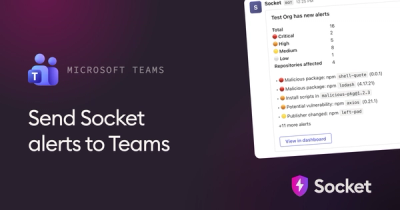
Microsoft Teams Notifications Are Now Available in Socket
Socket can now send alerts and supply chain attack notifications to Microsoft Teams, with filters that route the right updates to each channel.
By Jeppe Hasseriis - Sep 01, 2026
dsh-token-usage
Advanced tools
Token-usage statistics for the DeepSeek Harness settings UI: summary cards + 3-month heatmap of real token spend converted to official peak/off-peak prices (CNY/USD), incremental index
English | 中文


Turn every real token spend into a bill priced at the official peak/off-peak rates.
Summary cards + GitHub-style heatmap · real token cost estimates · auto-converted official prices
What it is · Screenshots · Features · How it works · Install · Configuration · Limitations · Development
dsh-token-usage is a token-usage statistics plugin for DeepSeek Harness (dsh). It adds a Usage Stats page to the Web settings panel: summary cards (total tokens / daily average / cache hit rate / estimated spend, switchable in one click between today / this week / this month) plus a 3-month GitHub-style heatmap — quantifying your real token consumption from past sessions and, crucially, converting it automatically to what it actually costs you at the official peak/off-peak prices (shown in CNY and USD side by side).
It's not a reskin of a native page — it shows your budget from the level that matters: which model is burning money, which hours are the most expensive, and how much the cache-hit rate saves you — all visible at a glance and priced precisely against the official rates.
Native dsh web | With this plugin |
|---|---|
| No token-usage stats entry | Settings → Usage Stats: summary cards + 3-month heatmap |
| No spend estimates | Real tokens × official peak/off-peak prices → estimated CNY & USD |
| No price management | Per-model price table: CNY / USD × peak / off-peak, edit inline |
| Hard-coded prices | Official defaults built in; ark-code-latest and other aliases auto-mapped |
All data comes from the usage field carried by assistant/message events in persisted session logs — the plugin is a pure observer: it never touches the agent loop and never reports anything to an external service. Everything stays on your machine.

Four cards at the top: total tokens, daily average, average cache hit rate, and estimated spend (CNY & USD together). Click to switch instantly between today / this week / this month (pure client state, no extra requests).
A GitHub-contribution-style horizontal week strip: one column per week, one row per weekday, with month boundaries annotated. Hover any day's cell to see that day's total tokens, input (cache miss), input (cache hit), output, cache hit rate, and spend (CNY / USD) — which day spiked, how much of the budget a week consumed, all at a glance.
Lists per-model prices for every connected model (from the ctx.llm model catalog), in CNY and USD, each split into peak / off-peak tiers for display and editing; ships official tiered defaults for deepseek-v4-flash and deepseek-v4-pro.
Switch the table's currency and period (peak / off-peak), edit prices inline, hit "Save prices" to persist — stats refresh instantly with the new prices (no restart).
Every call's spend is resolved from its own event timestamp — calls during Beijing peak hours (09:00–12:00, 14:00–18:00) are billed at the peak tier, all others at the off-peak tier (half of peak). Billing lands automatically all day, no manual tier picking.
Never modifies the agent loop, never uploads to any external service; the index is incremental and memory-bounded, answering hot requests in tens of milliseconds — install and forget it in the background.
$DSH_HOME/dsh-token-usage/index.json, restored from disk on restart with near-zero rescan, and memory is bounded to the 3-month stats window plus 45 days of slack. A 30s whole-page response cache covers the rest.This plugin installs directly into the native Web profile of DeepSeek Harness (web is a built-in profile shipped with the distribution; dsh web is a hardcoded alias for --profile web). Once installed, no profile flag is needed at launch — run pnpm dsh web from the harness checkout and the plugin is loaded.
dsh plugin --profile web add dsh-token-usage
dsh plugin --profile web add github:Tastelessor/dsh-usage-stats#<commit-sha>
# If the first add fails, add the package key pnpm printed to the web
# profile's pnpm-workspace.yaml:
#   $DSH_HOME/profiles/web/pnpm-workspace.yaml
#   allowBuilds:
#     dsh-token-usage: true
# then re-add.
dsh plugin --profile web add /path/to/dsh-token-usage
dsh plugin add ./uses a pnpm link and does not runprepare— runpnpm buildfirst, then add.
pnpm dsh web # from the DeepSeek Harness checkout; web is the built-in profile, no --profile
Override in the web profile's cordis.patch.yml ($DSH_HOME/profiles/web/cordis.patch.yml, or via a --patch overlay); the two currencies are configured independently, each model entry holds a peak / offPeak pair, and unset entries fall back to the built-in defaults:
- patch:
    - id: dsh-token-usage
      config:
        currency: CNY        # preferred currency: CNY (default, ¥) / USD ($)
        models:
          deepseek-v4-flash:
            cny:             # CNY prices (¥ / 1M tokens)
              peak:          # Beijing 09:00–12:00, 14:00–18:00
                inputPerM: 3.0         # input, cache miss
                cacheReadPerM: 0.10    # input, cache hit
                outputPerM: 9.0       # output
                cacheWritePerM: 0      # not billed by the official v4 pricing
              offPeak:       # all other hours (half of peak)
                inputPerM: 1.5
                cacheReadPerM: 0.05
                outputPerM: 4.5
                cacheWritePerM: 0
            usd:             # USD prices ($ / 1M tokens)
              peak:
                inputPerM: 0.44
                cacheReadPerM: 0.014
                outputPerM: 1.32
                cacheWritePerM: 0
              offPeak:
                inputPerM: 0.22
                cacheReadPerM: 0.007
                outputPerM: 0.66
                cacheWritePerM: 0
Legacy flat entries (a bare
inputPerM/cacheReadPerM/outputPerM/cacheWritePerMblock, as in pre-2026-08-17 configs) still parse and are treated as "the same price at all hours" — both tiers equal.The built-in defaults (
src/host/config.ts) match the official prices below; the in-page "Save prices" button writes exactly themodels.<id>.cny|usdshape shown here (both tiers) — no manual config editing needed.
Prices and spend match model ids exactly. ARK's coding endpoints advertise their model under ids like ark-code-latest (whose physical model changes over time; today it is DeepSeek V4 Flash — both the catalog and every usage event carry the alias id, so without a mapping the built-in deepseek-v4-flash price never matches). The plugin ships ark-code-latest → deepseek-v4-flash by default and lets you override/extend via aliases:
- patch:
    - id: dsh-token-usage
      config:
        aliases:
          ark-code-latest: deepseek-v4-flash   # built-in; point it at the physical model
          my-other-alias: deepseek-v4-pro
DeepSeek bills time-of-day tiers since 2026-08-17: peak hours are Beijing time 09:00–12:00 and 14:00–18:00; off-peak is half of peak (¥ / $ per 1M tokens, cache hit / miss / output):
| Model | Off-peak CNY | Peak CNY | Off-peak USD | Peak USD |
|---|---|---|---|---|
| deepseek-v4-flash | 0.05 / 1.5 / 4.5 | 0.10 / 3.0 / 9.0 | $0.007 / $0.22 / $0.66 | $0.014 / $0.44 / $1.32 |
| deepseek-v4-pro | 0.15 / 4.5 / 13.5 | 0.30 / 9.0 / 27.0 | $0.022 / $0.66 / $1.98 | $0.044 / $1.32 / $3.96 |
Spend estimation resolves each usage event's own timestamp against these windows (Beijing time, UTC+8 — independent of the host's timezone), so peak-hour and off-peak calls land on their correct rates automatically.
Implementation note: dsh's web settings API (
settings.mutate) only exposes a hardcoded allowlist of host namespaces — external plugin namespaces are rejected (settings-not-exposed) — so price write-back goes through the plugin's ownPOST /dsh-token-usage/pricesroute, which callsctx.settingsin-process (exactly equivalent to hand-editing the config).
reasoningTokens is a subset of output tokens and is never counted twice.pnpm install # install deps (peers are provided by the dsh profile at runtime)
pnpm test # vitest, 85 tests
pnpm typecheck # tsc --noEmit
pnpm build # tsdown build into lib/
Like this project? Give it a ⭐ Star.
FAQs
Token-usage statistics for the DeepSeek Harness settings UI: summary cards + 3-month heatmap of real token spend converted to official peak/off-peak prices (CNY/USD), incremental index
The npm package dsh-token-usage receives a total of 542 weekly downloads. As such, dsh-token-usage popularity was classified as not popular.
We found that dsh-token-usage demonstrated a healthy version release cadence and project activity because the last version was released less than a year ago. It has 1 open source maintainer collaborating on the project.
Product
Socket can now send alerts and supply chain attack notifications to Microsoft Teams, with filters that route the right updates to each channel.

Security News
pnpm 12 rewrites the package manager in Rust, cutting install times by up to 90% while preserving pnpm 11 workflows and lockfiles.

Security News
Socket CTO Ahmad Nassri joins AppSec leaders at Black Hat to discuss active malware, package manager risks, and software supply chain defense.