
Product
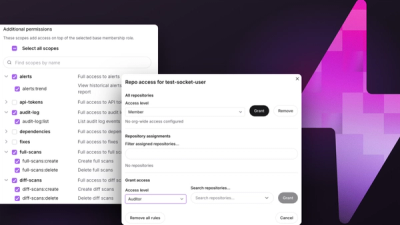
Introducing Repository Access Permissions and Custom Roles
Socket now supports Custom Roles and Repository Access Permissions so organizations can control who can access specific repositories and actions.
By Joe Werle - Jun 19, 2026
ember-cli-airbrake
Advanced tools

ember-cli-airbrake is an Ember CLI addon for integrating the Airbrake JS error notifier into your app.
ember install ember-cli-airbrakeconfig/environment.js with an airbrake object that includes projectId and projectKey:// in "production" environment section, e.g.:
ENV.airbrake = {
projectId: '123456',
projectKey: 'your-project-key'
}
Installing the addon will install the NPM component for the airbrake client. This addon uses the airbrake client version 0.5.9.
You most likely will want to only configure airbrake for your production environment.
The window.onerror and Ember.onerror handlers will only be set if there is an airbrake configuration for a particular environment.
In all cases, an airbrake service will be exposed. If airbrake isn't configured the airbrake service uses the Ember.K "no-op" function for its methods. This facilitates the usage of the airbrake service without having to add environment-checking code in your app.
If you are using Errbit, the open-source Airbrake API compatible error catcher, you must also set the host parameter to your errbit installation.
Example configuration for the production environment:
// config/environment.js
module.exports = function(environment) {
  var ENV = {
    /* ... */

  if (environment === 'production') {
    ENV.airbrake = {
      projectId:  'my_project_id',
      projectKey: 'my_project_key'
      // host: 'http://errors.myapp.com/'
    };
  }

  return ENV;
};
After installing the addon and configuring it properly, errors will be reported to airbrake. If you want to use the airbrake client to explicitly notify errors, you can use the exposed airbrake service.
airbrake serviceThe airbrake service exposes the following methods:
notify(error) -- if you want to explicitly notify errors. Normally this will not be necessaryaddFilter(filterFn) -- refer to the airbrake client js documentationaddReporter(reporter) -- refer to the airbrake client js documentationsetSession(sessionData) -- adds a filter to the client that sets the session data to all future error notificationsThe airbrake js client uses "filters" to optionally limit reported notifications or to modify the body of an individual notification.
To include user data with your error notices, add a filter that modifies notice.session.
Example:
// in application route, or somewhere else that has determined a user is logged in
airbrake: Ember.inject.service(),

identifyUser: function(userData) {
  let airbrake = this.get('airbrake');
  airbrake.setSession(userData);
  // future notices will have their `notice.session` property set to the value of `userData`
}
Normally the window.onerror or Ember.onerror handlers will do this for you, but if you want to
explicitly notify of an error, use the airbrake service's notify method:
// ... some-component.js
airbrake: Ember.inject.service(),

notifyOfError: function() {
  let airbrake = this.get('airbrake');
  airbrake.notify(new Error('this is the error'));
}
In any environment where config.airbrake is not set (such as your test environment, typically),
the error handlers for airbrake notification will not be set up. The airbrake service will still
exist, but all its methods will be no-ops. This way your tests will still run happily even
if they use, e.g. airbrake.setSession to set user session information.
FAQs
An ember-cli addon that integrates airbrake error reporting
We found that ember-cli-airbrake demonstrated a not healthy version release cadence and project activity because the last version was released a year ago. It has 2 open source maintainers collaborating on the project.
Did you know?

Socket for GitHub automatically highlights issues in each pull request and monitors the health of all your open source dependencies. Discover the contents of your packages and block harmful activity before you install or update your dependencies.
Product
Socket now supports Custom Roles and Repository Access Permissions so organizations can control who can access specific repositories and actions.
Product
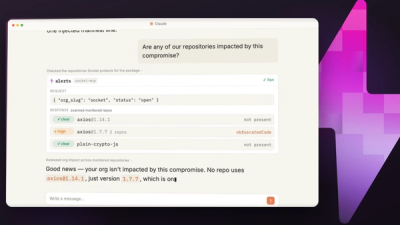
Socket MCP now lets AI assistants review org alerts, investigate threats using the Socket threat feed, and inspect package files in addition to dependency scoring.
Product
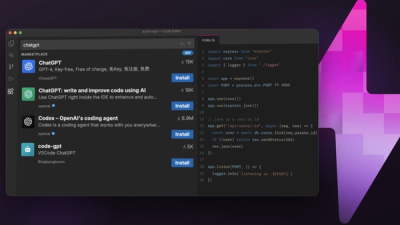
Socket Firewall blocks malicious VS Code and Open VSX extensions before install, protecting developers from compromised editor marketplaces.