

Company News
AWS Security Hub Adds Socket for Supply Chain Security
Socket is now in the AWS Security Hub Extended plan. Adopt it through AWS, apply committed spend, and block malicious open source packages.
By Feross Aboukhadijeh - Aug 04, 2026
Model Context Protocol (MCP) server for Enpass vaults: unlock, list vaults, list and read entries, create entries. Master passwords are kept in the OS keychain and never pass through the model.
A Model Context Protocol (MCP) server that gives an AI assistant controlled, local access to your Enpass password vaults: unlock a vault, list vaults, and list and read entries. Creating and deleting entries is possible too, but switched off until you enable it.
Runs locally over stdio. Your Enpass vault never leaves your machine, and your master password never passes through the model: it is stored in your operating system's keychain and read directly by the server.
unlock_vault tool deliberately takes no
password parameter, so the password can never end up in the model's context or in
logs.vault.enpassdb file
directly with SQLCipher. Nothing is uploaded anywhere.get_item / get_password, when you explicitly ask for them.ENPASS_MCP_ALLOW_WRITES=1 to enable them (see Writing).Entry passwords are, by design, returned to the assistant when you ask for them, so only connect this to an assistant and vaults you trust.
vault.enpassdb, SQLCipher format)Native dependencies (better-sqlite3-multiple-ciphers, @napi-rs/keyring) ship
prebuilt binaries for common platforms, so no compiler is required in the normal case.
git clone https://github.com/bitterdev/enpass-mcp.git
cd enpass-mcp
npm install
npm link   # optional: makes the `enpass-mcp` command available globally
This is the secure step that keeps the master password away from the model. You run it yourself; the password is typed into a hidden prompt and stored in the OS keychain.
# Find your vault files automatically
enpass-mcp discover

# Register a vault (you will be prompted for the master password)
enpass-mcp add-vault personal --path "/Users/you/Documents/Enpass/Vaults/primary/vault.enpassdb"
enpass-mcp add-vault work     --path "/path/to/work/vault.enpassdb"

# With a keyfile
enpass-mcp add-vault personal --path "/path/vault.enpassdb" --keyfile "/path/vault.keyfile"

# Manage
enpass-mcp list-vaults
enpass-mcp test-unlock personal
enpass-mcp remove-vault work
add-vault verifies the password can actually unlock the vault before saving it.
The vault file is usually found at:
| OS | Typical location |
|---|---|
| macOS | ~/Documents/Enpass/Vaults/<vault>/vault.enpassdb |
| Windows | %USERPROFILE%\Documents\Enpass\Vaults\<vault>\vault.enpassdb |
| Linux | ~/Documents/Enpass/Vaults/<vault>/vault.enpassdb |
If you sync via Dropbox / OneDrive / WebDAV, point --path at the synced copy.
The server speaks MCP over stdio. Point your MCP client at enpass-mcp serve.
Claude Desktop (claude_desktop_config.json):
{
  "mcpServers": {
    "enpass": {
      "command": "enpass-mcp",
      "args": ["serve"]
    }
  }
}
If you did not run npm link, use the absolute path instead:
{
  "mcpServers": {
    "enpass": {
      "command": "node",
      "args": ["/absolute/path/to/enpass-mcp/src/cli.js", "serve"]
    }
  }
}
Claude Code:
claude mcp add enpass -- enpass-mcp serve
| Tool | Description |
|---|---|
list_vaults | List registered vaults, whether their file exists, whether a password is stored, and whether they are unlocked. |
unlock_vault | Unlock a vault using the master password from the OS keychain. Takes only a vault name, never a password. |
lock_vault | Lock a vault and clear its derived key from memory. |
list_items | List entries (title, username, URL). Never returns passwords. Supports query, category, folder, limit. |
get_item | Return a full entry including all field values (password, TOTP, etc.) and its attachment list. |
get_password | Return the password and, if present, the current TOTP code of an entry. |
get_otp | Generate the current TOTP / 2FA one-time code for an entry, with seconds until it rotates. |
list_attachments | List an entry's file attachments (name, size, MIME). |
export_attachment | Decrypt an attachment; writes it to disk and returns the path (or base64 inline for small files). |
sync_status | List the vaults that use Enpass folder sync and whether the copy in the sync folder is newer. |
With ENPASS_MCP_ALLOW_WRITES=1 three more tools appear (see Writing):
| Tool | Description |
|---|---|
create_item | Create an entry, including custom fields; sensitive values are encrypted the way Enpass does it. |
delete_item | Delete an entry, or move it to the trash, leaving the tombstone Enpass uses so the deletion syncs. |
sync_pull | Take in a newer copy from the sync folder, after backing up the local vault. |
list_items / get_item work for every Enpass entry type (logins, credit
cards, secure notes, identities, etc.), not just logins, and return all fields.
A typical assistant flow: list_vaults → unlock_vault → list_items → get_password.
Enpass stores each vault as a standard SQLCipher database (vault.enpassdb). The raw
encryption key is derived from your master password (optionally combined with a
keyfile) and the 16-byte salt at the start of the file:
cipher_compatibility 4 (Enpass 6.8+) or 3 (older vaults)The server tries these combinations automatically, so it works across Enpass vault versions. The derived key is kept in memory only, for the lifetime of the server process, and is never written to disk or returned to the model.
References: Enpass Security Whitepaper, hazcod/enpass-cli.
Enpass encrypts every value flagged as "sensitive" a second time, underneath
SQLCipher, with a key that belongs to the entry rather than the vault. Fields
carrying that layer have itemfield.algo_version = 1:
| Piece | Where | Layout |
|---|---|---|
| Key and nonce | item.key | 44 bytes: 32-byte AES-256 key, then a 12-byte GCM nonce |
| Value | itemfield.value | hex of ciphertext || 16-byte GCM tag |
| Additional data | the entry's uuid | hyphens stripped, hex-decoded to 16 raw bytes |
Binding the AAD to the entry uuid is what makes a value unusable if it is copied into
another entry. Enpass did not re-encrypt existing entries when it introduced this
layer, so one vault mixes ciphertext and plaintext under the same algo_version; a
value is treated as encrypted only when it has the shape of a payload (pure hex, whole
bytes, longer than the tag on its own).
A value that looks encrypted but fails authentication is returned as null with
decryptionFailed: true, never as the raw column content: stored ciphertext is a
plausible-looking string, and handing that back would silently pass off a wrong secret
as a real one.
Entries with a one-time-password secret (stored by Enpass as an otpauth:// URI)
can produce a live 2FA code: get_otp returns the current 6-digit code and the
seconds until it rotates, and get_password includes the current code alongside the
password. This lets an assistant fill both the password and the 2FA prompt.
Enpass keeps file attachments encrypted. Small files (up to 1 KB) sit inline in the
vault; larger files live in separate <uuid>.enpassattach SQLCipher files next to the
vault, each encrypted with its own key stored in the vault. export_attachment handles
both: it decrypts the file and, by default, writes it to disk and returns the path, so
it works for files of any size without pushing binary data through the model.
External-attachment handling is implemented from Enpass's documented format. If you hit
a vault whose attachments do not decrypt, please open an issue with the (non-secret)
schema of your attachment table.
Writing is switched off by default. A password vault is the last place where a tool
should be able to change data just because a model decided to, so the server starts
read-only and does not even list create_item, delete_item and sync_pull until you
turn them on:
ENPASS_MCP_ALLOW_WRITES=1
Set it in the server's environment (in your MCP client config, or in the .env next to
vaults.json). Nothing else changes: reading works exactly the same either way.
Enpass must be closed while writing. The app keeps the database in memory and would write its own cached copy back over any change made underneath it. Every writing tool refuses to run while Enpass is open.
Earlier versions of this README claimed writing was impossible because recent vaults (schema version 6) crash Enpass when entries are inserted directly. The crash was real, the diagnosis was wrong. Three concrete rules make it work, all of them derived from what Enpass itself writes:
NULL. The crash is EXC_BAD_ACCESS in strlen on a null
pointer: a column omitted from the INSERT defaults to NULL, and the app calls
strlen on it. Every column is written explicitly, empty strings instead of NULL.login.default always carries the same nine
fields, in the same order, with the same field uids, even when most are empty.
Writing only the fields you happen to have a value for produces an entry the app
cannot render.item.key is a 32-byte AES-256 key plus a
12-byte GCM nonce, stored as hex(ciphertext || tag) with the item UUID as
additional authenticated data. Nothing in it is tied to Enpass internals, so a fresh
random key per item is fine.Verified end to end against a real vault: written, read back, decrypted to the original, deleted, synced in both directions, and Enpass opens the vault without crashing.
Master passwords are in the OS keychain; only non-secret data (vault names and paths)
is stored in a small vaults.json:
~/Library/Application Support/enpass-mcp/vaults.json%APPDATA%\enpass-mcp\vaults.json~/.config/enpass-mcp/vaults.jsonOverride the directory with ENPASS_MCP_CONFIG_DIR.
Environment variables:
| Variable | Effect |
|---|---|
ENPASS_MCP_ALLOW_WRITES | 1, true, yes or on enables the writing tools. Anything else, including unset, keeps the server read-only. |
ENPASS_MCP_CONFIG_DIR | Where vaults.json and the optional .env live. |
ENPASS_MASTER_PASSWORD | Optional fallback master password for vaults without a keychain entry. Prefer the keychain. |
ENPASS_MASTER_PASSWORD_<VAULT> | Same, for one specific vault. |
npm test                    # runs against genuine SQLCipher fixtures in test/fixtures

# Rebuild the fixtures from scratch with real SQLCipher (vault + entries + attachments)
npm install --no-save @journeyapps/sqlcipher
npm run generate-fixtures
CI (GitHub Actions) creates a vault from scratch with real SQLCipher, seeds entries and attachments, then runs the full read-only test suite on Node 18/20/22.
MIT © Fabian Bitter
FAQs
Model Context Protocol (MCP) server for Enpass vaults: unlock, list vaults, list and read entries, create entries. Master passwords are kept in the OS keychain and never pass through the model.
The npm package enpass-mcp receives a total of 51 weekly downloads. As such, enpass-mcp popularity was classified as not popular.
We found that enpass-mcp demonstrated a healthy version release cadence and project activity because the last version was released less than a year ago. It has 1 open source maintainer collaborating on the project.
Did you know?

Socket for GitHub automatically highlights issues in each pull request and monitors the health of all your open source dependencies. Discover the contents of your packages and block harmful activity before you install or update your dependencies.
Company News
Socket is now in the AWS Security Hub Extended plan. Adopt it through AWS, apply committed spend, and block malicious open source packages.
Research
/Security News
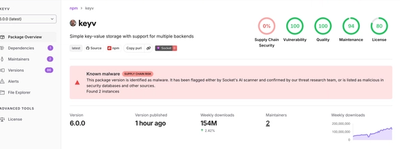
Popular npm packages keyv and cacheable compromised.

Security News
A misconfiguration gave three Anthropic models internet access, and one, believing it was in a simulation, shipped a credential-stealing package to PyPI.