

Product
PHP and Composer Support Is Now in Beta
Socket’s PHP and Composer support is now in Beta for all customers, with PHP reachability analysis generally available.
By Trevor Norris, Benjamin Barslev - Aug 21, 2026
Parse in reverse. AST goes in, code comes out.
import { print } from 'esrap';
import ts from 'esrap/languages/ts';
const ast = {
type: 'Program',
body: [
{
type: 'ExpressionStatement',
expression: {
callee: {
type: 'Identifier',
name: 'alert'
},
arguments: [
{
type: 'Literal',
value: 'hello world!'
}
]
}
}
]
};
const { code, map } = print(ast, ts());
console.log(code); // alert('hello world!');
If the nodes of the input AST have loc properties (e.g. the AST was generated with acorn with the locations option set), sourcemap mappings will be created.
esrap ships with two built-in languages — ts() and tsx() (considered experimental at present!) — which can print ASTs conforming to @typescript-eslint/types (which extends ESTree):
import ts from 'esrap/languages/ts';
import tsx from 'esrap/languages/tsx'; // experimental!
Both languages accept an options object:
const { code, map } = print(
  ast,
  ts({
    // how string literals should be quoted — `single` (the default) or `double`
    quotes: 'single',

    // an array of `{ type: 'Line' | 'Block', value: string, loc: { start, end } }` objects
    comments: [],

    // a pair of functions for inserting additional comments before or after a given node.
    // returns `Array<{ type: 'Line' | 'Block', value: string }>` or `undefined`
    getLeadingComments: (node) => [{ type: 'Line', value: ' a comment before the node' }],
    getTrailingComments: (node) => [{ type: 'Block', value: ' a comment after the node' }]
  })
);
You can generate the comments array by, for example, using Acorn's onComment option.
You can also create your own languages:
import { print, type Visitors } from 'esrap';

const language: Visitors<MyNodeType> = {
  _(node, context, visit) {
    // the `_` visitor handles any node type
    context.write('[');
    visit(node);
    context.write(']');
  },
  List(node, context) {
    // node.type === 'List'
    for (const child of node.children) {
      context.visit(child);
    }
  },
  Foo(node, context) {
    // node.type === 'Foo'
    context.write('foo');
  },
  Bar(node, context) {
    // node.type === 'Bar'
    context.write('bar');
  }
};

const ast: MyNodeType = {
  type: 'List',
  children: [{ type: 'Foo' }, { type: 'Bar' }]
};

const { code, map } = print(ast, language);

code; // `[[foo][bar]]`
The context API has several methods:
context.write(data: string, node?: BaseNode) — add a string. If node is provided and has a standard loc property (with start and end properties each with a line and column), a sourcemap mapping will be createdcontext.indent() — increase the indentation level, typically before adding a newlinecontext.newline() — self-explanatorycontext.space() — adds a space character, if it doesn't immediately follow a newlinecontext.margin() — causes the next newline to be repeated (consecutive newlines are otherwise merged into one)context.dedent() — decrease the indentation level (again, typically before adding a newline)context.visit(node: BaseNode) — calls the visitor corresponding to node.typecontext.location(line: number, column: number) — insert a sourcemap mapping without calling context.write(...)context.measure() — returns the number of characters contained in contextcontext.empty() — returns true if the context has no contentcontext.new() — creates a child contextcontext.append(child) — appends a child contextIn addition, context.multiline is true if the context has multiline content. (This is useful for knowing, for example, when to insert newlines between nodes.)
To understand how to wield these methods effectively, read the source code for the built-in languages.
You can pass the following options:
const { code, map } = print(ast, ts(), {
  // Populate the `sources` field of the resulting sourcemap
  // (note that the AST is assumed to come from a single file)
  sourceMapSource: 'input.js',

  // Populate the `sourcesContent` field of the resulting sourcemap
  sourceMapContent: fs.readFileSync('input.js', 'utf-8'),

  // Whether to encode the `mappings` field of the resulting sourcemap
  // as a VLQ string, rather than an unencoded array. Defaults to `true`
  sourceMapEncodeMappings: false,

  // String to use for indentation — defaults to '\t'
  indent: '  '
});
Because it's ginormous.
This repo uses pnpm. Once it's installed, do pnpm install to install dependencies, and pnpm test to run the tests.
FAQs
Parse in reverse
The npm package esrap receives a total of 3,326,628 weekly downloads. As such, esrap popularity was classified as popular.
We found that esrap demonstrated a healthy version release cadence and project activity because the last version was released less than a year ago. It has 2 open source maintainers collaborating on the project.
Product
Socket’s PHP and Composer support is now in Beta for all customers, with PHP reachability analysis generally available.
Product
Socket is bringing experimental protection to Firefox, scanning 97,000+ extensions in Mozilla's official directory for malware and risky updates.
Research
/Security News
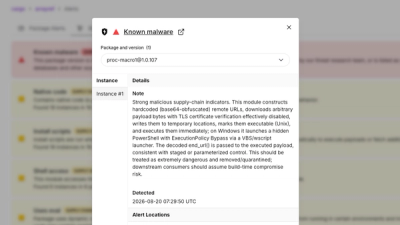
Three compromised Rust crates pulled in a malicious dependency that downloaded and executed cross-platform malware during Cargo builds.