


Product
PHP and Composer Support Is Now in Beta
Socket’s PHP and Composer support is now in Beta for all customers, with PHP reachability analysis generally available.
By Trevor Norris, Benjamin Barslev - Aug 21, 2026
evolveguard-cli
Advanced tools
Regression-testing CLI for self-edited Claude Agent Skills (SKILL.md, MEMORY.md) -- golden-transcript record/replay against a skill's own declared and inferred capability surface, zero hosted infrastructure.


Catch behavioral drift when a Claude Agent Skill edits itself, before the edit ships.
# PyPI -- Python CLI + library (genuine port)
pip install evolveguard-cli
# npm -- JavaScript/TypeScript CLI + library
npm install -g evolveguard-cli
Both packages are live and named consistently:
evolveguard-clion PyPI andevolveguard-clion npm (renamed 2026-07-19 from the old plainevolveguard, which is now deprecated).npm install -g evolveguard-cliandpip install evolveguard-cliboth work today; the demo GIFs below were recorded against the published packages, not a local build.

Claude Code's Agent Skills can be authored by a human, or by an agent itself: /skillify
turns a workflow into a SKILL.md, and the auto-memory system in this same environment
writes MEMORY.md files that quietly change what an agent does in its next session.
None of that gets a regression check today. A skill edit that breaks a working workflow
looks exactly like a skill edit that fixes one, until someone notices the agent stopped
doing something it used to do.
evolveguard records a baseline of a skill's own capability surface (what tools it's declared or shown to use), then re-derives that surface every time the skill file changes and diffs the result against the baseline: same tool-call sequence, or a flagged drift with a specific reason.
evolveguard record ./SKILL.md --fixtures ./fixtures.json
# ... skill gets edited, by a human or an agent ...
evolveguard check ./SKILL.md
EvolveGuard v0.1.0 -- Regression Check
skill: monorepo-scanner  baseline: 2026-07-15  fixtures: 1

[DRIFT] fixture: "scan a monorepo"  new tool call: fs.write (baseline had none)
         -> new tool call: fs.write (baseline had none) -- this edit introduces a
            capability the baseline never used

0 PASS, 1 DRIFT, 0 FAIL
exit code 1 (DRIFT blocks merge by default; override with --allow-drift)
That's real output from this repo's own fixtures/labeled-non-breaking-edits/case-03-add-write-capability/
test case, wired to filesystem: read-only -> read-write in the skill's frontmatter.

evolveguard does not run a live LLM agent, and it does not replay a real conversation transcript. It is a static, deterministic tool by design:
record parses a skill file's YAML frontmatter (declared tools, network,
filesystem, scope, and any bundled hooks), scans the skill's body text and any
hook scripts for static evidence of network calls or filesystem writes, and combines
both into a capability surface -- the set of tools the skill is declared or shown
to use. Each fixture's expectedToolCalls filters that surface down to the tools the
fixture author says it cares about; the result is the recorded baseline.check re-reads the (possibly edited) skill file, re-derives its capability
surface with the exact same logic, and re-filters it per fixture.diff compares baseline vs. current per fixture (PASS if the tool set and scopes
match, DRIFT with a specific reason otherwise), and separately diffs the whole
capability surface so a new capability that no fixture's expectedToolCalls happened
to cover still gets caught, instead of silently passing.evolveguard detects changes in what a skill is declared or shown to be capable of. It
can't tell you whether a live agent run would actually behave differently on a given
prompt -- that's a real, intentional scope limit. The tradeoff: it just needs a
SKILL.md file and a fixtures file, with nothing hosted and no SDK to integrate against,
which is also why it runs fully offline in a pre-commit hook or CI job.
Braintrust is a general LLM eval and observability platform. It is a strong choice
if you're already logging traces from a live agent and want statistical eval scoring
across runs, but it needs SDK integration and an eval-definition step per app. evolveguard
needs neither: point it at one SKILL.md file and a fixtures JSON, and it works.
agent-eval (this same author's other
repo) answers a different, more general question: "did my agent's behavior change
between two versions I define," for any agent, framework-agnostic, requiring you to
stand up and run both versions yourself. evolveguard answers a narrower, structurally
different question, triggered directly by a file diff on SKILL.md/MEMORY.md: did
this specific edit change the capability surface the baseline recorded. It parses the
skill artifact itself and never asks you to define or run anything live.
| evolveguard | Braintrust | agent-eval | |
|---|---|---|---|
| Setup | record + check against one file | SDK integration, eval definitions | Define and run two agent versions |
| Trigger | SKILL.md/MEMORY.md file diff | Manual eval run | Manual A/B run |
| Mechanism | Static capability-surface diff | Live-run trace scoring | Statistical behavior comparison |
| Hosted infra | None | Hosted platform | None |
| Live LLM calls | None | Yes (scores real runs) | Yes (runs both versions) |
| Best for | Self-edited Claude Agent Skills specifically | General LLM app eval/observability | Any agent, generic A/B regression |
# 1. Record a baseline against a skill and its labeled fixtures
evolveguard record ./skills/my-skill/SKILL.md --fixtures ./fixtures/my-skill.json
# writes ./skills/my-skill/.evolveguard-baseline.json

# 2. Edit the skill (by hand, or let an agent edit it)

# 3. Check for drift
evolveguard check ./skills/my-skill/SKILL.md
# writes ./evolveguard-report.json, exits 1 if drift was found
A fixtures file is a JSON array of labeled prompts and the tool-call shapes each one is expected to touch:
[
  {
    "id": "scan-a-monorepo",
    "prompt": "scan a monorepo",
    "expectedToolCalls": [{ "tool": "fs.read" }, { "tool": "fs.write" }]
  }
]
expectedToolCalls is optional -- omit it and the fixture is treated as exercising the
skill's entire capability surface. scopeMatches (a glob) narrows a tool to a specific
filesystem scope, e.g. { "tool": "fs.write", "scopeMatches": "./workspace/**" }.
Generated from the actual --help output of the built CLI.
evolveguard --helpUsage: evolveguard [options] [command]
Regression-testing CLI for self-edited Claude Agent Skills (SKILL.md,
MEMORY.md) -- golden-transcript record/replay against a skill's own declared
and inferred capability surface, zero hosted infrastructure.
Options:
-V, --version output the version number
-h, --help display help for command
Commands:
record [options] <skillPath> Record a golden-transcript baseline for a
skill against a set of labeled fixtures
check [options] <skillPath> Replay the fixtures from a baseline against
the current (possibly edited) skill and report
drift
report [options] [reportPath] Print a previously generated
evolveguard-report.json
mcp [coming soon] Expose record/check/report as
MCP tools for a coding agent to call
mid-session
help [command] display help for command
evolveguard record --helpUsage: evolveguard record [options] <skillPath>
Record a golden-transcript baseline for a skill against a set of labeled
fixtures
Arguments:
skillPath path to the SKILL.md or MEMORY.md file to baseline
Options:
--fixtures <path> path to a fixtures JSON file (array of {id, prompt,
expectedToolCalls?})
--baseline <path> path to write the baseline file (default:
<skill-dir>/.evolveguard-baseline.json)
--json output structured JSON instead of human-readable text
(default: false)
-h, --help display help for command
evolveguard check --helpUsage: evolveguard check [options] <skillPath>
Replay the fixtures from a baseline against the current (possibly edited) skill
and report drift
Arguments:
skillPath path to the SKILL.md or MEMORY.md file to check
Options:
--baseline <path> path to the baseline file (default:
<skill-dir>/.evolveguard-baseline.json)
--report <path> path to write the report file (default:
"./evolveguard-report.json")
--allow-drift exit 0 even if drift is detected (drift is still reported)
(default: false)
--json output structured JSON instead of human-readable text
(default: false)
-h, --help display help for command
evolveguard report --helpUsage: evolveguard report [options] [reportPath]
Print a previously generated evolveguard-report.json
Arguments:
reportPath path to the report file (default: "./evolveguard-report.json")
Options:
--json output structured JSON instead of human-readable text (default:
false)
-h, --help display help for command
Exit codes: 0 all fixtures PASS and no surface-level drift, 1 at least one DRIFT
was found (pass --allow-drift to still exit 0 while still reporting it), 2 a usage
error or a file that failed to parse.
Every subcommand supports --json for structured output an agent can parse directly:
evolveguard check ./SKILL.md --json
{
  "schemaVersion": 1,
  "skillName": "monorepo-scanner",
  "results": [
    {
      "id": "scan-a-monorepo",
      "verdict": "DRIFT",
      "changes": [
        /* ... */
      ]
    }
  ],
  "surfaceChanges": [],
  "summary": { "pass": 0, "drift": 1, "total": 1 },
  "exitCode": 1
}
evolveguard mcp is documented but not implemented yet -- see the CLI reference above.
Until it ships, call record/check/report --json directly as a subprocess from your
coding agent.
evolveguard also exports a programmatic API for the same pipeline, if you'd rather integrate it into your own tooling than shell out to the CLI. Both distributions expose the same functions and the same JSON-compatible file format -- a baseline recorded with one CLI can be checked with the other (see docs/concepts.md).
TypeScript:
import {
  recordBaseline,
  replaySkill,
  diffAll,
  writeBaseline,
  readBaseline,
} from 'evolveguard';

const baseline = recordBaseline('./SKILL.md', './fixtures.json');
writeBaseline('./.evolveguard-baseline.json', baseline);

// ... skill gets edited ...

const saved = readBaseline('./.evolveguard-baseline.json');
const replay = replaySkill('./SKILL.md', saved);
const report = diffAll(saved, replay);
See src/evolveguard/index.ts for the full exported surface: parseSkillFile,
deriveCapabilitySurface, loadSkill, buildFixtureSnapshots, loadFixtures,
recordBaseline, replaySkill, diffFixture, diffAll, diffSurface, writeBaseline,
readBaseline, writeReport, readReport, plus the shared types.ts interfaces.
Python (pip install evolveguard-cli):
from evolveguard import record_baseline, replay_skill, diff_all, write_baseline, read_baseline

baseline = record_baseline("./SKILL.md", "./fixtures.json")
write_baseline("./.evolveguard-baseline.json", baseline)

# ... skill gets edited ...

saved = read_baseline("./.evolveguard-baseline.json")
replay = replay_skill("./SKILL.md", saved)
report = diff_all(saved, replay)
See python/README.md for the Python-specific walkthrough and
the same exported surface under evolveguard/__init__.py.
No accuracy claim ships without the command that produced it. Run:
npx vitest run src/evolveguard/benchmark.test.ts
against fixtures/labeled-non-breaking-edits/ -- a small, hand-labeled corpus of real
before/after SKILL.md pairs (wording tweaks and typo fixes labeled non-breaking; a
filesystem-scope widen, a new write capability, and a hook script gaining a network call
labeled breaking). As of this commit: 0% false positives (0 of 2 non-breaking cases
flagged as drift). The corpus is small and will grow as more real skill edits are
reported; see fixtures/labeled-non-breaking-edits/README.md.
evolveguard is a command-line tool and TypeScript library that detects capability drift
in Claude Agent Skill files (SKILL.md) and Claude Code auto-memory files (MEMORY.md)
after they are edited, by a human or by an agent. It works by parsing a skill's declared
frontmatter scope and any static evidence of network or filesystem-write behavior in its
body text and bundled hook scripts, snapshotting that as a baseline, and re-deriving the
same snapshot after an edit to diff against it. It exists because Claude Code's Agent
Skills ecosystem lets skills and memory files change an agent's behavior without a
human necessarily reviewing every edit for regression, and no existing tool checks that
specific artifact shape without requiring SDK integration or a live agent run.
This is a v0.1 release: a small, focused addition to the existing Claude Agent Skills ecosystem. It ships fully MIT-licensed with no proprietary tier, as two independent, equally first-class packages:
evolveguard-cli, Python) -- live at
pypi.org/project/evolveguard-cli. A
genuine independent port, not a wrapper around the Node binary (see
python/README.md). pip install evolveguard-cli installs it
directly. The package was originally published under the name evolveguard; that
older PyPI project is retired and no longer receives updates -- install
evolveguard-cli instead.evolveguard-cli, TypeScript) -- live at
npmjs.com/package/evolveguard-cli.
npm install -g evolveguard-cli installs it directly. Renamed 2026-07-19 from the
old plain evolveguard, which is now deprecated, to match the PyPI package's
naming convention.What is evolveguard, exactly?
A command-line tool and library that detects capability drift in Claude Agent Skill
files (SKILL.md) and Claude Code auto-memory files (MEMORY.md) after they are
edited. It is not a self-evolving agent framework and does not build, run, or host
agents itself -- it is a regression-testing CI gate that reacts to a file diff on a
skill artifact that already changed, by a human or an agent. See "What is evolveguard,
and why does it exist" above for the full definition.
Does evolveguard call an LLM? No. Record and check are both fully static and deterministic -- see "How it works" above.
What's the core differentiator versus a general testing or eval tool?
It needs nothing hosted and nothing to integrate: point it at one SKILL.md file and a
fixtures JSON, and record/check work immediately, with zero SDK integration and no
live agent run. That is the tradeoff the "How it's different" table above documents --
narrower scope than a general eval platform, in exchange for zero setup.
How does evolveguard compare to Braintrust?
Braintrust is a general LLM eval and observability platform: it needs SDK integration
and an eval-definition step, and it scores real traces from a live agent run.
evolveguard needs neither -- it parses the skill file itself and never calls an LLM. Use
Braintrust if you're already logging traces and want statistical eval scoring across
runs; use evolveguard if you want a pre-commit or CI check that a SKILL.md/MEMORY.md
edit didn't silently widen what the skill can do. See the comparison table in "How it's
different" above for the full breakdown, including how it compares to this same
author's agent-eval.
Does it work with MEMORY.md files, which have no frontmatter? Yes. A file with no frontmatter is parsed with an empty declared scope, so its capability surface comes entirely from static evidence found in the body text.
What platforms does it run on, and how do I install it?
The npm package requires Node.js >=20.12 (any OS Node supports) and installs with
npm install -g evolveguard-cli. The PyPI package requires Python >=3.9 and installs with
pip install evolveguard-cli; both distributions are pure-library/CLI packages with no
native bindings, so there is no OS-specific build step on either side.
What's a real limitation to know about before relying on this?
It only sees declared or shown capability, not runtime behavior -- a skill could pass
check and still behave differently on a given prompt in ways that don't touch its
capability surface. The false-positive benchmark (see "False-positive rate" above) is
also currently a small, hand-labeled corpus of 5 before/after pairs, not a large dataset,
so treat the 0% figure as a starting measurement, not a statistical guarantee. The
mcp subcommand is also documented but not implemented yet in either distribution.
Is this a general agent-evolution framework? No. See "How it's different" above -- evolveguard deliberately does not build or host a self-evolving agent framework; it only tests skill/memory edits that already happened.
Is evolveguard free to use, including commercially? Yes. It's MIT-licensed with no proprietary tier or paid version -- see LICENSE. You can use, modify, and redistribute it, including in commercial projects, under the standard MIT terms.
See CONTRIBUTING.md.
See SECURITY.md.
MIT. See LICENSE.
FAQs
Regression-testing CLI for self-edited Claude Agent Skills (SKILL.md, MEMORY.md): golden-transcript record/replay against a skill's own declared and inferred capability surface, zero hosted infrastructure.
The npm package evolveguard-cli receives a total of 20 weekly downloads. As such, evolveguard-cli popularity was classified as not popular.
We found that evolveguard-cli demonstrated a healthy version release cadence and project activity because the last version was released less than a year ago. It has 2 open source maintainers collaborating on the project.
Product
Socket’s PHP and Composer support is now in Beta for all customers, with PHP reachability analysis generally available.
Product
Socket is bringing experimental protection to Firefox, scanning 97,000+ extensions in Mozilla's official directory for malware and risky updates.
Research
/Security News
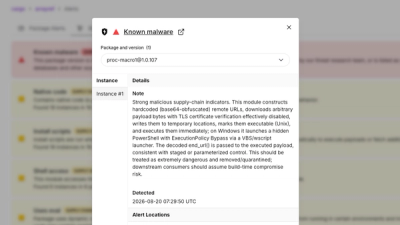
Three compromised Rust crates pulled in a malicious dependency that downloaded and executed cross-platform malware during Cargo builds.