


Security News
Risky Biz Podcast: AI Agents Are Raising the Stakes for Software Supply Chain Security
Open source attacks are accelerating as AI coding agents pull in dependencies faster, with less human review.
By Sarah Gooding - Jun 30, 2026


Dependency-free RFC 3986 URI toolbox.
All of the above functions can accept an additional options argument that is an object that can contain one or more of the following properties:
Malformed authorities and out-of-range ports are reported through the parsed component's error field. normalize() leaves malformed string inputs unchanged, and equal() returns false when either string input is malformed.
scheme (string)
Indicates the scheme that the URI should be treated as, overriding the URI's normal scheme parsing behavior.
reference (string)
If set to "suffix", it indicates that the URI is in the suffix format and the parser will use the option's scheme property to determine the URI's scheme.
tolerant (boolean, false)
If set to true, the parser will relax URI resolving rules.
absolutePath (boolean, false)
If set to true, the serializer will not resolve a relative path component.
unicodeSupport (boolean, false)
If set to true, the parser will unescape non-ASCII characters in the parsed output as per RFC 3987.
domainHost (boolean, false)
If set to true, the library will treat the host component as a domain name, and convert IDNs (International Domain Names) as per RFC 5891.
const uri = require('fast-uri')
uri.parse('uri://user:pass@example.com:123/one/two.three?q1=a1&q2=a2#body')
// Output
{
  scheme: "uri",
  userinfo: "user:pass",
  host: "example.com",
  port: 123,
  path: "/one/two.three",
  query: "q1=a1&q2=a2",
  fragment: "body"
}
const uri = require('fast-uri')
uri.serialize({scheme: "http", host: "example.com", fragment: "footer"})
// Output
"http://example.com/#footer"
const uri = require('fast-uri')
uri.resolve("uri://a/b/c/d?q", "../../g")
// Output
"uri://a/g"
const uri = require('fast-uri')
uri.normalize('http://example.com/a%2Fb')
// Output
"http://example.com/a%2Fb"
Reserved path escapes such as %2F and %2E are preserved as path data during normalization and comparison.
const uri = require('fast-uri')
uri.equal("example://a/b/c/%7Bfoo%7D", "eXAMPLE://a/./b/../b/%63/%7bfoo%7d")
// Output
true
fast-uri supports inserting custom scheme-dependent processing rules. Currently, fast-uri has built-in support for the following schemes:
fast-uri benchmark
┌─────────┬──────────────────────────────────────────┬──────────────────┬──────────────────┬────────────────────────┬────────────────────────┬─────────┐
│ (index) │ Task name                                │ Latency avg (ns) │ Latency med (ns) │ Throughput avg (ops/s) │ Throughput med (ops/s) │ Samples │
├─────────┼──────────────────────────────────────────┼──────────────────┼──────────────────┼────────────────────────┼────────────────────────┼─────────┤
│ 0       │ 'fast-uri: parse domain'                 │ '951.31 ± 0.75%' │ '875.00 ± 11.00' │ '1122538 ± 0.01%'      │ '1142857 ± 14550'      │ 1051187 │
│ 1       │ 'fast-uri: parse IPv4'                   │ '443.44 ± 0.22%' │ '406.00 ± 3.00'  │ '2422762 ± 0.01%'      │ '2463054 ± 18335'      │ 2255105 │
│ 2       │ 'fast-uri: parse IPv6'                   │ '1241.6 ± 1.74%' │ '1131.0 ± 30.00' │ '875177 ± 0.02%'       │ '884173 ± 24092'       │ 805399  │
│ 3       │ 'fast-uri: parse URN'                    │ '689.19 ± 4.29%' │ '618.00 ± 9.00'  │ '1598373 ± 0.01%'      │ '1618123 ± 23913'      │ 1450972 │
│ 4       │ 'fast-uri: parse URN uuid'               │ '1025.4 ± 2.02%' │ '921.00 ± 19.00' │ '1072419 ± 0.02%'      │ '1085776 ± 22871'      │ 975236  │
│ 5       │ 'fast-uri: serialize uri'                │ '1028.5 ± 0.53%' │ '933.00 ± 43.00' │ '1063310 ± 0.02%'      │ '1071811 ± 50523'      │ 972249  │
│ 6       │ 'fast-uri: serialize long uri with dots' │ '1805.1 ± 0.52%' │ '1627.0 ± 17.00' │ '602620 ± 0.02%'       │ '614628 ± 6490'        │ 553997  │
│ 7       │ 'fast-uri: serialize IPv6'               │ '2569.4 ± 2.69%' │ '2302.0 ± 21.00' │ '426080 ± 0.03%'       │ '434405 ± 3999'        │ 389194  │
│ 8       │ 'fast-uri: serialize ws'                 │ '979.39 ± 0.43%' │ '882.00 ± 8.00'  │ '1111665 ± 0.02%'      │ '1133787 ± 10378'      │ 1021045 │
│ 9       │ 'fast-uri: resolve'                      │ '2208.2 ± 1.08%' │ '1980.0 ± 24.00' │ '495001 ± 0.03%'       │ '505051 ± 6049'        │ 452848  │
└─────────┴──────────────────────────────────────────┴──────────────────┴──────────────────┴────────────────────────┴────────────────────────┴─────────┘
uri-js benchmark
┌─────────┬───────────────────────────────────────┬──────────────────┬──────────────────┬────────────────────────┬────────────────────────┬─────────┐
│ (index) │ Task name                             │ Latency avg (ns) │ Latency med (ns) │ Throughput avg (ops/s) │ Throughput med (ops/s) │ Samples │
├─────────┼───────────────────────────────────────┼──────────────────┼──────────────────┼────────────────────────┼────────────────────────┼─────────┤
│ 0       │ 'urijs: parse domain'                 │ '3618.3 ± 0.43%' │ '3314.0 ± 33.00' │ '294875 ± 0.04%'       │ '301750 ± 2975'        │ 276375  │
│ 1       │ 'urijs: parse IPv4'                   │ '4024.1 ± 0.41%' │ '3751.0 ± 25.00' │ '261981 ± 0.04%'       │ '266596 ± 1789'        │ 248506  │
│ 2       │ 'urijs: parse IPv6'                   │ '5417.2 ± 0.46%' │ '4968.0 ± 43.00' │ '196023 ± 0.05%'       │ '201288 ± 1727'        │ 184598  │
│ 3       │ 'urijs: parse URN'                    │ '1324.2 ± 0.23%' │ '1229.0 ± 17.00' │ '801535 ± 0.02%'       │ '813670 ± 11413'       │ 755185  │
│ 4       │ 'urijs: parse URN uuid'               │ '1822.0 ± 3.08%' │ '1655.0 ± 15.00' │ '594433 ± 0.02%'       │ '604230 ± 5427'        │ 548843  │
│ 5       │ 'urijs: serialize uri'                │ '4196.8 ± 0.36%' │ '3908.0 ± 27.00' │ '251146 ± 0.04%'       │ '255885 ± 1756'        │ 238276  │
│ 6       │ 'urijs: serialize long uri with dots' │ '8331.0 ± 1.30%' │ '7658.0 ± 72.00' │ '126440 ± 0.07%'       │ '130582 ± 1239'        │ 120034  │
│ 7       │ 'urijs: serialize IPv6'               │ '5685.5 ± 0.30%' │ '5366.0 ± 33.00' │ '182632 ± 0.05%'       │ '186359 ± 1153'        │ 175886  │
│ 8       │ 'urijs: serialize ws'                 │ '4159.3 ± 0.20%' │ '3899.0 ± 28.00' │ '250459 ± 0.04%'       │ '256476 ± 1855'        │ 240423  │
│ 9       │ 'urijs: resolve'                      │ '6729.9 ± 0.39%' │ '6261.0 ± 37.00' │ '156361 ± 0.06%'       │ '159719 ± 949'         │ 148591  │
└─────────┴───────────────────────────────────────┴──────────────────┴──────────────────┴────────────────────────┴────────────────────────┴─────────┘
WHATWG URL benchmark
┌─────────┬────────────────────────────┬──────────────────┬──────────────────┬────────────────────────┬────────────────────────┬─────────┐
│ (index) │ Task name                  │ Latency avg (ns) │ Latency med (ns) │ Throughput avg (ops/s) │ Throughput med (ops/s) │ Samples │
├─────────┼────────────────────────────┼──────────────────┼──────────────────┼────────────────────────┼────────────────────────┼─────────┤
│ 0       │ 'WHATWG URL: parse domain' │ '475.22 ± 0.20%' │ '444.00 ± 5.00'  │ '2217599 ± 0.01%'      │ '2252252 ± 25652'      │ 2104289 │
│ 1       │ 'WHATWG URL: parse URN'    │ '384.78 ± 0.85%' │ '350.00 ± 5.00'  │ '2809071 ± 0.01%'      │ '2857143 ± 41408'      │ 2598885 │
└─────────┴────────────────────────────┴──────────────────┴──────────────────┴────────────────────────┴────────────────────────┴─────────┘
Licensed under BSD-3-Clause.
The 'url' module is a built-in Node.js module for URL resolution and parsing. It provides similar functionality to fast-uri but is part of the Node.js standard library, making it widely used and supported. However, fast-uri is designed to be faster and more compliant with the latest standards.
The 'whatwg-url' package is a full implementation of the WHATWG URL Standard used by browsers. It offers comprehensive URL parsing and manipulation capabilities similar to fast-uri. While both aim for standard compliance, fast-uri focuses on performance optimization.
The 'uri-js' package provides URI parsing, validation, and manipulation. It supports a wide range of URI operations and is known for its flexibility. Compared to fast-uri, uri-js may offer more features but might not match the performance optimizations of fast-uri.
FAQs
Dependency-free RFC 3986 URI toolbox
The npm package fast-uri receives a total of 63,649,445 weekly downloads. As such, fast-uri popularity was classified as popular.
We found that fast-uri demonstrated a healthy version release cadence and project activity because the last version was released less than a year ago. It has 11 open source maintainers collaborating on the project.
Did you know?

Socket for GitHub automatically highlights issues in each pull request and monitors the health of all your open source dependencies. Discover the contents of your packages and block harmful activity before you install or update your dependencies.
Security News
Open source attacks are accelerating as AI coding agents pull in dependencies faster, with less human review.

Research
/Security News
Malicious Chrome and Firefox extensions posed as free VPNs while stealing clipboard data through later extension updates.
Research
/Security News
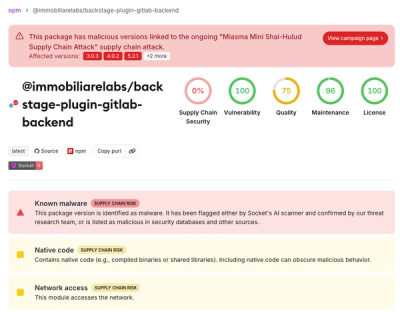
Miasma Mini Shai-Hulud hits @immobiliarelabs Backstage plugins, targeting GitLab and LDAP auth packages on npm.