

Research
/Security News
Popular npm Packages in the keyv and Cacheable Namespaces Compromised in Active Supply Chain Attack
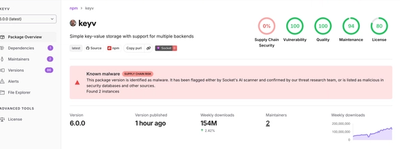
Popular npm packages keyv and cacheable compromised.
By Socket Research Team - Aug 04, 2026
figma-edit-mcp
Advanced tools
Read, create, and modify Figma designs programmatically via MCP, empowering AI to execute Figma changes safer, cleaner, and faster.




Connect AI assistants to Figma via Model Context Protocol to read designs, create and modify elements, and manage design systems programmatically.
This plugin empowers your AI assistant to become a Figma assistant, executing design updates Safer, Cleaner, and Faster than a human ever could.
This plugin allows you as a Designer to focus purely on creative decision-making, leaving the error-prone & repetitive manual changes to the automated systems.
🏆 Featured by IDEO: Letting AI edit live Figma files without trusting it to behave
📖 Documentation: neozhehan.github.io/figma-edit-mcp
The project has three goals: Safer, Cleaner, and Faster.
These goals support each other: when the plugin refuses mistakes, the file stays consistent, and a consistent file is easier for both you and the AI to work with.
Read the full reasoning behind these goals →
AI assistants sometimes invent things. An AI can name a layer that does not exist, or misremember which layer it was editing. This plugin does not depend on the AI being right. The plugin checks every edit itself, inside Figma, and refuses any edit that fails a check. The AI cannot skip these checks.
What the plugin enforces:
One honest limit: the plugin checks where an edit happens and which layer it touches. It cannot check whether the edit is the one you wanted. A wrong edit that follows all the rules will go through. So you review the AI's work the same way you would review a colleague's work.
The exact rules, and the conditions under which each one holds, are written down in SAFETY.md. That document is for developers. (Your AI assistant loads the same rules at runtime via the figma-edit skill or the figma-edit://guide/* resources.)
You do not need to know every Figma feature to direct this system. The work splits three ways:
The AI contributes scale. The plugin contributes protection. You contribute the design judgment.
The quickest way to run Figma Edit MCP is directly from the NPM registry. You do not need to clone this repository.
Add the server to your AI assistant's MCP configuration:
{
  "mcpServers": {
    "FigmaEdit": {
      "command": "npx",
      "args": ["-y", "figma-edit-mcp"]
    }
  }
}
The config file location depends on your host — see Integration-Specific Setup below. Bun users can substitute bunx for npx; both resolve the same package.
In a terminal, start the bridge that connects the MCP server to the Figma plugin. Keep this terminal running:
npx -y --package figma-edit-mcp figma-edit-mcp-socket
The Figma plugin ships inside the NPM package. Install the package once to materialize the plugin files on disk:
# In any directory of your choosing (e.g., ~/figma-edit-mcp/)
npm install figma-edit-mcp
Then in the Figma desktop app:
node_modules/figma-edit-mcp/figma_plugin/manifest.json from the directory above.The plugin is now available under Plugins → Development in any Figma file.
The package also ships a cross-tool skill that teaches your agent the server's safety constraints, error recovery, and tool selection — loaded on demand, so it costs almost nothing until needed. Agents that support the open SKILL.md standard (Claude Code, GitHub Copilot, OpenAI Codex, Cursor, Gemini CLI, Google Antigravity) discover it once it's in their skills directory:
# copy the skill into your agent's skills directory (path varies by host)
cp -R node_modules/figma-edit-mcp/skills/figma-edit ~/.claude/skills/
Clients that don't support skills can still reach the same guidance over the MCP connection as resources under figma-edit://guide/* — no install required.
Running from a local clone? See CONTRIBUTING.md for the contributor-only --local development workflow.
Paste the JSON snippet from the Quick Start into your host's MCP config file:
| Integration | Config File Location | Notes |
|---|---|---|
| Cursor | ~/.cursor/mcp.json | Restart Cursor after editing |
| VS Code / GitHub Copilot | ~/Library/Application Support/Code/User/mcp.json | Requires VS Code 1.102+ with Copilot; enable Agent Mode |
| Google Antigravity | ~/.gemini/antigravity/mcp_config.json | Restart Antigravity to load |
| Claude Desktop | ~/Library/Application Support/Claude/claude_desktop_config.json | — |
| Claude Code (CLI / VS Code) | run claude mcp add FigmaEdit npx figma-edit-mcp | No file edit needed |
| LM Studio | edit mcp.json via the Developer tab | Or use a deeplink, if provided |
If you prefer to edit your host's MCP config directly, paste this snippet into the appropriate config file:
{
  "mcpServers": {
    "FigmaEdit": {
      "command": "npx",
      "args": ["-y", "figma-edit-mcp"]
    }
  }
}
| Integration | Config File Location |
|---|---|
| Cursor | ~/.cursor/mcp.json |
| VS Code / Copilot | ~/Library/Application Support/Code/User/mcp.json |
| Antigravity | ~/.gemini/antigravity/mcp_config.json |
| Claude Desktop | ~/Library/Application Support/Claude/claude_desktop_config.json |
| LM Studio | Use the in-app editor (via Developer tab) or edit mcp.json |
Running from a local clone? See CONTRIBUTING.md for the --local workflow.
For local development — building from source, running the bridge from a clone, and the --local integrate workflow — see CONTRIBUTING.md.
To allow Figma (running on Windows) to connect to the bridge (running inside WSL), the bridge needs to listen on 0.0.0.0 instead of localhost:
npx -y --package figma-edit-mcp figma-edit-mcp-socket --host 0.0.0.0
# or via environment variable:
FIGMA_EDIT_MCP_SOCKET_HOST=0.0.0.0 npx -y --package figma-edit-mcp figma-edit-mcp-socket
Then point the Figma plugin's WebSocket address at your WSL instance's IP.
npx -y --package figma-edit-mcp figma-edit-mcp-socketchannel_join MCP tool to establish communicationTools are grouped into a two-level, underscore-separated namespace (group_action). Reads are *_list / *_info; writes use verb leaves. Anything that mutates a node lives under node_*.
page — pages| Tool | Description |
|---|---|
page_info | List the document's pages; with pageIds, return those pages and their top-level children |
node — read, transform, and style any node| Tool | Description |
|---|---|
node_info | Read one or more nodes — recursive traversal with properties, filter, and maxDepth (the workhorse read; also returns bound variables / explicit modes) |
node_transform | Move and/or resize a node by setting absolute x / y / width / height |
node_rename | Rename a node |
node_delete | Delete one or more nodes in a single validated batch |
node_clone | Duplicate a node, optionally at a new position |
view_navigate | Navigate the editor view to a page or node(s) |
node_group | Wrap nodes in a new group |
node_ungroup | Dissolve a group, promoting its children |
node_flatten | Flatten a node and its children into a single vector |
node_insert_child | Reparent a node under a new parent at an optional index |
node_set_auto_layout | Configure a frame's auto-layout (mode, padding, spacing, alignment, sizing) |
node_set_fill | Set a node's fill to a color or image, or clear it |
node_set_stroke | Set stroke color and weight (uniform or per-side) |
node_set_corner_radius | Set corner radius (uniform or per-corner) |
node_set_effects | Set the effect array (shadows, blurs) |
node_apply_style | Link a node to a shared library style (paint/text/effect/grid) |
node_bind_variable | Bind a variable to a node property, or set an explicit variable mode |
node_export_visual | Render a node to an image (PNG / JPG / SVG / PDF) |
create — make new nodes| Tool | Description |
|---|---|
create_shape | Create a rectangle, ellipse, polygon, or star (type) with optional fill/stroke |
create_frame | Create a frame with optional fill/stroke and full auto-layout |
create_text | Create a text node with optional font size/weight/color |
create_svg | Create a node from an SVG markup string |
create_component | Convert an existing frame into a main component |
create_instance | Instantiate a component at a position |
create_component_set | Combine components into a component set (variants) |
style — shared styles| Tool | Description |
|---|---|
style_list | List all local styles (paint/text/effect/grid) |
style_manage | Create a named style, or update one when styleId is given |
style_delete | Delete a local style by id (detaches consumers, which keep their resolved values) |
text — text content & typography| Tool | Description |
|---|---|
text_set_content | Batch-set the text of one or more text nodes |
text_set_style | Set any combination of typography properties on a text node |
component — components & variants| Tool | Description |
|---|---|
component_list | List components, with filtering and scope options |
component_manage_property | Add or edit a component-property definition (BOOLEAN/TEXT/INSTANCE_SWAP) |
component_delete_property | Remove a component-property definition |
instance — component instances| Tool | Description |
|---|---|
instance_set_property | Set one property on an instance (toggle, text, swap, or variant) |
instance_get_overrides | Read the override properties from a source instance |
instance_set_overrides | Apply copied overrides to target instances |
variable — variables & collections| Tool | Description |
|---|---|
variable_list | List variables/collections, or detail by ID; optionally scan consumers |
variable_manage | Create collections and variables and set values/aliases |
variable_delete | Delete variables or a collection (rejected if still in use) |
annotation — Dev Mode annotations| Tool | Description |
|---|---|
annotation_list | Read annotations on a node; optionally include categories |
annotation_set | Batch create or update native annotations (markdown) |
reaction — prototype reactions| Tool | Description |
|---|---|
reaction_list | Read prototype reactions (click flows, overlays) from nodes |
reaction_update | Replace a node's reactions with a full new array |
channel — connection| Tool | Description |
|---|---|
channel_join | Join a WebSocket channel to establish communication with the plugin |
Built-in prompts guide complex multi-step design tasks:
| Prompt | Description |
|---|---|
swap_overrides_instances | Transfer component instance overrides from a source to multiple targets |
When working with Figma Edit MCP:
channel_join before sending any other commands.Node IDs copied from Figma URLs use dashes (20485-41), but the plugin API expects colons (20485:41). The MCP server automatically converts dash-format IDs before forwarding, so either format works without manual intervention.
Built on prior work by sonnylazuardi and the contributors to grab/cursor-talk-to-figma-mcp. Thank you for the foundation this project builds on.
Thanks to @dusskapark for the following contributions:
The MIT License (MIT)
Copyright (c) 2025 sonnylazuardi
Copyright (c) 2026 Neo Product LLC
FAQs
Read, create, and modify Figma designs programmatically via MCP, empowering AI to execute Figma changes safer, cleaner, and faster.
The npm package figma-edit-mcp receives a total of 92 weekly downloads. As such, figma-edit-mcp popularity was classified as not popular.
We found that figma-edit-mcp demonstrated a healthy version release cadence and project activity because the last version was released less than a year ago. It has 1 open source maintainer collaborating on the project.
Did you know?

Socket for GitHub automatically highlights issues in each pull request and monitors the health of all your open source dependencies. Discover the contents of your packages and block harmful activity before you install or update your dependencies.
Research
/Security News
Popular npm packages keyv and cacheable compromised.

Security News
A misconfiguration gave three Anthropic models internet access, and one, believing it was in a simulation, shipped a credential-stealing package to PyPI.

Security News
/Company News
Socket has joined the new Composer and Packagist sponsorship program as a launch sponsor, supporting the team that keeps PHP's package ecosystem secure.