
Product
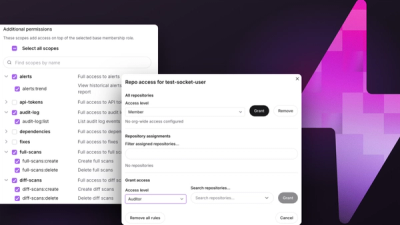
Introducing Repository Access Permissions and Custom Roles
Socket now supports Custom Roles and Repository Access Permissions so organizations can control who can access specific repositories and actions.
By Joe Werle - Jun 19, 2026
frappe-js-sdk
Advanced tools
TypeScript/JavaScript library for a Frappe Framework backend.




The library currently supports the following features:
We plan to add the following features in the future:
exists in the database.The library uses Axios under the hood to make API calls to your Frappe backend.
| Maintainer | GitHub | Social |
|---|---|---|
| Nikhil Kothari | nikkothari22 | @nik_kothari22 |
| Janhvi Patil | janhvipatil | @janhvipatil_ |
| Sumit Jain | sumitjain236 |
npm install frappe-js-sdk
or
yarn add frappe-js-sdk
To get started, initialise the library:
import { FrappeApp } from 'frappe-js-sdk';
//Add your Frappe backend's URL
const frappe = new FrappeApp('https://test.frappe.cloud');
In case you want to use the library with token based authentication (OAuth bearer tokens or API key/secret pairs), you can initialise the library like this:
import { FrappeApp } from "frappe-js-sdk";

const frappe = new FrappeApp("https://test.frappe.cloud", {
    useToken: true,
    // Pass a custom function that returns the token as a string - this could be fetched from LocalStorage or auth providers like Firebase, Auth0 etc.
    token: getTokenFromLocalStorage(),
    // This can be "Bearer" or "token"
    type: "Bearer"
})
const auth = frappe.auth()
This makes an API call to the /api/method/login endpoint.
auth
  .loginWithUsernamePassword({ username: 'admin', password: 'my-password' })
  .then((response) => console.log('Logged in'))
  .catch((error) => console.error(error));
This makes an API call to the /api/method/frappe.auth.get_logged_user endpoint.
auth
  .getLoggedInUser()
  .then((user) => console.log(`User ${user} is logged in.`))
  .catch((error) => console.error(error));
This makes an API call to the /api/method/logout endpoint.
auth
  .logout()
  .then(() => console.log('Logged out.'))
  .catch((error) => console.error(error));
This makes an API sends a password reset link to the specified email address.
auth
  .forgetPassword('example@example.com')
  .then(() => console.log('Password Reset Email Sent!'))
  .catch(() => console.error("We couldn't find your account."));
const db = frappe.db();
db.getDoc('DocType', 'My DocType Name')
  .then((doc) => console.log(doc))
  .catch((error) => console.error(error));
db.getDocList('DocType')
  .then((docs) => console.log(docs))
  .catch((error) => console.error(error));
Optionally, a second argument can be provided to filter, sort, limit and paginate results.
db.getDocList('DocType', {
  /** Fields to be fetched */
  fields: ['name', 'creation'],
  /** Filters to be applied - SQL AND operation */
  filters: [['creation', '>', '2021-10-09']],
  /** Filters to be applied - SQL OR operation */
  orFilters: [],
  /** Fetch from nth document in filtered and sorted list. Used for pagination  */
  limit_start: 5,
  /** Number of documents to be fetched. Default is 20  */
  limit: 10,
  /** Sort results by field and order  */
  orderBy: {
    field: 'creation',
    order: 'desc',
  },
  /** Group the results by particular field */
  groupBy: 'name',
  /** Fetch documents as a dictionary */
  asDict: false,
})
  .then((docs) => console.log(docs))
  .catch((error) => console.error(error));
Type declarations are available for the second argument in the source code.
const filters = [['creation', '>', '2021-10-09']];
const debug = false; /** Default is false - Optional **/

db.getCount('DocType', filters, debug)
  .then((count) => console.log(count))
  .catch((error) => console.error(error));
To create a new document, pass the name of the DocType and the fields to createDoc.
db.createDoc('My Custom DocType', {
  name: 'Test',
  test_field: 'This is a test field',
})
  .then((doc) => console.log(doc))
  .catch((error) => console.error(error));
To update an existing document, pass the name of the DocType, name of the document and the fields to be updated to updateDoc.
db.updateDoc('My Custom DocType', 'Test', {
  test_field: 'This is an updated test field.',
})
  .then((doc) => console.log(doc))
  .catch((error) => console.error(error));
To create a new document, pass the name of the DocType and the name of the document to be deleted to deleteDoc.
db.deleteDoc('My Custom DocType', 'Test')
  .then((response) => console.log(response.message)) // Message will be "ok"
  .catch((error) => console.error(error));
To rename a document, pass the name of the DocType, old name, new name, and an optional merge flag to renameDoc.
db.renameDoc('My Custom DocType', 'Old Name', 'New Name')
  .then((response) => console.log(response.message)) // The message will reflect the updated document name.
  .catch((error) => console.error(error));
To retrieve document values, pass the name of the DocType, field names (string or array), filters, and additional parameters to getValue.
/** Get single field value **/
db.getValue('My Custom DocType', 'Field_Name', [['Filter1', '=', 'Value1'],['Filter2', '=', 'Value2']])
  .then((doc) => console.log(doc))
  .catch((error) => console.error(error));

/** Get multiple field values **/
db.getValue('My Custom DocType', ['Field_Name1', 'Field_Name2'], [['Filter1', '=', 'Value1'],['Filter2', '=', 'Value2']])
  .then((doc) => console.log(doc))
  .catch((error) => console.error(error));
To set field values, pass the name of the DocType, document name, field name (or an object of field-value pairs), and an optional value to setValue.
/** Set value of a single field **/
db.setValue('My Custom DocType', 'Test', 'Field_Name', 'Value')
  .then((doc) => console.log(doc))
  .catch((error) => console.error(error));

/** Set values of multiple fields **/
db.setValue('My Custom DocType', 'Test', {'Field_Name1':"Value1",'Field_Name2':"Value2"})
  .then((doc) => console.log(doc))
  .catch((error) => console.error(error));
To retrieve a field value from a Single-type doctype, pass the name of the DocType and field name to getSingleValue.
db.getSingleValue('My Custom Single DocType', 'Field_Name')
  .then((response) => console.log(response.message)) // Message will reflect the value of the field.
  .catch((error) => console.error(error));
To submit a document, pass the document object to submit.
db.submit(doc)
  .then((doc) => console.log(doc))
  .catch((error) => console.error(error));
To cancel a submitted document, pass the name of the DocType and document name to cancel.
db.cancel('My Custom DocType', 'Test')
  .then((doc) => console.log(doc))
  .catch((error) => console.error(error));
The library supports Typescript out of the box.
For example, to enforce type on the updateDoc method:
interface TestDoc {
  test_field: string;
}
db.updateDoc<TestDoc>('My Custom DocType', 'Test', {
  test_field: 'This is an updated test field.',
});
The library also has an inbuilt type FrappeDoc which adds the following fields to your type declarations when you use it with the database methods:
export type FrappeDoc<T> = T & {
  /** User who created the document */
  owner: string;
  /** Date and time when the document was created - ISO format */
  creation: string;
  /** Date and time when the document was last modified - ISO format */
  modified: string;
  /** User who last modified the document */
  modified_by: string;
  idx: number;
  /** 0 - Saved, 1 - Submitted, 2 - Cancelled */
  docstatus: 0 | 1 | 2;
  parent?: any;
  parentfield?: any;
  parenttype?: any;
  /** The primary key of the DocType table */
  name: string;
};
All document responses are returned as an intersection of FrappeDoc and the specified type.
const call = frappe.call();
Make sure all endpoints are whitelisted (@frappe.whitelist()) in your backend
Make a GET request to your endpoint with parameters.
const searchParams = {
  doctype: 'Currency',
  txt: 'IN',
};
call
  .get('frappe.desk.search_link', searchParams)
  .then((result) => console.log(result))
  .catch((error) => console.error(error));
Make a POST request to your endpoint with parameters.
const updatedFields = {
  doctype: 'User',
  name: 'Administrator',
  fieldname: 'interest',
  value: 'Frappe Framework, ERPNext',
};
call
  .post('frappe.client.set_value', updatedFields)
  .then((result) => console.log(result))
  .catch((error) => console.error(error));
Make a PUT request to your endpoint with parameters.
const updatedFields = {
  doctype: 'User',
  name: 'Administrator',
  fieldname: 'interest',
  value: 'Frappe Framework, ERPNext',
};
call
  .put('frappe.client.set_value', updatedFields)
  .then((result) => console.log(result))
  .catch((error) => console.error(error));
Make a DELETE request to your endpoint with parameters.
const documentToBeDeleted = {
  doctype: 'Tag',
  name: 'Random Tag',
};
call
  .put('frappe.client.delete', documentToBeDeleted)
  .then((result) => console.log(result))
  .catch((error) => console.error(error));
const file = frappe.file();
const myFile; //Your File object

const fileArgs = {
  /** If the file access is private then set to TRUE (optional) */
  "isPrivate": true,
  /** Folder the file exists in (optional) */
  "folder": "Home",
  /** File URL (optional) */
  "file_url": "",
  /** Doctype associated with the file (optional) */
  "doctype": "User",
  /** Docname associated with the file (mandatory if doctype is present) */
  "docname": "Administrator",
  /** Field in the document **/
  "fieldname": "image"
}

file.uploadFile(
            myFile,
            fileArgs,
            /** Progress Indicator callback function **/
            (completedBytes, totalBytes) => console.log(Math.round((completedBytes / totalBytes) * 100), " completed")
        )
        .then(() => console.log("File Upload complete"))
        .catch(e => console.error(e))
See LICENSE.
FAQs
TypeScript/JavaScript client for Frappe Framework REST API
The npm package frappe-js-sdk receives a total of 14,658 weekly downloads. As such, frappe-js-sdk popularity was classified as popular.
We found that frappe-js-sdk demonstrated a healthy version release cadence and project activity because the last version was released less than a year ago. It has 1 open source maintainer collaborating on the project.
Did you know?

Socket for GitHub automatically highlights issues in each pull request and monitors the health of all your open source dependencies. Discover the contents of your packages and block harmful activity before you install or update your dependencies.
Product
Socket now supports Custom Roles and Repository Access Permissions so organizations can control who can access specific repositories and actions.
Product
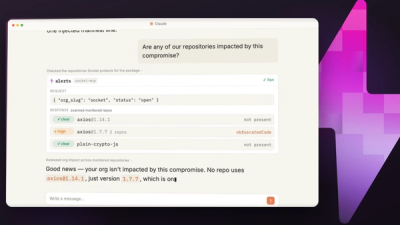
Socket MCP now lets AI assistants review org alerts, investigate threats using the Socket threat feed, and inspect package files in addition to dependency scoring.
Product
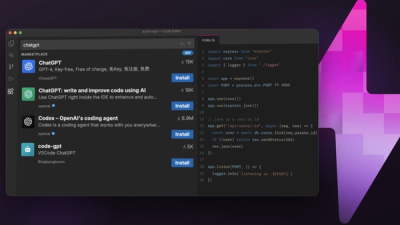
Socket Firewall blocks malicious VS Code and Open VSX extensions before install, protecting developers from compromised editor marketplaces.