

Security News
Risky Biz Podcast: AI Agents Are Raising the Stakes for Software Supply Chain Security
Open source attacks are accelerating as AI coding agents pull in dependencies faster, with less human review.
By Sarah Gooding - Jun 30, 2026
Learn more at docs.freestyle.sh
npm install freestyle
The Freestyle SDK includes a command-line interface for managing your Freestyle resources.
Set the environment variable with your API key:
export FREESTYLE_API_KEY="your-api-key"
Or create a .env file in your project directory:
FREESTYLE_API_KEY=your-api-key
# Create a new VM
freestyle vm create --name my-vm

# Create a VM from a snapshot (for debugging)
freestyle vm create --snapshot <snapshot-id>

# Create a VM with domain
freestyle vm create --domain myapp.example.com --port 3000

# Create VM and SSH into it (auto-deletes on exit)
freestyle vm create --ssh

# Create VM from snapshot and SSH into it
freestyle vm create --snapshot <snapshot-id> --ssh

# List all VMs
freestyle vm list

# SSH into a VM
freestyle vm ssh <vmId>

# SSH into a VM and delete it on exit
freestyle vm ssh <vmId> --delete-on-exit

# Execute a command on a VM
freestyle vm exec <vmId> "ls -la"

# Delete a VM
freestyle vm delete <vmId>
# Deploy from inline code
freestyle deploy --code "export default () => 'Hello World'"

# Deploy from a file
freestyle deploy --file ./my-function.js

# Deploy from a Git repository
freestyle deploy --repo <repoId>

# Deploy a prebuilt directory
freestyle deploy --dir ./dist

# Deploy a directory and run server-side build auto-detection
freestyle deploy --dir . --build

# Deploy a directory with explicit build settings
freestyle deploy --dir . --build --build-command "npm run build" --build-out-dir dist

# Add environment variables
freestyle deploy --code "..." --env API_KEY=secret --env DEBUG=true
# Execute a one-off function from inline code
freestyle run --code "console.log('Hello!')"

# Execute from a file
freestyle run --file ./script.js
# Get help for any command
freestyle --help
freestyle vm --help
import { freestyle, VmSpec } from "freestyle";
import { VmNodeJs } from "@freestyle-sh/with-nodejs";

// Create and store code with git.
const { repoId } = await freestyle.git.repos.create({
  source: {
    url: "https://github.com/freestyle-sh/freestyle-base-nextjs-shadcn",
  },
});

// Create a new branch from the default branch
const repo = freestyle.git.repos.ref({ repoId });
const { name, sha } = await repo.branches.create({
  name: "feature/something",
});

// Create commits with files (text and binary)
const { commit } = await repo.commits.create({
  message: "Add new feature",
  branch: "feature/something",
  files: [
    { path: "README.md", content: "# My Project" },
    { path: "logo.png", content: base64Image, encoding: "base64" }
  ],
  author: { name: "John Doe", email: "john@example.com" }
});

// Develop code with VMs. Add language runtimes via `with` — install the
// matching `@freestyle-sh/with-*` package and pass a builder instance.
const { vm } = await freestyle.vms.create({
  spec: new VmSpec().with("node", new VmNodeJs()),
  gitRepos: [{ repo: repoId, path: "/repo" }],
});

await vm.fs.writeTextFile("/repo/api/hello.js", "...");
await vm.exec("ls /repo");
await vm.node.runCode({ code: "console.log('hello')" });

// Deploy your code to the internet.
const { deploymentId } = await freestyle.serverless.deployments.create({
  repo: repoId,
});

// Verify a custom domain and point it at your deployment.
const { record } = await freestyle.domains.verifications.create({
  domain: "example.com",
});

console.log(record);

await freestyle.domains.verifications.complete({
  domain: "example.com",
});

await freestyle.domains.mappings.create({
  domain: "example.com",
  deploymentId: deploymentId,
});

// test your app with lightweight JS workers
for (let i = 0; i < 10; i++) {
  freestyle.serverless.runs.create({
    code: `export default () => {
        fetch("https://example.com/api/hello")
          .then(res => res.json())
        })
        `,
  });
}

// Restrict outbound requests and attach headers for matching domains.
await freestyle.serverless.runs.create({
  code: `export default async () => {
    const res = await fetch("https://api.freestyle.sh/some-path");
    return await res.text();
  }`,
  egress: {
    allow: {
      domains: {
        "api.freestyle.sh": [
          {
            transform: [
              {
                headers: {
                  "X-Freestyle-Admin-Key": "abc",
                  "X-Freestyle-User-Id": "123",
                },
              },
            ],
          },
        ],
        "*": [],
      },
    },
  },
});

// The same egress config shape is supported for deployments.
await freestyle.serverless.deployments.create({
  code: "export default () => new Response('ok')",
  egress: {
    allow: {
      domains: {
        "api.freestyle.sh": [
          {
            transform: [
              {
                headers: {
                  "X-Freestyle-Admin-Key": "abc",
                  "X-Freestyle-User-Id": "123",
                },
              },
            ],
          },
        ],
        "*": [],
      },
    },
  },
});
FAQs
Learn more at [docs.freestyle.sh](https://docs.freestyle.sh)
The npm package freestyle receives a total of 12,114 weekly downloads. As such, freestyle popularity was classified as popular.
We found that freestyle demonstrated a healthy version release cadence and project activity because the last version was released less than a year ago. It has 2 open source maintainers collaborating on the project.
Did you know?

Socket for GitHub automatically highlights issues in each pull request and monitors the health of all your open source dependencies. Discover the contents of your packages and block harmful activity before you install or update your dependencies.
Security News
Open source attacks are accelerating as AI coding agents pull in dependencies faster, with less human review.
Research
/Security News
Malicious Chrome and Firefox extensions posed as free VPNs while stealing clipboard data through later extension updates.
Research
/Security News
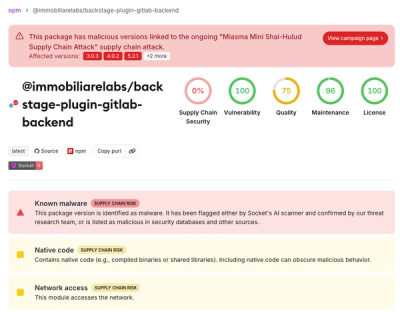
Miasma Mini Shai-Hulud hits @immobiliarelabs Backstage plugins, targeting GitLab and LDAP auth packages on npm.