
Research
/Security News
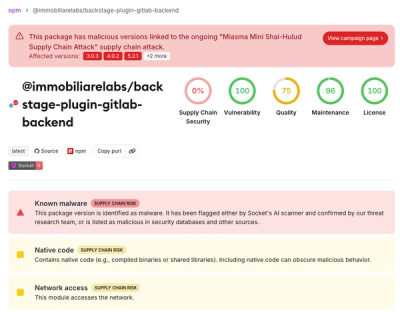
Miasma Mini Shai-Hulud Hits ImmobiliareLabs npm Packages
Miasma Mini Shai-Hulud hits @immobiliarelabs Backstage plugins, targeting GitLab and LDAP auth packages on npm.
By Socket Research Team - Jun 26, 2026
Zero-config automatic bug context collector for the browser. Drop it in, forget about it. When something breaks, you already have everything you need.



Testers spend 90% of their time manually collecting bug context — screenshots, error messages, console logs, steps to reproduce. ghostbug eliminates that by silently capturing everything in the background.
| Sentry / LogRocket | ghostbug | |
|---|---|---|
| Setup | Account, API keys, config | ghostbug.init() |
| Server needed | Yes (paid) | No — everything local |
| Bundle size | 50-200KB+ | ~7KB gzipped |
| Dependencies | Multiple | Zero |
| Output | Dashboard (another tab) | JSON / Markdown you paste into GitHub Issues |
npm install ghostbug
import ghostbug from "ghostbug";

ghostbug.init();
That's it. ghostbug now auto-captures:
window.onerror + unhandled promise rejectionsconsole.error() and console.warn()fetch and XMLHttpRequest (4xx/5xx)ghostbug.init(options?)Initialize ghostbug. Call once when your app loads.
ghostbug.init({
  // Show floating widget UI (default: false)
  widget: true,

  // Or with widget options
  widget: {
    position: "bottom-right", // 'bottom-left' | 'bottom-right' | 'top-left' | 'top-right'
    collapsed: true,
    zIndex: 2147483647,
  },

  // Toggle individual collectors (all true by default)
  collectors: {
    errors: true,
    console: true,
    network: true,
    clicks: true,
  },

  // Max reports stored (oldest dropped when full)
  maxReports: 50,

  // Max breadcrumb trail per report
  maxBreadcrumbs: 20,

  // Rate limiting (prevent flood from error loops)
  rateLimit: { maxEvents: 10, windowMs: 1000 },

  // Filter/transform reports before storage
  beforeReport: (report) => {
    // Return false to discard
    // Return modified report to transform
    return report;
  },
});
ghostbug.getReports()Returns all captured bug reports as an array.
const reports = ghostbug.getReports();
console.log(reports);
ghostbug.toMarkdown()Returns a GitHub/Jira-ready markdown string of all captured bugs.
const md = ghostbug.toMarkdown();
// Paste into GitHub Issues, Jira, Slack, etc.
Example output:
## 1. TypeError: Cannot read property 'id' of undefined

- **Type:** error
- **Time:** 2026-02-23T10:21:33.000Z
- **Occurrences:** 3
- **URL:** https://myapp.com/dashboard
- **Browser:** Chrome 122

### Stack Trace
TypeError: Cannot read property 'id' of undefined
    at UserProfile (app.js:42:12)

### Breadcrumbs
| Time | Category | Event |
|------|----------|-------|
| 10:21:30 | click | Clicked button "Save" |
| 10:21:31 | network | POST /api/user -> 500 |
| 10:21:33 | error | TypeError: Cannot read... |
ghostbug.download(filename?)Downloads all reports as a JSON file.
ghostbug.download(); // downloads ghostbug-report.json
ghostbug.download("my-bugs.json"); // custom filename
ghostbug.onBug(callback)Subscribe to bugs in real-time. Returns an unsubscribe function.
const unsubscribe = ghostbug.onBug((report) => {
  // Send to Slack
  fetch("/api/slack-webhook", {
    method: "POST",
    body: JSON.stringify({ text: report.payload.message }),
  });
});

// Later: stop listening
unsubscribe();
ghostbug.destroy()Teardown everything — removes all listeners, restores patched APIs, unmounts widget.
ghostbug.destroy();
"use client"; // Next.js App Router

import { useEffect } from "react";
import ghostbug from "ghostbug";

export default function GhostbugProvider({ children }) {
  useEffect(() => {
    ghostbug.init({ widget: true });
    return () => ghostbug.destroy();
  }, []);

  return <>{children}</>;
}
// layout.tsx
import GhostbugProvider from "./components/GhostbugProvider";

export default function RootLayout({ children }) {
  return (
    <html>
      <body>
        <GhostbugProvider>{children}</GhostbugProvider>
      </body>
    </html>
  );
}
// main.ts
import ghostbug from "ghostbug";

ghostbug.init({ widget: true });
<script src="https://unpkg.com/ghostbug/dist/index.iife.js"></script>
<script>
  ghostbug.default.init({ widget: true });
</script>
Enable the floating widget for testers — a small bug icon that shows captured bugs with copy/export buttons.
ghostbug.init({ widget: true });
The widget:
Each captured bug contains:
{
  id: string;              // Unique report ID
  fingerprint: string;     // Hash for deduplication
  type: "error" | "console" | "network";
  timestamp: string;       // ISO 8601
  count: number;           // Occurrences (deduped)
  payload: { ... };        // Error details
  breadcrumbs: [ ... ];    // Events leading up to the bug
  context: {
    url: string;
    userAgent: string;
    viewport: { width, height };
    // ...
  };
}
window.onerror and listens for unhandledrejectionconsole.error / console.warn (always calls originals)fetch and XMLHttpRequest (only captures 4xx/5xx, never alters responses)stopPropagation)destroy() restores all original APIs# Install dependencies
npm install
# Build (ESM + CJS + IIFE)
npm run build
# Run tests
npm test
# Watch mode
npm run test:watch
# Type check
npm run typecheck
# Lint
npm run lint
MIT
FAQs
Zero-config automatic bug context collector SDK for the browser
The npm package ghostbug receives a total of 2 weekly downloads. As such, ghostbug popularity was classified as not popular.
We found that ghostbug demonstrated a healthy version release cadence and project activity because the last version was released less than a year ago. It has 1 open source maintainer collaborating on the project.
Did you know?

Socket for GitHub automatically highlights issues in each pull request and monitors the health of all your open source dependencies. Discover the contents of your packages and block harmful activity before you install or update your dependencies.
Research
/Security News
Miasma Mini Shai-Hulud hits @immobiliarelabs Backstage plugins, targeting GitLab and LDAP auth packages on npm.

Security News
Rolldown paused Rust React Compiler integration after a 5MB binary size increase raised concerns about shipping React-specific code to all Vite users.

Security News
/Research
Mini Shai-Hulud expands into the Go ecosystem after hitting LeoPlatform npm packages and targeting GitHub Actions workflows.