
Research
/Security News
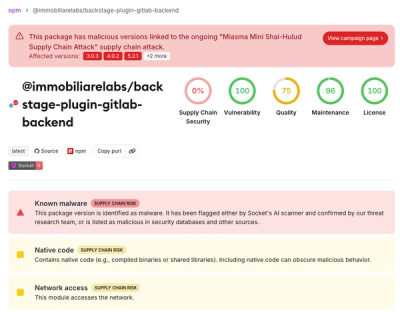
Miasma Mini Shai-Hulud Hits ImmobiliareLabs npm Packages
Miasma Mini Shai-Hulud hits @immobiliarelabs Backstage plugins, targeting GitLab and LDAP auth packages on npm.
By Socket Research Team - Jun 26, 2026

The JavaScript reference implementation for GraphQL, a query language for APIs created by Facebook.



See more complete documentation at https://graphql.org/ and https://graphql.org/graphql-js/.
Looking for help? Find resources from the community.
A general overview of GraphQL is available in the README for the Specification for GraphQL. That overview describes a simple set of GraphQL examples that exist as tests in this repository. A good way to get started with this repository is to walk through that README and the corresponding tests in parallel.
Install GraphQL.js from npm
With npm:
npm install --save graphql
or using yarn:
yarn add graphql
GraphQL.js provides two important capabilities: building a type schema and serving queries against that type schema.
First, build a GraphQL type schema which maps to your codebase.
import {
  graphql,
  GraphQLSchema,
  GraphQLObjectType,
  GraphQLString,
} from 'graphql';

var schema = new GraphQLSchema({
  query: new GraphQLObjectType({
    name: 'RootQueryType',
    fields: {
      hello: {
        type: GraphQLString,
        resolve() {
          return 'world';
        },
      },
    },
  }),
});
This defines a simple schema, with one type and one field, that resolves
to a fixed value. The resolve function can return a value, a promise,
or an array of promises. A more complex example is included in the top-level tests directory.
Then, serve the result of a query against that type schema.
var source = '{ hello }';

graphql({ schema, source }).then((result) => {
  // Prints
  // {
  //   data: { hello: "world" }
  // }
  console.log(result);
});
This runs a query fetching the one field defined. The graphql function will
first ensure the query is syntactically and semantically valid before executing
it, reporting errors otherwise.
var source = '{ BoyHowdy }';

graphql({ schema, source }).then((result) => {
  // Prints
  // {
  //   errors: [
  //     { message: 'Cannot query field BoyHowdy on RootQueryType',
  //       locations: [ { line: 1, column: 3 } ] }
  //   ]
  // }
  console.log(result);
});
Note: Please don't forget to set NODE_ENV=production if you are running a production server. It will disable some checks that can be useful during development but will significantly impact performance.
The npm branch in this repository is automatically maintained to be the last
commit to main to pass all tests, in the same form found on npm. It is
recommended to use builds deployed to npm for many reasons, but if you want to use
the latest not-yet-released version of graphql-js, you can do so by depending
directly on this branch:
npm install graphql@git://github.com/graphql/graphql-js.git#npm
Each release of GraphQL.js will be accompanied by an experimental release containing support for the @defer and @stream directive proposal. We are hoping to get community feedback on these releases before the proposal is accepted into the GraphQL specification. You can use this experimental release of GraphQL.js by adding the following to your project's package.json file.
"graphql": "experimental-stream-defer"
Community feedback on this experimental release is much appreciated and can be provided on the issue created for this purpose.
GraphQL.js is a general-purpose library and can be used both in a Node server and in the browser. As an example, the GraphiQL tool is built with GraphQL.js!
Building a project using GraphQL.js with webpack or
rollup should just work and only include
the portions of the library you use. This works because GraphQL.js is distributed
with both CommonJS (require()) and ESModule (import) files. Ensure that any
custom build configurations look for .mjs files!
We actively welcome pull requests. Learn how to contribute.
This repository is managed by EasyCLA. Project participants must sign the free (GraphQL Specification Membership agreement before making a contribution. You only need to do this one time, and it can be signed by individual contributors or their employers.
To initiate the signature process please open a PR against this repo. The EasyCLA bot will block the merge if we still need a membership agreement from you.
You can find detailed information here. If you have issues, please email operations@graphql.org.
If your company benefits from GraphQL and you would like to provide essential financial support for the systems and people that power our community, please also consider membership in the GraphQL Foundation.
Changes are tracked as GitHub releases.
GraphQL.js is MIT-licensed.
GraphQL.JS follows Semantic Versioning (SemVer) for its releases. Our version support policy is as follows:
We do not currently offer a Long-Term Support version of GraphQL.JS. Users are encouraged to upgrade to the latest stable version to receive the most up-to-date features, performance improvements, and security updates.
We will announce the EOL date for a major version at least 6 months in advance. After a version reaches its EOL, it will no longer receive updates, even for critical security issues.
To assist users in upgrading to newer versions:
We prioritize the security of GraphQL.JS:
We welcome community contributions for all versions of GraphQL.JS. However, our maintainers will primarily focus on reviewing and merging contributions for supported versions.
Apollo Server is a community-driven, open-source GraphQL server that works with many Node.js HTTP server frameworks. It simplifies building a GraphQL API by providing features like performance tracing and schema stitching. Compared to graphql, Apollo Server offers a more integrated set of tools for building production-ready GraphQL services.
Express GraphQL is a GraphQL HTTP server middleware for Express.js. It allows you to serve a GraphQL API as a web service. While graphql provides the core functionality for schema creation and query execution, express-graphql makes it easy to integrate GraphQL with the Express web application framework.
TypeGraphQL is a framework for building GraphQL APIs in Node.js using TypeScript, based on the official graphql-js package. It allows for defining the schema using TypeScript classes and decorators, which can be more familiar to developers with an object-oriented background. It provides a more type-safe and class-based approach to defining GraphQL schemas compared to the more traditional, function-based approach of graphql.
FAQs
A Query Language and Runtime which can target any service.
The npm package graphql receives a total of 38,781,961 weekly downloads. As such, graphql popularity was classified as popular.
We found that graphql demonstrated a healthy version release cadence and project activity because the last version was released less than a year ago. It has 6 open source maintainers collaborating on the project.
Did you know?

Socket for GitHub automatically highlights issues in each pull request and monitors the health of all your open source dependencies. Discover the contents of your packages and block harmful activity before you install or update your dependencies.
Research
/Security News
Miasma Mini Shai-Hulud hits @immobiliarelabs Backstage plugins, targeting GitLab and LDAP auth packages on npm.

Security News
Rolldown paused Rust React Compiler integration after a 5MB binary size increase raised concerns about shipping React-specific code to all Vite users.

Security News
/Research
Mini Shai-Hulud expands into the Go ecosystem after hitting LeoPlatform npm packages and targeting GitHub Actions workflows.