
Product
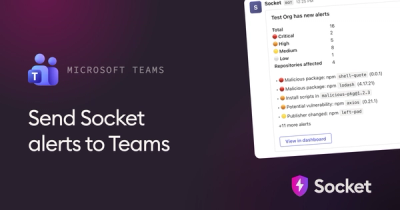
Microsoft Teams Notifications Are Now Available in Socket
Socket can now send alerts and supply chain attack notifications to Microsoft Teams, with filters that route the right updates to each channel.
By Jeppe Hasseriis - Sep 01, 2026
guniweb-sap-mcp
Advanced tools
GuniWeb SAP S/4HANA & ECC MCP Server -- OData V2/V4, IDoc, and RFC/BAPI for n8n
Designed for n8n, usable from any MCP host. Free to use — built and maintained by GuniWeb.
Connect n8n workflows to SAP S/4HANA and ECC via OData V2, V4, IDocs, and RFC/BAPI using the Model Context Protocol (MCP). Made for AI-assisted, human-governed workflows: the workflow author decides which SAP APIs are called and in what order; the LLM extracts, maps and fills in parameters. Writes are off by default and switched on explicitly, per server and per token.
graph LR
n8n["n8n workflow<br/>AI-assisted, human-governed"] -->|MCP Protocol| MCP["guniweb-sap-mcp<br/>22 Tools • 8 Auth Types"]
MCP -->|"OData V2/V4<br/>IDoc XML<br/>RFC/BAPI"| SAP["SAP S/4HANA & ECC"]
MCP -->|"OAuth2 / JWT"| BTP["SAP BTP"]
BTP --> SAP
style n8n fill:#4a90d9,color:#fff,stroke:#3a7bc8
style MCP fill:#2d2d2d,color:#fff,stroke:#555
style SAP fill:#1a6fb5,color:#fff,stroke:#0f5a9d
style BTP fill:#e8a317,color:#fff,stroke:#c88d14
$batch requestsap_enable_tools -- LLMs activate additional tool tiers at runtime, within the limits you set--allow-writereadOnly and tool-tier ceilings per Bearer token, only ever more restrictivegraph TB
subgraph Technical["Technical User Auth"]
basic["basic<br/><i>Direct S/4HANA</i>"]
userbasic["user-basic<br/><i>Personal SAP login per request</i>"]
oauth2["oauth2<br/><i>BTP Client Credentials</i>"]
apikey["apikey<br/><i>Sandbox / Testing</i>"]
end
subgraph Enterprise["Enterprise Auth (OIDC)"]
ias["ias<br/><i>SAP IAS Token</i>"]
xsuaa["xsuaa<br/><i>SAP XSUAA Token</i>"]
end
subgraph Principal["Principal Propagation<br/><i>End-user identity forwarded to SAP</i>"]
btp["btp-principal<br/><i>JWT Bearer Exchange<br/>via Destination Service</i>"]
saml["saml-bearer<br/><i>SAML 2.0 Assertion<br/>+ RSA-SHA256 Signing</i>"]
end
style Technical fill:#2a5f8f,color:#fff,stroke:#1a4f7f
style Enterprise fill:#5b8c5a,color:#fff,stroke:#4b7c4a
style Principal fill:#8b5e3c,color:#fff,stroke:#7b4e2c
--demoNo SAP system at hand? Start the server against a built-in mock S/4HANA and try every tool from n8n or any MCP client:
npx guniweb-sap-mcp --demo                                   # stdio — n8n MCP Client in command mode
npx guniweb-sap-mcp --demo --transport http --port 8808      # HTTP — n8n MCP Client with URL http://localhost:8808/mcp
npx guniweb-sap-mcp --demo --allow-write                     # also try sap_create / sap_update / sap_delete / sap_batch
The demo starts an in-memory OData V2 gateway on localhost (three services with real SAP field names — API_BUSINESS_PARTNER, API_SALES_ORDER_SRV, API_PRODUCT_SRV; ~20 business partners, 15 sales orders with items, 10 products) and points the server at it. It behaves like a Gateway where it matters: catalog discovery, $metadata, $filter/$expand/paging, CSRF tokens, ETags, deep insert, function imports, $batch with changesets, SAP-style error payloads. Sample data only — nothing is real, nothing leaves your machine, and changes are gone when the process ends. Also SAP_MCP_DEMO=true (e.g. in Docker). A workflow you build against the demo runs against a real system after you replace --demo with your SAP_* configuration.
npm install -g guniweb-sap-mcp
Or run it as a container: docker run --rm -p 8808:8808 -e SAP_MCP_DEMO=true ghcr.io/guniweb/guniweb-sap-mcp:latest
export SAP_BASE_URL=https://your-sap-system.example.com
export SAP_AUTH_TYPE=basic
export SAP_USERNAME=your-user
export SAP_PASSWORD=your-password
export SAP_CLIENT=100   # do not omit: without it a client-dependent Gateway
                        # answers 401 "Anmeldung fehlgeschlagen", which looks
                        # like a wrong password but is not one
# stdio (default) -- for n8n MCP Client in command mode
guniweb-sap-mcp

# HTTP -- for n8n MCP Client in URL mode or Docker
guniweb-sap-mcp --transport http --port 8808

# With tool tier control
guniweb-sap-mcp --transport http --port 8808 --tiers core,odata
guniweb-sap-mcp --transport http --port 8808 --allow-write   # writes are OFF by default

# Production: authenticate the MCP endpoint AND the inbound IDoc webhook
guniweb-sap-mcp --transport http --port 8808 --api-key <mcp-key> --webhook-secret <idoc-secret>
# Look around first — mock S/4HANA inside the container, no SAP system needed
docker run --rm -p 8808:8808 -e SAP_MCP_DEMO=true ghcr.io/guniweb/guniweb-sap-mcp:latest

# Against a real system (pin the version in production)
docker run -d --name sap-mcp -p 8808:8808 --env-file .env \
  ghcr.io/guniweb/guniweb-sap-mcp:<version>

# Flags go straight to the server — writes stay off unless you say so
docker run -d -p 8808:8808 --env-file .env \
  ghcr.io/guniweb/guniweb-sap-mcp:<version> --allow-write
The image is built from the published npm package, not from a second build path — what runs in the container is the artifact you would have installed with npm install, so the two cannot drift apart. HTTP transport on port 8808 is the default inside the image (SAP_MCP_TRANSPORT / SAP_MCP_PORT); it runs as a non-root user, answers a health check on /healthz, and is published for linux/amd64 and linux/arm64 with build provenance.
Not included: RFC/BAPI. That path needs the SAP NW RFC SDK, which SAP licenses to customers only and which therefore cannot ship in a public image. Everything else — OData V2/V4, IDoc over HTTP/XML — works. For RFC, install the SDK on the host and run the server from npm (Setup for SAP ECC).
A docker-compose.yml that puts n8n next to the server is in the repository.
| Variable / Flag | Default | Description |
|---|---|---|
--tool-timeout / SAP_MCP_TOOL_TIMEOUT | 30 (seconds) | Time budget for a whole tool call, however many SAP requests it makes. On expiry the client gets a valid MCP response with truncated: true and a plain-language reason — never a hanging connection. Paginated reads return the pages fetched so far. 0 disables the budget (logged as a warning at startup) |
SAP_HTTP_TIMEOUT_MS | 30000 | Timeout for a single outbound SAP request (ms). Hanging gateways fail fast with a structured TIMEOUT error instead of stalling the n8n agent. Capped by whatever is left of the tool budget above |
--cache-dir / SAP_CACHE_DIR | (unset = in-memory only) | Persist the catalog and metadata caches to disk so a restart does not refetch them. Without it every restart re-reads the full catalog — on a system with 1222 services that is the cold start that breaks client timeouts. n8n evicts its own client entry on a transport error, so restarts are not rare |
SAP_CA_CERT | (unset) | Path to the root CA that signs your SAP certificate — the documented way past a corporate PKI. Mirrored into NODE_EXTRA_CA_CERTS. Prefer this over SAP_TLS_VERIFY=false, which disables the check rather than solving it |
--concurrency / SAP_CONCURRENCY | 5 | Upper bound on simultaneous SAP requests where several are unavoidable |
--allow-write / SAP_MCP_ALLOW_WRITE | (unset = read-only) | Since 0.2.2 the server is read-only by default. sap_create, sap_update, sap_delete, sap_function and sap_idoc_send are not registered at all until you set this — a tool an agent cannot see is a tool it cannot call by accident. --read-only is still accepted and now simply describes the default |
SAP_JWT_ISSUER | (unset = no verification) | Issuer whose JWKS is used to verify incoming user tokens. Without it tokens are only decoded, and the resulting identity is marked verified: false — safe to forward to SAP (SAP verifies itself), but not safe to base a local decision on. With it, a token failing verification is rejected with 401 rather than silently downgraded to the technical user |
SAP_WEBHOOK_SECRET / --webhook-secret | (unset = open + startup warning) | Shared secret for the inbound IDoc webhook. Accepts Authorization: Bearer <secret> or HTTP Basic auth whose password equals the secret (matches SAP SM59 HTTP destinations) |
SAP_WEBHOOK_HOST / --webhook-host | all interfaces | Bind address of the standalone IDoc webhook (stdio mode). Set 127.0.0.1 behind a reverse proxy |
SAP_WEBHOOK_MAX_BODY_BYTES | 10485760 (10 MB) | Reject larger IDoc payloads with 413 before they are buffered in memory |
In HTTP transport mode the /idoc route is mounted on the MCP port: with --webhook-secret it authenticates independently of --api-key (so SAP's Basic auth works while n8n uses the Bearer key); without it, it falls under --api-key if set — and is open if neither is configured (the server logs a warning at startup).
Both timeouts must stay below the smallest client limit in your setup. Measured against a production S/4HANA behind Cloudflare: Cloudflare aborts at 100 s (524), n8n's MCP client transport at 300 s. A budget above the smallest limit never takes effect, because the client gives up first.
Every tool call logs one line on completion, carrying a correlation id that also appears on each SAP request it triggered:
{"correlationId":"a3f19c8b2d04","tool":"sap_discover_services","outcome":"ok","durationMs":842,"sapCalls":1,"resultBytes":18422}
grep a3f19c8b2d04 then shows the full story of that one call — including how many SAP requests it produced. outcome is one of ok, error, timeout (budget expired) or aborted (client disconnected).
level: 50 means something is actually wrong. Expected non-2xx responses — the 404s from the catalog path probing and from the V4 catalog attempt on systems that have none — are logged at info with "expected": true, not at error. Measured on a production system: over 96 hours of runtime that false alarm was the only error-level entry in the log. Alerting on level: 50 is therefore meaningful; before, it produced nothing but noise.
test-connection walks the whole chain and reports the first failing stage — DNS, TLS (including the certificate chain), authentication, client (Mandant), catalog. Stages after the failure are reported as skipped, never as passed. The same five stages are logged once at startup, so the container log shows the state of the connection without calling anything.
Every error response carries a classification, the SAP error code where one exists, a plain-language message and the next action — no tool answers with "Unknown error". Three cases that used to cost a separate diagnosis each:
| What SAP returns | What the server tells you |
|---|---|
403 with /IWFND/MED/170 | The service is not registered — activate it in /IWFND/MAINT_SERVICE. Not an authorization problem, despite the 403 |
401 with an HTML logon page | Is sap-client set? Without it a client-dependent Gateway rejects the logon in a way that looks like a wrong password |
UNABLE_TO_GET_ISSUER_CERT_LOCALLY | The certificate chain is incomplete; supply the root CA via SAP_CA_CERT. The message names the issuing CA |
If SAP_TLS_VERIFY=false is in effect, every tool result carries a warning about it — not just the startup log. A disabled check that nobody sees after the first day tends to stay for years; on the production system that prompted this work it was set, and nobody noticed.
--transport http serves MCP in stateless mode: every request is self-contained and the server neither issues nor expects an mcp-session-id header. There is no server-side session to resume, so a client may reconnect at any time without losing state.
Clients that require a session id — they read mcp-session-id from the initialize response and send it back on subsequent requests — will fail against this server. The n8n MCP Client, Claude Desktop, and the MCP Inspector all work without it.
The legacy --transport sse mode is different: it keeps a per-connection session and expects a ?sessionId= query parameter on /messages. Prefer http for new setups.
destinations.jsonThe SAP_* variables describe one SAP system. To run one server against several — a production system next to a test client, or several customers' systems behind one n8n — put the connections into a destinations.json and point the server at it:
guniweb-sap-mcp --transport http --port 8808 --destinations /config/destinations.json
# or: SAP_MCP_DESTINATIONS=/config/destinations.json
{
  "version": 1,
  "destinations": {
    "default": {
      "baseUrl": "https://s4prod.example.com",
      "authType": "basic",
      "username": "MCP_USER",
      "password": "${S4PROD_PASSWORD}",
      "sapClient": "100"
    },
    "s4test": {
      "baseUrl": "https://s4test.example.com",
      "authType": "basic",
      "username": "MCP_USER",
      "password": "${S4TEST_PASSWORD}",
      "sapClient": "200"
    }
  }
}
SAP_* variables accept (authType and its credentials, sapClient, baseUrl) — all authentication types work per destination."authType": "user-basic": the destination knows system and client only; SAP user and password come with each request (X-SAP-Username/X-SAP-Password, in n8n the credential of the GuniWeb SAP node). Everyone acts in SAP as themselves — authorizations, change documents and audit trail on the real user, no shared technical account. No fallback to a technical user (401 without a login), caches per user, passwords never logged. HTTP transport only. Details in the setup guide.${VARIABLE}; it is resolved from the environment at load time (Docker secrets, .env). A placeholder that cannot be resolved makes the file invalid — an empty password would otherwise surface as a misleading 401 from SAP.kill -HUP <pid> forces a reload. An invalid file never replaces the running configuration — the error is logged and the last valid one stays in force.--destinations nothing changes: the SAP_* variables are the single destination default. With the file, SAP_* (if set) is added as default unless the file defines one — so an installation can migrate without a gap.default (or the only one). With a token: the token's destination — see below.Tokens: one Bearer value per n8n credential selects the system. The n8n MCP Client sends exactly one Authorization header, so a token does two jobs at once — it authenticates the request and picks the destination. SAP passwords never leave the server; n8n only holds the token.
{
  "version": 1,
  "destinations": { "s4prod": { "...": "..." }, "s4test": { "...": "..." } },
  "tokens": [
    { "hash": "sha256:9f2c…", "destination": "s4prod", "label": "n8n prod workflows" },
    { "hash": "sha256:1a7e…", "destination": "s4test", "label": "n8n dev", "revoked": false }
  ]
}
gsm_<destination>_<random>) is printed once by tokens issue and cannot be recovered afterwards. Put it into an n8n Bearer Auth credential on the MCP Client node. As soon as at least one token exists, requests without a valid token get 401 — --api-key keeps working alongside and serves the default destination."revoked": true disables a token on the next request (hot reload, no restart). After 10 failed attempts within a minute the client address gets 429 with Retry-After — also for a valid token — as a brake on guessing (a reverse proxy with a real rate limit is still the right place for that). Tokens are never written to the log; rejections are logged with address and reason.
Managing the file — no hand-editing needed. The same binary carries the admin commands; every command validates the result exactly like the server does before writing (never leaves an unloadable file), writes atomically, and a running server picks the change up on the next request:export SAP_MCP_DESTINATIONS=/config/destinations.json # or --destinations <path> on each call
guniweb-sap-mcp destinations add s4prod --base-url https://s4prod.example.com --auth-type basic \
--username MCP_USER --password '${S4PROD_PASSWORD}' --sap-client 100
guniweb-sap-mcp destinations add legacy --from-env # copy the current SAP_* environment (migration)
guniweb-sap-mcp destinations list # names, URLs, auth type, client, token count — never secrets
guniweb-sap-mcp tokens issue s4prod --label "n8n prod" --read-only --tiers core,odata
# → prints the plain token ONCE on stdout (everything else goes to stderr, so TOKEN=$(…) works)
guniweb-sap-mcp tokens list # label, destination, hash prefix, policy, status
guniweb-sap-mcp tokens revoke "n8n prod" # by label or ≥ 8 hex chars of the hash
guniweb-sap-mcp destinations remove s4test [--force] # refuses while tokens point at it, unless --force
--set field=value covers any auth type (--auth-type oauth2 --set clientId=… --set clientSecret='${BTP_SECRET}' --set tokenServiceUrl=…); ${ENV_VAR} values are checked against the current environment (--allow-missing-env to skip, e.g. when the variable only exists inside the container). In Docker, run the commands inside the container so they see the same file and environment: docker compose exec sap-mcp guniweb-sap-mcp tokens issue s4prod.
"policy": { "readOnly": true, "tiers": ["core", "odata"] }. A policy only ever restricts: readOnly: true hides the write tools for that token even when the server runs with --allow-write (readOnly: false cannot open a read-only server), and tiers is a ceiling — tiers outside it are invisible for that token and sap_enable_tools cannot switch them on. tools/list is filtered per request, so an agent on a read-only token never sees sap_create in the first place.Admin API — the same operations over HTTP (self-service). With --admin-token <secret> (or SAP_MCP_ADMIN_TOKEN, at least 16 characters, e.g. openssl rand -base64 32) the server exposes the CLI's operations under /admin — for an n8n workflow that provisions a new customer's access, a script, or a person with curl, without a shell on the host:
guniweb-sap-mcp --transport http --port 8808 --destinations /config/destinations.json --admin-token "$ADMIN"

A="Authorization: Bearer $ADMIN"; J="Content-Type: application/json"; U=http://localhost:8808/admin
curl -H "$A" $U/destinations                                    # list — never secrets
curl -H "$A" -H "$J" -X PUT $U/destinations/s4prod \           # create (201) or replace (200)
     -d '{"baseUrl":"https://s4prod.example.com","authType":"basic","username":"MCP_USER","password":"${S4PROD_PASSWORD}","sapClient":"100"}'
curl -H "$A" -H "$J" -X POST $U/tokens \                       # → { "token": "gsm_s4prod_…", … } — shown ONCE
     -d '{"destination":"s4prod","label":"n8n prod","readOnly":true,"tiers":["core","odata"]}'
curl -H "$A" $U/tokens                                          # label, destination, hash prefix, policy, status
curl -H "$A" -X DELETE "$U/tokens/n8n%20prod"                   # revoke by label or hash prefix
curl -H "$A" -X DELETE "$U/destinations/s4test?force=true"      # remove; without force it refuses while tokens exist
/admin; the n8n tokens and --api-key open only /mcp. A leaked n8n token cannot mint further access, an admin secret cannot read SAP data. Wrong secrets are counted per client address (429 after 10 failures per minute); every change is logged with action, target and client address — never the token, never the secret. Without --admin-token, /admin/* answers 404."reloaded": true). If the server cannot load what was written — typically a ${VAR} that only your shell knows, written with ?allowMissingEnv=true — the answer says "reloaded": false with the errors, and the last valid configuration stays in force.--admin-token the server starts even if destinations.json does not exist yet and no SAP_* is set: /mcp answers 503 until the first destination (and a token, or a destination named default) has been created through the API. docker run … -e SAP_MCP_ADMIN_TOKEN=… -e SAP_MCP_DESTINATIONS=/config/destinations.json is a complete first start./mcp; the admin secret travels as a Bearer header like any other credential.http://sap-mcp:8808/mcp (Docker) or http://localhost:8808/mcp, with a Bearer Auth credential holding your API key or destination token--allow-write, and per-token policies narrow it further. Design the workflow as a deterministic, human-authored sequence — the LLM fills in the parametersECC NetWeaver backends require additional setup beyond the Quick Start. The MCP server supports ECC 6.0+ (EHP 7+) for OData V2, OData V4, IDoc HTTP/XML, and RFC/BAPI. Cloud-only S/4HANA tenants do not need this section.
In transaction SICF, activate the standard ICF services under /sap/opu/odata/. Then use transaction /IWFND/MAINT_SERVICE to register the OData services you want to expose.
The MCP server's catalog auto-discovery probes three paths in sequence and caches the first 200 hit:
/sap/opu/odata/IWFND/CATALOGSERVICE;v=2/ServiceCollection (S/4HANA default)/sap/opu/odata/iwfnd/CATALOGSERVICE;v=2/ServiceCollection (lower-case ECC)/sap/opu/odata/IWFND/CATALOGSERVICE/ServiceCollection (ECC EHP 7 v=1)Override via ODATA_V2_CATALOG_PATH if your gateway uses a non-standard mount.
Required for the rfc tool tier. Skip this step if you only use OData or IDoc.
Linux:
tar xzf nwrfcsdk_linux.tgz -C /usr/sap/
export LD_LIBRARY_PATH=/usr/sap/nwrfcsdk/lib:$LD_LIBRARY_PATH
npm install node-rfc
macOS:
tar xzf nwrfcsdk_darwin.tgz -C /usr/sap/
export DYLD_LIBRARY_PATH=/usr/sap/nwrfcsdk/lib:$DYLD_LIBRARY_PATH
npm install node-rfc
node-rfc is declared as optionalDependencies -- if the SDK is missing, the server logs a Pino warning at startup and the RFC tier is skipped. OData and IDoc tools continue to work.
In addition to the variables documented in Quick Start:
| Variable | Required | Description |
|---|---|---|
ODATA_V2_CATALOG_PATH | No (auto-discover) | Override catalog path, e.g. /sap/opu/odata/iwfnd/CATALOGSERVICE;v=2/ServiceCollection |
SAP_TLS_VERIFY | No (default true) | Set to false to disable TLS certificate verification for self-signed-cert ECC scenarios |
SAP_CLIENT_CERT_PATH | For X.509 client-cert | Path to PEM-encoded client certificate, e.g. /etc/sap/client.crt |
SAP_CLIENT_KEY_PATH | For X.509 client-cert | Path to PEM-encoded private key (optional passphrase via prompt) |
SAP_SNC_QOP | For SNC (RFC) | SNC Quality-of-Protection level: 1 (auth-only), 2 (integrity), 3/8/9 (encryption) |
SAP_SNC_MYNAME | For SNC (RFC) | Local SNC name, e.g. p:CN=mcp-server, O=GuniWeb |
SAP_SNC_PARTNERNAME | For SNC (RFC) | Backend SNC name, e.g. p:CN=SAPSERVER, O=ACME |
SAP_SNC_LIB | For SNC (RFC) | Path to SNC library (.so / .dylib / .dll), e.g. /usr/sap/sapcrypto/libsapcrypto.so |
| Tool | Description |
|---|---|
test-connection | Stage-by-stage connection diagnosis (DNS → TLS → auth → client → catalog); names the first failing stage |
sap_list_services | List entity sets in an OData service (paged, default 50) |
sap_discover_services | Discover all services with category filtering and search |
sap_get_metadata | Inspect entity types, properties, keys, and what SAP allows per entity set (creatable/updatable/deletable) |
| Tool | Description |
|---|---|
sap_read | Read a single entity or collection |
sap_query | Query with OData $filter, $select, $expand, paging (default top 50) |
sap_nl_query | Natural language query with structured filters |
sap_create | Create entities (supports deep insert + draft services) |
sap_update | Update entities (automatic ETag handling) |
sap_delete | Delete entities (automatic ETag handling) |
sap_function | Call V2 function imports or V4 actions/functions |
sap_batch | Execute multiple operations in a single batch |
sap_enable_tools)| Tool | Description |
|---|---|
sap_idoc_send | Send IDoc to SAP via HTTP/XML |
sap_idoc_list_received | List received IDocs from webhook |
sap_idoc_status | Check IDoc processing status |
sap_idoc_discover | Discover available IDoc types |
sap_enable_tools, requires SAP NW RFC SDK)| Tool | Description |
|---|---|
sap_rfc_call | Call any RFC-enabled function module with zod-validated parameters |
sap_rfc_metadata | Fetch function-module signature (imports/exports/tables/exceptions) |
sap_bapi_call | Invoke a BAPI, parse BAPIRET2 return tables, pin connection for follow-up commit |
sap_bapi_commit | Invoke BAPI_TRANSACTION_COMMIT on the pinned session |
sap_rfc_search_functions | Find function modules by name pattern via RFC_FUNCTION_SEARCH |
| Tool | Description |
|---|---|
sap_enable_tools | Activate/deactivate tool tiers at runtime |
graph TB
subgraph n8n["n8n"]
Agent["AI Agent + LLM"]
MCPClient["MCP Client Tool"]
Agent --> MCPClient
end
subgraph Server["guniweb-sap-mcp"]
Transport["Transport<br/>stdio | HTTP | SSE"]
UserCtx["UserContext<br/>Extraction"]
Registry["ToolRegistryManager<br/>Core | OData | IDoc"]
Tools["17 MCP Tools<br/>3 Resources • 3 Prompts"]
OData["ODataClient<br/>V2/V4 Auto-Detect"]
Discovery["Service Discovery<br/>16 Domain Categories"]
NLQuery["NL-to-OData<br/>Filter Builder"]
HTTP["SapHttpClient<br/>CSRF • Redirect • Auth"]
Auth["Auth Layer<br/>8 Auth Types"]
Cache["Per-User Token Cache<br/>LRU • SHA-256"]
Transport --> UserCtx
Transport --> Registry
Registry --> Tools
Tools --> OData
Tools --> Discovery
Tools --> NLQuery
OData --> HTTP
Discovery --> HTTP
NLQuery --> OData
HTTP --> Auth
Auth --> Cache
end
subgraph SAP["SAP Backend"]
S4["S/4HANA<br/>OData V2/V4"]
IDoc["IDoc<br/>HTTP/XML"]
BTPSuite["BTP Integration<br/>Suite"]
DestSvc["Destination<br/>Service"]
TokenSvc["XSUAA / IAS<br/>Token Service"]
end
MCPClient -->|MCP Protocol| Transport
HTTP -->|Direct| S4
HTTP -->|Via BTP| BTPSuite
BTPSuite --> S4
HTTP --> IDoc
Auth -->|Token Exchange| DestSvc
Auth -->|OIDC / OAuth2| TokenSvc
DestSvc --> S4
style n8n fill:#e8f4fd,stroke:#4a90d9
style Server fill:#f5f5f5,stroke:#555
style SAP fill:#e8f0fe,stroke:#1a6fb5
graph LR
    subgraph Path1["Path 1: Direct"]
        n1["n8n"] -->|MCP| s1["MCP Server"] -->|Basic Auth| sap1["SAP S/4HANA"]
    end

    subgraph Path2["Path 2: BTP Client Credentials"]
        n2["n8n"] -->|MCP| s2["MCP Server"] -->|OAuth2| btp2["BTP Suite"] --> sap2["SAP S/4HANA"]
        s2 -->|CC Flow| tok2["XSUAA"]
    end

    subgraph Path3["Path 3: BTP Principal Propagation"]
        n3["n8n + JWT"] -->|MCP| s3["MCP Server"] -->|JWT Exchange| dest3["Destination Svc"] --> sap3["SAP S/4HANA"]
    end

    subgraph Path4["Path 4: SAML Bearer (no BTP)"]
        n4["n8n + JWT"] -->|MCP| s4["MCP Server"] -->|"SAML Assertion<br/>RSA-SHA256"| sap4["SAP OAuth2<br/>Endpoint"]
    end

    style Path1 fill:#e8f4fd,stroke:#4a90d9
    style Path2 fill:#fef9e7,stroke:#e8a317
    style Path3 fill:#eafaf1,stroke:#5b8c5a
    style Path4 fill:#fdf2e9,stroke:#8b5e3c
sequenceDiagram
    participant LLM as LLM (via n8n)
    participant Tool as MCP Tool
    participant Registry as ToolRegistry
    participant OData as ODataClient
    participant HTTP as SapHttpClient
    participant SAP as SAP Gateway

    LLM->>Tool: sap_create(serviceUrl, entitySet, data)
    Tool->>Registry: isToolVisible?
    Registry-->>Tool: yes
    Tool->>OData: create(entitySet, data)
    OData->>HTTP: request(POST, url, data)

    Note over HTTP,SAP: CSRF Token Fetch
    HTTP->>SAP: GET /sap/opu/odata/sap/SRV/<br/>x-csrf-token: fetch<br/>sap-client: 324
    SAP-->>HTTP: x-csrf-token: TOKEN<br/>set-cookie: SESSION

    Note over HTTP,SAP: Mutating Request
    HTTP->>SAP: POST /sap/opu/odata/sap/SRV/EntitySet<br/>x-csrf-token: TOKEN<br/>Cookie: SESSION
    SAP-->>HTTP: 201 Created + entity data

    HTTP-->>OData: response
    OData-->>Tool: created entity
    Tool-->>LLM: JSON result via MCP
The MCP server supports the following SAP backends. Connector availability depends on the target system; see footnotes for prerequisites.
| Connector | ECC 6.0+ (EHP 7+) | S/4HANA on-prem | S/4HANA Cloud (Public) |
|---|---|---|---|
| OData V2 | ✅ supported 1 | ✅ supported | ✅ supported |
| OData V4 | ⚠️ partial 2 | ✅ supported | ✅ supported |
| IDoc (HTTP/XML) | ✅ supported 1 | ✅ supported | ❌ N/A 3 |
| RFC/BAPI | ✅ supported 145 | ✅ supported 45 | ❌ N/A 3 |
Additionally validated against:
--allow-write; per-token policies can only restrict, never widen; every tool call leaves one log line with a correlation id that also appears on each SAP request it triggered. That is what makes "human-governed" verifiable: the workflow author, not the model, decides where writes are possible.guniweb-sap-mcp is built and maintained by GuniWeb — a consultancy with its own solutions: processes that work, systems that grow with you. GuniWeb optimises business processes for mid-sized companies, with more than 20 years of practice, strategic consulting and hands-on implementation, so that a company does not just become more digital but runs better. This server is one of those solutions: it runs in production at customers and is used in teaching and research. The compiled package on npm is free to use under the ISC license; the source code is not public.
Contact: support@guniweb.de. Security issues: see SECURITY.md — and note the zero-telemetry commitment there.
Built with:
SAP, S/4HANA, ECC, NetWeaver, ABAP are trademarks or registered trademarks of SAP SE in Germany and other countries. This project is not affiliated with SAP SE.
ISC
NetWeaver Gateway ICF services must be activated (transaction SICF). See Setup for SAP ECC. ↩ ↩2 ↩3
OData V4 in ECC is rare; most ECC NetWeaver Gateway services are V2. V4 is the default for S/4HANA. ↩
S/4HANA Cloud Public Edition does not expose RFC or classic IDoc-HTTP for external consumers. Use SAP BTP Integration Suite as an intermediary. ↩ ↩2
Requires SAP NW RFC SDK 7.50+ on the host. node-rfc is declared as optionalDependencies; missing SDK degrades gracefully with a startup warning. ↩ ↩2
SNC library (SAP_SNC_LIB) is OS-specific (.so / .dylib / .dll) and must be installed separately. ↩ ↩2
FAQs
GuniWeb SAP S/4HANA & ECC MCP Server -- OData V2/V4, IDoc, and RFC/BAPI for n8n
The npm package guniweb-sap-mcp receives a total of 147 weekly downloads. As such, guniweb-sap-mcp popularity was classified as not popular.
We found that guniweb-sap-mcp demonstrated a healthy version release cadence and project activity because the last version was released less than a year ago. It has 1 open source maintainer collaborating on the project.
Product
Socket can now send alerts and supply chain attack notifications to Microsoft Teams, with filters that route the right updates to each channel.

Security News
pnpm 12 rewrites the package manager in Rust, cutting install times by up to 90% while preserving pnpm 11 workflows and lockfiles.
Security News
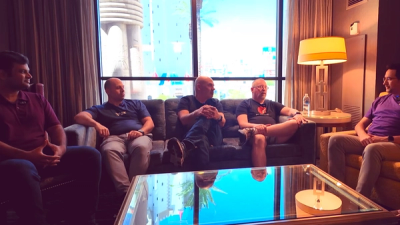
Socket CTO Ahmad Nassri joins AppSec leaders at Black Hat to discuss active malware, package manager risks, and software supply chain defense.