

Company News
AWS Security Hub Adds Socket for Supply Chain Security
Socket is now in the AWS Security Hub Extended plan. Adopt it through AWS, apply committed spend, and block malicious open source packages.
By Feross Aboukhadijeh - Aug 04, 2026
html-to-figma-design-system
Advanced tools
Convert HTML to Figma using your design system — MCP server + local bridge for DS-aware design generation via the Plugin API
The only MCP that translates HTML into Figma using your own design system.
Give Claude an HTML file. It reads your design system — published components and design token variables — and builds the layout inside Figma using real DS instances. Not hardcoded shapes. Not a visual approximation. Real component instances with real token bindings.



Not a Figma product. This is an independent, open-source MCP server built for Claude Code.
Most HTML-to-Figma tools do a visual copy — they dump raw frames with hardcoded hex values. When you get the file, nothing connects to your design system. You have to re-apply tokens, swap in real components, and fix every layer by hand.
This tool does the opposite. Claude reads your HTML and your published component library at the same time, maps HTML elements to DS components, applies your token variables to every fill and text style, and builds a Figma file that's already part of your system.
If you update a token in your library and re-publish, the Figma nodes update automatically.
Have an existing HTML file — a prototype, a coded mockup, a landing page? Claude reads it and recreates it inside Figma using your design system instead of hardcoded values.
"Here's an HTML file I built as a prototype. Translate it into Figma on the 'Prototypes' page, artboard 'Onboarding v2'. Use my design system components wherever possible — match the layout, hierarchy, and content."
Describe a screen and Claude builds it in Figma — section by section, using your actual published components and design token variables.
"Go to the 'Screens' page in my design file and build a new dashboard on the artboard called 'Overview'. Use the top-nav shell. Include: 4 KPI metric cards, a line chart of weekly activity, a data table with sortable columns, and a donut chart by category."
Name the components you want, and Claude will find and insert the real library instances.
"Build a settings screen using my Sidebar, Modal/Large, and FormInput components. Use the
surface-secondarybackground,spacing-xlgaps, andtext-secondaryfor label colors."
Step 1 — Make sure your Figma is set up (see Before you start below)
Step 2 — Run the installer:
bash <(curl -fsSL https://raw.githubusercontent.com/miapre/html-to-figma-design-system/main/install.sh)
The script clones this repo, runs npm install, asks for your Figma token, and prints the exact block to add to ~/.claude/settings.json.
Step 3 — Restart Claude Code, then each session:
cd ~/html-to-figma-design-system && npm run bridge — keep this terminal openThese are the most common reason things break. Work through them in order before running the installer.
The browser version of Figma does not work. The bridge communicates with a Figma plugin over WebSocket, which requires the desktop app.
Download it at: figma.com/downloads
The bridge uses this token to resolve published component keys via the Figma REST API.
claude-bridgeYou will be asked to paste it during the install script. It gets saved to the .env file in the repo.
The plugin imports components from your team library. Your design system must live in a separate Figma file and be published as a library.
To publish:
If you add or update a component later, publish again before asking Claude to use it.
Starting from scratch? See docs/GUIDE.md — Part 0 for how to structure a design system file, set up variables (tokens), and create components properly.
Publishing makes the library available to your team. Enabling makes it accessible in a specific file.
You only need to do this once per file.
Publishing component libraries and using variables (design tokens) requires a Figma Professional plan or above — not the Starter/Free plan.
If you are on a free plan, the bridge can still create frames and text nodes, but component insertion and variable binding will not work.
Prefer to set things up manually, or want to understand each step? See docs/GUIDE.md for the full walkthrough:
Once the MCP is registered, Claude has access to:
Build
| Tool | What it does |
|---|---|
figma_create_frame | Create an auto-layout frame (shells, cards, rows, columns) |
figma_create_text | Create a text node bound to DS text style and color variable |
figma_create_rectangle | Create a rectangle (dividers, placeholders, blocks) |
figma_create_chart | Render a chart (scatter, line, donut, bar) in a single call |
figma_insert_component | Insert a published library component by key or node ID |
figma_batch | Execute multiple operations in a single round trip (tables, lists, grids) |
Edit
| Tool | What it does |
|---|---|
figma_set_component_text | Set a text property on a component instance |
figma_set_text | Set text on a specific nested TEXT node by direct ID |
figma_set_node_fill | Apply a DS color variable to any node or its vector descendant |
figma_set_layout_sizing | Adjust sizing, alignment, padding, or dimensions on a node |
figma_set_variant | Set a VARIANT or BOOLEAN component property directly |
figma_set_visibility | Show or hide a node |
figma_swap_main_component | Swap an instance to a different variant by component key |
figma_replace_component | Replace a node with a new component at the same parent position |
figma_move_node | Reorder a node within its parent |
figma_delete_node | Delete a node |
Inspect
| Tool | What it does |
|---|---|
figma_get_node_props | Get component properties and text layers for a node |
figma_get_node_children | List direct children of a node |
figma_get_node_parent | Get parent and siblings of a node |
figma_get_text_info | Get DS text style ID and color variable of a TEXT node |
figma_get_component_variants | List all variant options in a component set |
figma_list_text_styles | List all DS text styles with their IDs |
figma_get_selection | Get currently selected node IDs and dimensions |
figma_select_node | Select and zoom to a node by ID |
figma_get_page_nodes | List all top-level nodes on the current page |
figma_get_pages | List all pages in the document |
figma_change_page | Switch to a different page |
1. Start the bridge (keep this terminal open):
cd ~/html-to-figma-design-system   # or wherever you installed it
npm run bridge
2. Run the plugin in Figma desktop: Plugins → Development → HTML to Figma — Design System → Run
The plugin panel shows "Connected ✓" when ready.
3. Ask Claude to build something.
Claude Code → MCP server (mcp.js) → Bridge server (bridge.js) → Figma Plugin → Figma document
Two separate channels connect Claude to Figma:
Read channel — official Figma MCP Claude uses Figma's official MCP server to inspect designs, discover node IDs, and read existing content. Read-only.
Write channel — this repo
Claude calls tools in mcp.js. Each call is an HTTP POST to bridge.js running locally on your machine. The bridge forwards the instruction to the Figma plugin over WebSocket. The plugin executes it using Figma's Plugin API and returns the new node ID. Claude uses that ID as the parent for the next element.
All variable bindings are real — nodes created this way use your actual design token variables, not hardcoded values. If you update a token in your library and re-publish, the nodes update automatically.
This tool runs entirely on your machine. No design data, component names, token values, or HTML content is sent to any external server. The only outbound network call is to the Figma REST API to resolve published component keys using your Personal Access Token — the same call Figma's own plugins make.
"Figma plugin is not connected" → The bridge is running but the plugin is not. Go to Figma desktop → Plugins → Development → HTML to Figma — Design System → Run.
"Library import failed" → Your design system library is not enabled in the target file. Open the Assets panel → Team library → toggle it on.
"No component key" → The component is not published. Open your design system file → Assets → Team library → Publish.
"object is not extensible"
→ A frame-only property (like counterAxisSizingMode) is being passed to a text node. See docs/GUIDE.md — Troubleshooting for the full list.
MIT
FAQs
Convert HTML to Figma using your design system — MCP server + local bridge for DS-aware design generation via the Plugin API
We found that html-to-figma-design-system demonstrated a healthy version release cadence and project activity because the last version was released less than a year ago. It has 1 open source maintainer collaborating on the project.
Did you know?

Socket for GitHub automatically highlights issues in each pull request and monitors the health of all your open source dependencies. Discover the contents of your packages and block harmful activity before you install or update your dependencies.
Company News
Socket is now in the AWS Security Hub Extended plan. Adopt it through AWS, apply committed spend, and block malicious open source packages.
Research
/Security News
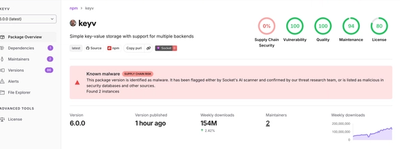
Popular npm packages keyv and cacheable compromised.

Security News
A misconfiguration gave three Anthropic models internet access, and one, believing it was in a simulation, shipped a credential-stealing package to PyPI.