


Security News
Risky Biz Podcast: AI Agents Are Raising the Stakes for Software Supply Chain Security
Open source attacks are accelerating as AI coding agents pull in dependencies faster, with less human review.
By Sarah Gooding - Jun 30, 2026
i18n Tool Kit - Zero-dependency internationalization toolkit for setup, scanning, analysis, validation, auto translation, fixing, reporting, and runtime translation loading.
A zero-dependency internationalization toolkit for setup, scanning, analysis, validation, usage tracking, translation completion, automatic JSON locale translation, reporting, and runtime translation loading.







Use the CLI in CI, Workbench for project-level management, and Lens for day-to-day editor feedback.
# global CLI use
npm install -g i18ntk
# local project use
npm install --save-dev i18ntk
# one-off execution
npx i18ntk --help
What it does
What it does not do
Why not i18next?
i18next is mainly a runtime internationalization library. i18ntk is mainly workflow tooling around translation files. They can work together: i18next handles runtime translation, while i18ntk handles setup, scanning, validation, reporting, and maintenance.
| Need | i18ntk | i18next |
|---|---|---|
| Runtime translation | Basic toolkit | Mature runtime |
| Locale file scanning | Yes | No |
| Missing key detection | Yes | No |
| Unused key detection | Yes | No |
| Validation reports | Yes | Limited |
| Auto-translation workflow | Yes | External tooling |
--no-prompt, CI=true, or non-TTY stdin/stdout.--code-dir / --source-code-dir, --locales-dir / --i18n-dir, and --source-locale while preserving legacy aliases.i18ntk-analyze setup guidance crash, i18ntk-complete --help, i18ntk-summary NaN averages, validation success/failure wording, and completion summary labels.supportedExtensions default now includes .tsx and .jsx. Previously excluded from source scanning, causing React/Next.js projects to miss 97%+ of translation keys.complete command now correctly inserts missing keys at the right nesting level when target locale files have namespace wrappers (e.g., auth.json containing { "auth": { ... } }). Keys inside auth.panel.sign_in now go inside the auth wrapper, not at root level.complete command: missing keys now inserted inside namespace wrapper when file has top-level key matching filename (e.g., auth.json with { "auth": … }).translate --output-dir: output now placed in <outputDir>/<targetLang>/<filename>, preventing language overwrites.scanner and report-model to filter out JS built-in type names (e.g., Promise, Boolean) and code expressions (e.g., &&, ${…}) from hardcoded text detection.getAllKeys() no longer reports parent namespace objects (footer) as missing keys alongside their leaf children (footer.copyright).de, ru) as issues. Auto-detects available languages from the i18n directory structure.src/ directory for hardcoded text, not locales/.initRuntime() now supports localeDir/targetLocale/sourceLocale as aliases for baseDir/language/fallbackLanguage.readJsonSafe() now recursively strips __proto__, constructor, and prototype keys from all parsed JSON; deepMerge() in the runtime blocks these keys during locale merging; mergeWithDefaults() in settings-manager filters them from user settings.sourceDir declaration that caused a SyntaxError at module load has been removed. Corrupt backup files are now handled gracefully with descriptive error messages.i18ntk-complete no longer crashes with getUnifiedConfig is not defined. The missing config-helper import has been added.stripBOMAndComments() in i18n-helper now handles null/undefined inputs without throwing.I18NTK_DEBUG is set. Settings save errors are now re-thrown instead of silently swallowed. Legacy config migration has proper error handling.See CHANGELOG.md for more release details.
Initialize a project:
i18ntk
# or with explicit command
i18ntk --command=init
Run common checks:
i18ntk --command=analyze
i18ntk --command=validate
i18ntk --command=usage
i18ntk report --json
i18ntk --command=sizing
i18ntk --command=summary
Complete or fix translation files:
i18ntk --command=complete
i18ntk-fixer --help
Auto-translate locale JSON:
i18ntk --command=translate
# or
i18ntk-translate locales/en/common.json de --report-stdout
The full onboarding guide is in docs/getting-started.md.
Primary CLI:
i18ntk
i18ntk --help
i18ntk --command=init
i18ntk --command=analyze
i18ntk --command=validate
i18ntk --command=usage
i18ntk report --json --markdown --html --out ./i18ntk-reports
i18ntk --command=scanner
i18ntk --command=sizing
i18ntk --command=complete
i18ntk --command=translate
i18ntk --command=summary
Standalone executables:
i18ntk-init
i18ntk-analyze
i18ntk-validate
i18ntk-usage
i18ntk-report
i18ntk-scanner
i18ntk-sizing
i18ntk-complete
i18ntk-summary
i18ntk-doctor
i18ntk-fixer
i18ntk-backup
i18ntk-translate
Note: manager route i18ntk --command=backup is available via the interactive menu. Use i18ntk-backup directly for scripted backup operations.
| Command | What it does | Looks for | Writes or changes |
|---|---|---|---|
i18ntk | Opens the interactive management menu. | Project config, setup state, available commands. | Only changes files after you choose a command that writes. |
i18ntk --command=init / i18ntk-init | Sets up locale folders and missing target-language files. | Source language files and selected target languages. | Locale JSON files, .i18ntk-config, optional reports/backups. |
i18ntk --command=analyze / i18ntk-analyze | Compares source and target translation coverage. | Missing keys, extra keys, untranslated markers, completion by language. | Markdown/JSON/text reports when report output is enabled. |
i18ntk --command=validate / i18ntk-validate | Validates structure and translation quality risks. | Placeholder mismatches, missing keys, risky URLs/emails/secrets, likely English target text. | Validation summary report. Does not edit locale files. |
i18ntk --command=usage / i18ntk-usage | Maps translation keys to source files and finds unused/missing keys. | Direct i18n calls, literal known-key references, bounded dynamic templates/object maps, unresolved dynamic expressions, hardcoded text candidates, namespace/file naming mismatches. | Usage report with key locations, namespace recommendations, unresolved dynamic expressions, hardcoded text suggestions, and optional dead-key report. Does not delete unless cleanup deletion is explicitly enabled. |
i18ntk report / i18ntk-report | Generates the stable schemaVersion 1 report used by CLI automation and i18ntk Workbench. | Locale completeness, missing keys, unused keys with confidence, placeholders, likely untranslated values, expansion risk, and hardcoded text candidates. | JSON to stdout by default, plus JSON/Markdown/HTML files when --out is used. Does not edit locale files. |
i18ntk --command=scanner / i18ntk-scanner | Scans source for i18n issues and hardcoded user-facing text. | JSX/template text, common text attributes, i18n usage patterns, source-language text profiles. | Scanner report. Does not edit files. |
i18ntk --command=complete / i18ntk-complete | Adds missing keys to target language files for 100% key coverage. | Source-language keys missing from targets. | Target locale JSON files, using missing translation markers/prefixes. |
i18ntk --command=translate / i18ntk-translate | Auto-translates locale JSON using configured provider behavior. | Missing, empty, untranslated-marker, source-copy, likely-English, or visibly corrupt target values by default. | Target locale JSON files and translation reports. Existing translated values are kept unless --translate-all is used. If unresolved values remain after retry, writes i18ntk-reports/auto-translate/latest.json for targeted follow-up. |
i18ntk --command=sizing / i18ntk-sizing | Estimates translated string length expansion and layout risk. | Text length, expansion ratios, placeholder-bearing strings. | Sizing report. Does not edit locale files. |
i18ntk --command=summary / i18ntk-summary | Shows project translation status. | Configured locales, reports, completeness status. | Console/report output only. |
i18ntk-fixer | Fixes placeholder and missing-marker issues, and can audit English source files with --check-placeholders. | Placeholder corruption, missing translation markers, configured language files, [LANG] ... leftovers in English locales. | Locale JSON files when fixes are applied. Use dry-run options where available before bulk edits. |
i18ntk-backup | Creates, verifies, restores, and cleans locale backups. | Locale JSON files and backup manifests. | Backup archives/manifests, or restored locale files when using restore. |
Many commands support:
--code-dir <path> or --source-code-dir <path> for application source files--locales-dir <path> or --i18n-dir <path> for locale files--output-dir <path>--source-locale <code>--ui-language <code>--no-prompt--helpLegacy --source-dir and --source-language remain supported. For scanner-style commands, --source-dir means source code. For locale-only commands, prefer --locales-dir to avoid ambiguity.
Command-specific tools add their own flags such as --dry-run, --output-report, --cleanup, --predict-expansion, or Auto Translate provider options.
Example:
i18ntk --command=analyze --code-dir=./src --locales-dir=./locales --source-locale=en --output-dir=./i18ntk-reports
Interactive manager flow:
i18ntk
# choose "Auto Translate"
Direct CLI examples:
i18ntk-translate locales/en/common.json de
i18ntk-translate locales/en/common.json fr --dry-run --report-stdout
i18ntk-translate locales/en es --source-dir locales/en --files "*.json" --no-confirm --preserve-placeholders
Provider examples:
export DEEPL_API_KEY="your-deepl-api-key"
i18ntk-translate locales/en/common.json de --provider deepl --no-confirm --preserve-placeholders

export LIBRETRANSLATE_URL="https://libretranslate.com/translate"
export LIBRETRANSLATE_API_KEY="optional-api-key"
i18ntk-translate locales/en/common.json es --provider libretranslate --no-confirm --preserve-placeholders
google remains the default provider. You can also set I18NTK_TRANSLATE_PROVIDER=deepl or I18NTK_TRANSLATE_PROVIDER=libretranslate.
Provider requests are HTTPS-only and response-size limited, and security logs redact provider query strings and response bodies. DeepL is pinned to official DeepL hosts by default; set I18NTK_ALLOW_CUSTOM_TRANSLATE_HOSTS=1 only for a trusted DeepL-compatible proxy. Custom LibreTranslate URLs are blocked for localhost/private IP ranges unless I18NTK_ALLOW_PRIVATE_TRANSLATE_URLS=1 is set for trusted local testing. Keep provider API keys in environment variables or a secret manager.
The manager flow asks for:
./localesallIf you select a locale root such as ./locales and choose source language en, the manager automatically uses ./locales/en when that folder contains the source JSON files.
Before writing files, the manager can run a dry-run preview. After confirmation it writes translated files under sibling target-language folders, for example:
locales/en/common.json
locales/de/common.json
locales/fr/common.json
Auto Translate is target-aware by default. When a target file already exists, it keeps translated target values and only sends values that are missing, empty, marked as untranslated, still identical to the source, likely still English, or visibly corrupt from encoding damage such as ?????, replacement characters, or common mojibake. Use --translate-all when you intentionally want to re-translate every source string.
Auto Translate detects common placeholders such as:
{name}{{count}}%s%d:id%{name}${value}{count, plural, one {# item} other {# items}}$t(common.save)%(total).2fUseful flags:
--preserve-placeholders: translate text around placeholders and reinsert original tokens--skip-placeholders: copy placeholder-bearing strings unchanged--send-placeholders: send placeholder-bearing strings through translation after masking--custom-regex <regex>: add project-specific placeholder detection--only-missing: keep existing translated target values and translate only missing/source-copy/likely English values (default)--translate-all: re-translate every source stringProgress output is stage-aware for large files. Normal keys are reported as Translating strings, while preserve-mode placeholder work is reported as Translating placeholder-safe text segments; each progress update includes the current key path when available.
Auto Translate can create and use a project-local protection file:
i18ntk-translate locales/en/common.json de --create-protection-file --protection-file ./i18ntk-auto-translate.json
Example i18ntk-auto-translate.json:
{
  "version": 1,
  "terms": [
    "BrandName",
    "PRODUCT_CODE",
    { "value": "OK", "context": "after:Click|Press|Tap" },
    { "value": "API", "context": "standalone" }
  ],
  "keys": ["app.brandName", "legal.companyName", "product.*.symbol"],
  "values": ["BrandName Ltd", "support@example.com"],
  "patterns": ["[A-Z]{2,}-\\d+"]
}
terms are masked before translation and restored exactly afterward.
after:word, before:word, standalone, surrounded:left,right).keys are exact key paths or * wildcard paths copied unchanged.values are exact source values copied unchanged.patterns are JavaScript regex strings for advanced protected substrings.Useful flags:
--protection-file <path>--create-protection-file--no-protectionOpen Settings and choose Auto Translate to edit defaults for placeholder mode, translate-only-needed mode, concurrency, batch size, retry settings, report output, BOM output, protection file path, first-run setup prompt, and update prompt.
See docs/auto-translate.md for the full Auto Translate guide.
Validation checks locale structure, completeness, placeholders, and content risks.
Validation warning types are specific:
Potential risky content: URL, email address, or secret-like valuePossible untranslated English content: target-language value appears to contain too much EnglishEnglish-content warnings include:
Tune warnings in .i18ntk-config:
{
  "englishContentThresholdPercent": 10,
  "allowedEnglishTerms": ["BrandName", "PRODUCT_CODE"]
}
i18ntk-sizing reports translation file sizes, key counts, average value length, and file-set mismatches across language folders.
i18ntk-sizing --locales-dir ./locales --format table
i18ntk-sizing --locales-dir ./locales --detailed --output-dir ./i18ntk-reports
Use --detailed to print per-file rows in the terminal.
Predict UI layout overflow risk by analyzing per-key character-count expansion across languages:
i18ntk-sizing --locales-dir ./locales --predict-expansion --output-report
Expansion ratios are classified into risk tiers:
The report includes a built-in language-pair expansion reference table (EN→DE +35%, EN→RU +50%, EN→JA −40%, etc.) and lists the top-30 most-expanded keys.
i18ntk-scanner now supports detecting hardcoded text in multiple source languages beyond English:
i18ntk-scanner --code-dir ./src --source-locale de
i18ntk-scanner --code-dir ./src --source-locale ja --output-report
Supported language profiles (12+): English, German, French, Spanish, Japanese, Chinese, Russian, Korean, Arabic, Hindi, and more. Each profile includes language-specific character ranges, stopword lists for false-positive filtering, and transliteration rules for key generation.
i18ntk-usage can identify translation keys that are defined but never referenced in source code:
i18ntk-usage --code-dir ./src --locales-dir ./locales --cleanup
i18ntk-usage --code-dir ./src --locales-dir ./locales --cleanup --dry-run-delete
Each dead key receives a confidence score (0.0–1.0) factoring:
t(`prefix.${dynamic}`)) — lower score and listed in the usage report; simple consts, bounded arrays, object maps, and ternaries are expanded to exact keys where possibleThe --dry-run-delete flag writes a .dead-keys.json report for review before any destructive action.
Enforce consistent translation key naming across your project:
i18ntk-validate --enforce-key-style
Configure the expected style in .i18ntk-config:
{
  "keyStyle": "dot.notation"
}
Supported styles: dot.notation, snake_case, camelCase, kebab-case, flat. Violations are reported as warnings with suggested canonical forms.
utils/watch-locales.js now provides debounced file watching with EventEmitter support:
const watchLocales = require('i18ntk/utils/watch-locales');
const watcher = watchLocales('./locales');

watcher.on('change', (filePath) => {
  console.log('Locale changed:', filePath);
});

watcher.on('add', (filePath) => {
  console.log('Locale added:', filePath);
});

// Later:
watcher.stop();
Features: 300ms debounce (configurable), SHA-256 hash tracking to skip no-change saves, and a maximum of 50 watched directories.
The watchLocales return value gained EventEmitter methods in v4.0.0. Existing stop-function usage still works:
const stop = watchLocales('./locales', onChange);
Can be updated to:
const watcher = watchLocales('./locales');
watcher.on('change', onChange);
watcher.stop();
Passing a callback as the second argument is still supported — it auto-subscribes to change and add events.
Create differential backups that only include changed files:
i18ntk-backup create ./locales --incremental
Incremental backups store SHA-256 hashes per file and a parent-chain reference. Restoring an incremental backup automatically chains from the oldest full backup through each incremental diff in order. Chain depth is capped at 10 increments. Use verify to validate the hash chain.
Reduce memory usage by deferring locale file loads until first key access:
const runtime = require('i18ntk/runtime');

const i18n = runtime.initRuntime({
  baseDir: './locales',
  language: 'en',
  lazy: true,
});

console.log(i18n.t('common.hello')); // loads common.json on first access
When lazy: true, the runtime builds a key-to-file manifest on first access and loads individual files on demand. Files are loaded once and cached. If the manifest is missing or incomplete, the runtime falls back to full eager loading for that language. Manifest size is capped at 100KB with path containment validation.
Production guidance:
initRuntime() instead of module-level runtime.t() in apps with multiple tenants, projects, or locale roots.lazy: true for large modular locale folders where lower steady-state memory matters more than a small first-key lookup cost.preload: true without lazy for small locale sets or latency-sensitive startup paths.refresh(language) after deploying or writing changed locale files so cached data and lazy manifests are rebuilt.i18n.t('common.hello', {}, { language: 'de' }).translateBatch() for small groups of labels and clearCache() / getCacheInfo() for cache maintenance and diagnostics.i18ntk/runtime/enhanced remains available for compatibility with existing async/encryption users, but new production integrations should start with i18ntk/runtime.Use i18ntk/runtime when an application needs to read locale JSON files at runtime.
const runtime = require('i18ntk/runtime');

const i18n = runtime.initRuntime({
  baseDir: './locales',
  language: 'en',
  fallbackLanguage: 'en',
  keySeparator: '.',
  preload: true,
});

console.log(i18n.t('common.hello'));
i18n.setLanguage('fr');
console.log(i18n.getLanguage());
console.log(i18n.getAvailableLanguages());
i18n.refresh('fr');
Useful production helpers:
i18n.t('common.hello', {}, { language: 'de' }); // per-call language override
i18n.translateBatch(['menu.home', 'menu.settings']);
i18n.clearCache('fr');
console.log(i18n.getCacheInfo());
See docs/runtime.md for runtime details.
i18ntk uses a project-local .i18ntk-config file.
Example:
{
  "version": "4.5.4",
  "sourceDir": "./locales",
  "i18nDir": "./locales",
  "outputDir": "./i18ntk-reports",
  "sourceLanguage": "en",
  "defaultLanguages": ["en", "de", "es", "fr", "ru"],
  "reports": {
    "format": "markdown"
  },
  "englishContentThresholdPercent": 10,
  "allowedEnglishTerms": ["BrandName", "PRODUCT_CODE"],
  "autoTranslate": {
    "placeholderMode": "preserve",
    "concurrency": 12,
    "batchSize": 100,
    "progressInterval": 25,
    "retryCount": 3,
    "retryDelay": 1000,
    "timeout": 15000,
    "dryRunFirst": true,
    "onlyMissingOrEnglish": true,
    "reportStdout": true,
    "bom": false,
    "protectionEnabled": true,
    "protectionFile": "./i18ntk-auto-translate.json",
    "promptProtectionSetup": true,
    "promptProtectionUpdate": true
  },
  "setup": {
    "completed": true
  },
  "extensions": {
    "workbench": {
      "localeDirectory": "./locales",
      "sourceLocale": "en"
    },
    "lens": {
      "localeDirectory": "./locales",
      "sourceLocale": "en",
      "keyFormats": ["dot", "snake"]
    }
  }
}
See docs/api/CONFIGURATION.md for the full configuration model.
The public package intentionally ships runtime and CLI files only.
The package includes:
main/runtime/README.md, CHANGELOG.md, LICENSE, and policy filesThe public package manifest includes readmeFilename: "README.md", and the release staging script fails if README.md is missing or empty.
.i18ntk-config, or protection files.| Tool | Purpose |
|---|---|
| i18ntk | Zero-dependency i18n toolkit for scanning, validation, translation, reports, and runtime loading. |
| i18ntk Workbench | Full VS Code localization health dashboard powered by i18ntk. |
| i18ntk Lens | Lightweight inline translation hovers, diagnostics, and key navigation. |
| PublishGuard | Pre-publish safety scanner for npm packages and VS Code extensions. |
| ContextKit | AI coding context manager for AGENTS.md, Claude, Cursor, Copilot, Roo, and Codex files. |
MIT. See LICENSE.
FAQs
i18n Tool Kit - Zero-dependency internationalization toolkit for setup, scanning, analysis, validation, auto translation, fixing, reporting, and runtime translation loading.
The npm package i18ntk receives a total of 54 weekly downloads. As such, i18ntk popularity was classified as not popular.
We found that i18ntk demonstrated a healthy version release cadence and project activity because the last version was released less than a year ago. It has 1 open source maintainer collaborating on the project.
Did you know?

Socket for GitHub automatically highlights issues in each pull request and monitors the health of all your open source dependencies. Discover the contents of your packages and block harmful activity before you install or update your dependencies.
Security News
Open source attacks are accelerating as AI coding agents pull in dependencies faster, with less human review.

Research
/Security News
Malicious Chrome and Firefox extensions posed as free VPNs while stealing clipboard data through later extension updates.
Research
/Security News
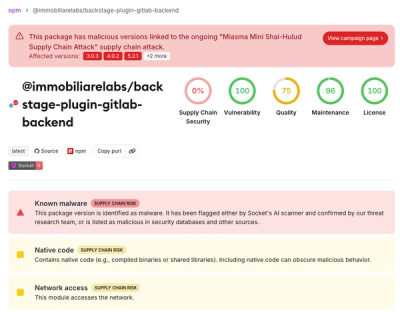
Miasma Mini Shai-Hulud hits @immobiliarelabs Backstage plugins, targeting GitLab and LDAP auth packages on npm.