
Product
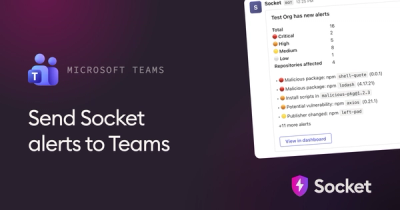
Microsoft Teams Notifications Are Now Available in Socket
Socket can now send alerts and supply chain attack notifications to Microsoft Teams, with filters that route the right updates to each channel.
By Jeppe Hasseriis - Sep 01, 2026

A tiny first-in-first-out task queue with explicit flow control. Add functions, let the queue start automatically, and call this.next() when each task is ready to release the next one.
Documentation · Quick start · API · Patterns · Browser use · Examples · Playground · Performance · Testing




npm install js-queue
Native ES modules:
import Queue from 'js-queue';

const queue=new Queue;

queue.add(
    function(){
        console.log('first');
        this.next();
    },
    function(){
        console.log('second');
        this.next();
    }
);
CommonJS remains supported:
const Queue=require('js-queue');
js-queue works with bundlers and without a bundler. Bundlers resolve the bare package imports normally. Native browser ESM uses a standard import map and runs the same JavaScript directly, with no build or transpilation step.
For a normal npm layout where easy-stack is hoisted, place this complete import map before the module script:
<script type="importmap">
{
  "imports": {
    "js-queue": "./node_modules/js-queue/queue.js",
    "js-queue/": "./node_modules/js-queue/",
    "js-queue/stack": "./node_modules/js-queue/stack.js",
    "js-queue/stack.js": "./node_modules/js-queue/stack.js",
    "easy-stack": "./node_modules/easy-stack/stack.js"
  }
}
</script>
<script type="module">
  import Queue from 'js-queue';
  import Stack from 'js-queue/stack';

  const queue=new Queue;
  const stack=new Stack;
</script>
If npm nests easy-stack because the application installs a conflicting root version, use this complete scoped map instead. Its scope preserves the dependency boundary that Node and bundlers apply to imports originating inside js-queue:
<script type="importmap">
{
  "imports": {
    "js-queue": "./node_modules/js-queue/queue.js",
    "js-queue/": "./node_modules/js-queue/",
    "js-queue/stack": "./node_modules/js-queue/stack.js",
    "js-queue/stack.js": "./node_modules/js-queue/stack.js",
    "easy-stack": "./node_modules/easy-stack/stack.js"
  },
  "scopes": {
    "./node_modules/js-queue/": {
      "easy-stack": "./node_modules/js-queue/node_modules/easy-stack/stack.js"
    }
  }
}
</script>
<script type="module">
  import Stack from 'js-queue/stack';

  const stack=new Stack;
</script>
Every import-map URL is relative to the HTML document. Serve the application over HTTP(S), and configure that server to expose the mapped node_modules files. file:// is not a supported loading path. See the browser guide for the classic-script option and live no-bundler examples.
js-queue does not guess when a task is complete. A task releases the next item by calling this.next()—immediately, from a callback, or after an awaited operation.
queue.add(function(){
    fetch('/work')
        .then(handleResponse)
        .finally(()=>this.next());
});
That explicit hand-off makes the same queue useful for synchronous steps, callback APIs, network work, connection gates, and manually controlled pipelines.
The fastest js-queue yet. Install it. Don’t rebuild it.


Node 24.18, 100,000 operations, median of 21 alternating samples. Method and results. CI reruns the tagged comparison.
| Member | Type | Purpose |
|---|---|---|
add(...tasks) | method | Validate and append functions; auto-start when idle. |
next() | method | Run the next FIFO task when the queue is not stopped. |
clear() | method | Remove pending tasks and return the new empty array. |
contents | getter/setter | Read or replace the pending function array. |
size | getter | Number of pending tasks. |
running | getter | Whether a task currently owns the queue. |
autoRun | boolean | Start automatically after add(); defaults to true. |
stop | boolean | Hold execution without discarding pending work. |
Every task receives the queue as this. Invalid tasks are rejected before any item from the same add() call is appended. If a task throws synchronously, the queue returns to an idle, recoverable state and preserves the remaining work.
| Import | Format | Use |
|---|---|---|
js-queue | ESM or CommonJS | Conditional primary entry. |
js-queue/queue.js | ESM or CommonJS | Compatibility path to the queue. |
js-queue/queue-vanilla.js | classic browser script | Publishes globalThis.Queue. |
js-queue/stack | ESM or CommonJS | The modernized easy-stack 2.1 LIFO entry. |
The runtime supports Node.js 22.13 and newer. Native ESM and CommonJS both load the same synchronous source files; no duplicate Node build is shipped.
Tested with vanilla-test. The repository has 102 focused checks organized into five non-overlapping layers: Unit, Functional, Behavioral, Integration, and Regression. Forty-two shared checks import the package by its bare name and run unchanged in Node and real Google Chrome; Chrome resolves those imports through the checked-in import-map configuration.

npm test
npm run test:unit
npm run test:functional
npm run test:behavioral
npm run test:integration
npm run test:regression
npm run test:consumer
npm run coverage
The 10 Unit checks isolate API facts. The 30 Functional checks cover queue workflows and Playground behavior. The 9 Behavioral checks verify complete consumer outcomes across explicit hand-offs, gates, recovery policies, stale-reference isolation, independent queues, reprioritization, and native no-bundler loading. The 28 Integration checks cover interacting queue operations, package formats, a poisoned packed-consumer dependency conflict, benchmark evidence, stack compatibility, and local HTTP delivery. The 25 Regression checks protect validation, recovery, the no-WeakMap performance contract, import maps, documentation, artwork, and deployment wiring. Both native V8 collectors continue to enforce 100% statement, branch, function, and line coverage for the shipped ESM queue.
Node coverage report · Chrome coverage report
Version 3.1 replaces WeakMap lookups with private instance fields, shares one Node source between import and require, and moves the runtime floor to Node 22.13. Existing require('js-queue') and require('js-queue/stack.js') syntax remains supported on that Node floor; queue-vanilla.js remains available to current browsers with native private fields.
Read the migration guide and changelog before upgrading an application on Node versions older than 22.13.
FAQs
A tiny FIFO task queue with explicit flow control for Node and browsers
The npm package js-queue receives a total of 521,730 weekly downloads. As such, js-queue popularity was classified as popular.
We found that js-queue demonstrated a healthy version release cadence and project activity because the last version was released less than a year ago. It has 1 open source maintainer collaborating on the project.
Product
Socket can now send alerts and supply chain attack notifications to Microsoft Teams, with filters that route the right updates to each channel.

Security News
pnpm 12 rewrites the package manager in Rust, cutting install times by up to 90% while preserving pnpm 11 workflows and lockfiles.

Security News
Socket CTO Ahmad Nassri joins AppSec leaders at Black Hat to discuss active malware, package manager risks, and software supply chain defense.