
Security News
The Code You Didn't Write Is Still Yours to Defend
AI agents are pulling packages into environments no scanner is watching, creating exposure before security teams can see it.
By Brad Arkin - Jun 23, 2026
Your AI app, live as you type — declare widgets, write event handlers, done. The same file runs in the browser or on a stateless Node server.
 knobkit

Your AI app, live as you type. Declare widgets, write event handlers — done. The same file runs entirely in the browser — no server at all — or with handlers on a stateless Node server. Swap one line.
import { knobkit, chat } from "knobkit";
const convo = chat({ placeholder: "Say something…" });
const app = knobkit({
title: "Echo bot",
description: "Whatever you send comes back reversed.",
widgets: [convo],
});
app.on(convo.sent, async ({ text }) => {
convo.say({ role: "user", content: text });
convo.say({ role: "assistant", content: [...text].reverse().join("") });
});
app.serve();
That's a complete app. app.serve() runs the handler on Node; change that one line to
app.mount("#root") and the identical file runs fully client-side. For a real model-backed chatbot
(streaming, history), see examples/.
Same authoring feel — declare inputs, write a function, get an app — different architecture:
mount apps build to static files —
host them anywhere, run WebGPU models client-side), then move handlers to a server when you need
secrets, large models, or native deps — by changing the last line.on(event, async fn) functions. No full-script
re-execution on every interaction, no reactive graph to fight, no widget-key gymnastics.{ type, payload } — never a
copy of state. An attribute a handler never reads (say, generated audio) never leaves the browser.npm create knobkit@latest my-app # choose mount (browser) or serve (node)
cd my-app
npm install
npm run dev
Skip the prompts with npm create knobkit@latest my-app -- --mount (or --serve). Already have a
project? npm install knobkit. Requires Node ≥ 22.
The knobkit package installs a knobkit command:
knobkit dev      # dev server — auto-detects mount vs serve
knobkit build    # build a browser (mount) app to dist/
knobkit serve    # run a server (serve) app
The entry file is the "main" field of your package.json — like vite, the manifest names the
entry. Pass a file to run something else: knobkit dev other.tsx. Flags: --mount / --serve
force a mode, --port <n> sets the dev-server port. Otherwise knobkit dev detects the tier from
whether your entry file ends in mount() or serve().
await convo.history(), await box.value() — pulled from the browser.convo.say(m), convo.append(token), out.set(v), log.push(line).returning an event from a handler (it's re-emitted, like a user action).{ type, payload }. widget.sent("hi") builds one.on(event, handler) registers a handler against a widget's event (convo.sent, go.clicked).setup(fn) runs once per session — in the browser on mount, per connection on serve — with a
live context, so async startup (load model weights, fetch a user's data) happens here. The page
renders first; setup is non-blocking.busy marks a transient working span on a widget — widget.busy(handler) wraps an async handler,
or widget.busyStart()/busyEnd() bracket one by hand (e.g. a setup() load). The widget shows a
thin indeterminate bar and drops its input events while busy. disable()/enable() is the persistent
version (dimmed).mount vs serve is the only thing that changes between in-browser and client/server — the
widgets, handlers, and methods are identical.mount("#root") | serve() | |
|---|---|---|
| State | in the browser | in the browser |
on(...) handlers | run in the browser | run on a stateless Node server |
| Transport | local function call | socket.io |
| Use when | everything fits client-side (incl. WebGPU models) | the handler needs the server (large models, secrets, native deps) |
Inputs: text, number, slider, dropdown, checkbox, checkboxGroup, radio, upload, mic,
webcam, chat, button.
Outputs: output (plain text or format: "markdown"), json, log, label, html, image,
gallery, annotatedImage (boxes/labels over an image), highlightedText (spans over text), audio,
video, file (download), progress, chart (bar/line/area), frame (embed a URL or a sandboxed
HTML document in an isolated iframe).
Both (editable or read-only): code (syntax-highlighted editor/viewer), table (data grid).
Custom: widget({ state, … }).
widgets is the widget tree. An array is a vertical stack; row, col, and grid are containers
that nest other widgets — composed with the widget objects themselves, no keys or strings:
import { knobkit, upload, dropdown, button, output, row, col } from "knobkit";

knobkit({ widgets: col(photo, row(size, go), caption) });
knobkit({ widgets: grid([a, b, c, d], { cols: 2 }) });
tabs and accordion are containers too — tabs([{ label, content }, …]),
accordion({ label, open }, …children). Containers are themselves widgets whose state is their
arrangement, so a handler can restructure the UI at runtime — panel.add(chart), panel.remove(sidebar).
In examples/ — each is a single
demo.tsx. Run one with pnpm -F knobkit-example-<name> dev.
examples/playground is an
in-browser playground: a code editor on the right runs live as a mounted knobkit app on the left,
with a dropdown of built-in examples — itself a knobkit app built from code/dropdown/layout.
Run it with pnpm -F knobkit-example-playground dev.
Requires Node ≥ 22 and pnpm.
pnpm install
pnpm -F knobkit build     # build the library + browser client bundle
pnpm -F knobkit test      # vitest
pnpm typecheck            # all packages
See CLAUDE.md for the architecture and how to add a widget.
FAQs
Your AI app, live as you type — declare widgets, write event handlers, done. The same file runs in the browser or on a stateless Node server.
The npm package knobkit receives a total of 15 weekly downloads. As such, knobkit popularity was classified as not popular.
We found that knobkit demonstrated a healthy version release cadence and project activity because the last version was released less than a year ago. It has 1 open source maintainer collaborating on the project.
Did you know?

Socket for GitHub automatically highlights issues in each pull request and monitors the health of all your open source dependencies. Discover the contents of your packages and block harmful activity before you install or update your dependencies.
Security News
AI agents are pulling packages into environments no scanner is watching, creating exposure before security teams can see it.
Security News
GitHub Actions checkout now blocks risky pull_request_target checkouts by default to help prevent pwn request supply chain attacks.
Product
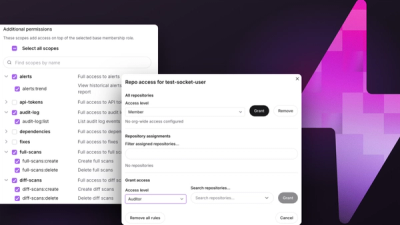
Socket now supports Custom Roles and Repository Access Permissions so organizations can control who can access specific repositories and actions.