



Research
/Security News
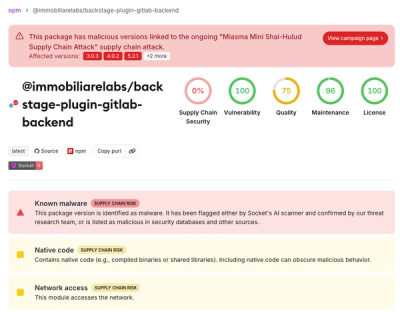
Miasma Mini Shai-Hulud Hits ImmobiliareLabs npm Packages
Miasma Mini Shai-Hulud hits @immobiliarelabs Backstage plugins, targeting GitLab and LDAP auth packages on npm.
By Socket Research Team - Jun 26, 2026
libphonenumber-js-basic
Advanced tools
A simpler (and smaller) rewrite of Google Android's popular libphonenumber library
[![NPM Version][npm-badge]][npm] [![Build Status][travis-badge]][travis] [![Test Coverage][coveralls-badge]][coveralls]
A simpler (and smaller) rewrite of Google Android's famous libphonenumber library: easy phone number parsing and formatting in javascript.
libphonenumber is a phone number formatting and parsing library released by Google, originally developed for (and currently used in) Google's Android mobile phone operating system. Implementing a rigorous phone number formatting and parsing library was crucial for the phone OS overall usability (back then, in the early 2000s, it was originally meant to be a phone after all, not just a SnapChat device).
libphonenumber-js is a simplified pure javascript port of the original libphonenumber library (written in C++ and Java because those are the programming languages used in Android OS). While libphonenumber has an official javascript port which is being maintained by Google, it is tightly coupled to Google's closure javascript utility framework. It still can be compiled into one big bundle which weighs 220 KiloBytes — quite a size for a phone number input component. It can be reduced to a specific set of countries only but that wouldn't be an option for a worldwide international solution.
One part of me was curious about how all this phone matching machinery worked, and another part of me was curious if there's a way to reduce those 220 KiloBytes to something more reasonable while also getting rid of the closure library and rewriting it all in pure javascript. So, that was my little hackathon for a couple of weeks, and seems that it succeeded. The resulting library does everything a modern web application needs while maintaining a much smaller size of about 75 KiloBytes.
libphonenumberlibphonenumber metadata size is about 200 KiloBytes1-800-GOT-MILK as we don't use telephone sets in the XXIst century that much (and we have phonebooks in your mobile phones)formatted are internationally diallable, because that's the only type of phone numbers users are supposed to be inputting on websites (no one inputs short codes, emergency telephone numbers like 911, etc.)possibleDigits data to speed up phone number pre-validation (it just skips to the regular expression check itself)011 ... in the US (again, just use the +... notation accepted worldwide for mobile phones)tel:... URIs (RFC 3966) because it's not relevant for user-facing web experiencenpm install libphonenumber-js --save
import { parse, format, asYouType } from 'libphonenumber-js'

parse('8 (800) 555 35 35', 'RU')
// { country: 'RU', phone: '8005553535' }

format('2133734253', 'US', 'International')
// '+1-213-373-4253'

new asYouType().input('+12133734')
// '+1 213 373 4'
new asYouType('US').input('2133734')
// '(213) 373-4'
"Country code" means either a two-letter ISO country code (like US) or a special 001 country code used for non-geographical entities (as per Google's libphonenumber library). For example, +7 800 555 35 35 phone number belongs to Russia so it has RU country code where as +800 1 1111 1111 phone number could belong to any country so it has 001 country code.
options can be either an object
country:
{
  restrict — (country code)
             the phone number must be in this country

  default — (country code)
            default country to use for phone number parsing and validation
            (if no country code could be derived from the phone number)
}
or just a country code which is gonna be country.restrict.
Returns { country, phone } where
country is a country codephone is a national (significant) numberIf the phone number supplied isn't valid then an empty object {} is returned.
parse('+1-213-373-4253') === { country: 'US', phone: '2133734253' }
parse('(213) 373-4253', 'US') === { country: 'US', phone: '2133734253' }
Formats a phone number using one of the following formats:
International — e.g. +1 213 373 4253International_plaintext — (aka E.164) e.g. +12133734253National — e.g. (213) 373-4253parsed_number argument should be taken from the result of the parse() function call: { country, phone }. phone must be a national (significant) number (i.e. no national prefix). parsed_number argument can also be expanded into two arguments:
format({ country: 'US', phone: '2133734253' }, 'International') === '+1 213 373 4253'
format('2133734253', 'US', 'International') === '+1 213 373 4253'
(aka is_valid_number)
Checks if a phone number is valid.
The arguments can be
parse() function call: { country, phone }(phone, country_code) which will then be simply passed to the parse() function for parsingisValidNumber('+1-213-373-4253') === true
isValidNumber('+1-213-373') === false
isValidNumber('(213) 373-4253', 'US') === true
isValidNumber('(213) 37', 'US') === false
isValidNumber({ phone: '2133734253', country: 'US' }) === true
The difference between using parse() and isValidNumber() for phone number validation is that isValidNumber() also checks the precise regular expressions of possible phone numbers for a country. For example, for Germany parse('123456', 'DE') would return { country: 'DE', phone: '123456' } because this phone number matches the general phone number rules for Germany. But, if the metadata is compiled with --extended flag (see below) and the precise regular expressions for possible phone numbers are included in the metadata then isValidNumber() is gonna use those precise regular expressions for validation and isValid('123456', 'DE') will return false because the phone number 123456 doesn't actually exist in Germany.
So, the general phone number rules for a country are mainly for phone number formatting: they dictate how different phone numbers (matching those general regular expressions) should be formatted. And parse() uses only those general regular expressions (as per the reference Google's libphonenumber implementation) to perform basic phone number validation. isValidNumber(), on the other hand, is all about validation, so it digs deeper into precise regular expressions (if they're included in metadata) for possible phone numbers in a given country. And that's the difference between them: parse() parses phone numbers and loosely validates them while isValidNumber() validates phone number precisely (provided the precise regular expressions are included in metadata).
By default those precise regular expressions aren't included in metadata at all because that would cause metadata to grow twice in its size (the complete metadata would be about 200 KiloBytes). If anyone needs to generate custom metadata then it's very easy to do so: just follow the instructions provided in the Customizing metadata section of this document (the option to look for is --extended).
class asYouType(default_country_code)(aka as_you_type)
Creates a formatter for partially entered phone number. The two-letter default_country_code is optional and, if specified, is gonna be the default country for the phone number being input (in case it's not an international one). The instance of this class has two methods:
input(text) — takes any text and appends it to the input; returns the formatted phone numberreset() — resets the inputThe instance of this class has also these fields:
valid — is the phone number being input a valid one alreadycountry — a country code of the country this phone belongs tocountry_phone_code — a phone code of the countrynational_number — national number part (so far)template — currently used phone number formatting template, where digits (and the plus sign, if present) are denoted by x-esnew asYouType().input('+12133734') === '+1 213 373 4'
new asYouType('US').input('2133734') === '(213) 373-4'
const formatter = new asYouType()
formatter.input('+1-213-373-4253') === '+1 213 373 4253'
formatter.valid === true
formatter.country === 'US'
formatter.country_phone_code = '1'
formatter.template === 'xx xxx xxx xxxx'
Metadata is generated from Google's original PhoneNumberMetadata.xml by transforming XML into JSON and removing unnecessary fields.
Currently I have an npm script for monitoring changes to PhoneNumberMetadata.xml in Google's repo and automatically creating a Pull Request in this repo with the fresh metadata when it is updated. What's left is to test this script and schedule it to run daily on my machine. So this project's metadata is supposed to be up-to-date. Still, in case the automatic metadata update script malfunctions some day, anyone can request metadata update via a Pull Request here on GitHub:
npm installnpm run metadata:updateupdate-metadata branch of your forknpm run metadata:update command creates a new update-metadata branch, downloads the new PhoneNumberMetadata.xml into the project folder replacing the old one, generates JSON metadata out of the XML one, checks if the metadata has changed, runs the tests, commits the new metadata and pushes the commit to the remote update-metadata branch of your fork.
Alternatively, a developer may wish to update metadata urgently, without waiting for a pull request approval. In this case just perform the steps described in the Customizing metadata section of this document.
There's also a React component utilizing this library: react-phone-number-input
If you spot any inconsistencies with the original Google's libphonenumber then create an issue in this repo.
If you're using Webpack 1 (which you most likely are) then make sure that
json-loader set up for *.json files in Webpack configurationjson-loader doesn't exclude /node_modules/resolve.extensions in Webpack configuration then make sure .json extension is present in the listWebpack 2 sets up json-loader by default so there's no need for any special configuration.
For those who aren't using bundlers for some reason there's a way to build a standalone version of the library
git clone https://github.com/halt-hammerzeit/libphonenumber-js.gitnpm installnpm run browser-buildbundle folder for libphonenumber-js.min.js<script src="/scripts/libphonenumber-js.min.js"></script>
<script>
var libphonenumber = window['libphonenumber-js']
alert(new libphonenumber.asYouType('US').input('213-373-4253'))
</script>
If only a specific set of countries is needed in a project, and a developer really wants to reduce the resulting bundle size, say, by 50 KiloBytes, then he can generate custom metadata and pass it as an extra argument to this library's functions. Or, say, if a developer wants to use the complete metadata (which is about 200 KiloBytes) for precise phone number validation then he can also generate such complete metadata set.
First, add metadata generation script to your project's package.json
{
  "scripts": {
    "libphonenumber-metadata": "libphonenumber-generate-metadata metadata.min.json --countries RU,DE --extended",
  }
}
And then run it like npm run libphonenumber-metadata.
The first argument is the output metadata file path. --countries argument is a comma-separated list of the required countries (if --countries is omitted then all countries are included). --extended argument may be passed to increase the precision of phone number validation but at the same time it will enlarge the resulting metadata size approximately twice.
Then use the generated metadata.min.json with the libphonenumber-js/custom functions
import { parse, format, isValidNumber, asYouType } from 'libphonenumber-js/custom'
import metadata from './metadata.min.json'

const parseCustomCountries = parse.bind({ metadata })
const formatCustomCountries = format.bind({ metadata })
const isValidNumberCustomCountries = isValidNumber.bind({ metadata })
const asYouTypeCustomCountries = asYouType(metadata)
For utilizing "tree-shaking" in ES6-capable bundlers (e.g. Webpack 2) libphonenumber-js/custom.es6 may be used instead.
metadata:update and metadata:pull-request scripts work as intended and add a daily launchd job for npm run metadata:update && npm run metadata:pull-requestAfter cloning this repo, ensure dependencies are installed by running:
npm install
This module is written in ES6 and uses Babel for ES5 transpilation. Widely consumable JavaScript can be produced by running:
npm run build
Once npm run build has run, you may import or require() directly from
node.
After developing, the full test suite can be evaluated by running:
npm test
When you're ready to test your new functionality on a real project, you can run
npm pack
It will build, test and then create a .tgz archive which you can then install in your project folder
npm install [module name with version].tar.gz
MIT [npm]: https://www.npmjs.org/package/libphonenumber-js [npm-badge]: https://img.shields.io/npm/v/libphonenumber-js.svg?style=flat-square [travis]: https://travis-ci.org/halt-hammerzeit/libphonenumber-js [travis-badge]: https://img.shields.io/travis/halt-hammerzeit/libphonenumber-js/master.svg?style=flat-square [coveralls]: https://coveralls.io/r/halt-hammerzeit/libphonenumber-js?branch=master [coveralls-badge]: https://img.shields.io/coveralls/halt-hammerzeit/libphonenumber-js/master.svg?style=flat-square
FAQs
A simpler (and smaller) rewrite of Google Android's popular libphonenumber library
We found that libphonenumber-js-basic demonstrated a not healthy version release cadence and project activity because the last version was released a year ago. It has 1 open source maintainer collaborating on the project.
Did you know?

Socket for GitHub automatically highlights issues in each pull request and monitors the health of all your open source dependencies. Discover the contents of your packages and block harmful activity before you install or update your dependencies.
Research
/Security News
Miasma Mini Shai-Hulud hits @immobiliarelabs Backstage plugins, targeting GitLab and LDAP auth packages on npm.

Security News
Rolldown paused Rust React Compiler integration after a 5MB binary size increase raised concerns about shipping React-specific code to all Vite users.

Security News
/Research
Mini Shai-Hulud expands into the Go ecosystem after hitting LeoPlatform npm packages and targeting GitHub Actions workflows.