

Company News
AWS Security Hub Adds Socket for Supply Chain Security
Socket is now in the AWS Security Hub Extended plan. Adopt it through AWS, apply committed spend, and block malicious open source packages.
By Feross Aboukhadijeh - Aug 04, 2026
lionscraper
Advanced tools
LionScraper bridge daemon, thin MCP stdio, and CLI — local HTTP + WebSocket to Chrome extension
lionscraperLionScraper is a browser extension that can collect lists, articles, links, images, and more from web pages. This npm package provides the companion bridge to that extension in three ways:
lionscraper-mcp): connect your AI app (e.g. Cursor) so the model can call scraping tools in chat.lionscraper): run daemon, scrape, and ping from a terminal over the same local HTTP/WebSocket port as the extension./v1/...) when the daemon is running—useful for scripts, services, or any HTTP client without MCP or the CLI front-end.The real scraping logic runs in the extension; this package connects and forwards.
curl, fetch, or any HTTP client against http://127.0.0.1:$PORT (see HTTP API (local REST) below).This package is published on npm as lionscraper.
npm install -g lionscraper
You get two commands; together they support three integration styles (MCP, CLI, HTTP API):
| Command | Role |
|---|---|
lionscraper-mcp | Thin MCP server (stdio) for AI apps |
lionscraper | CLI: daemon, stop, scrape, ping, … (also runs the process that serves the HTTP API) |
Without a global install, MCP can use npx; see JSON examples under Add MCP in your AI app.
Examples assume a global lionscraper install (UIs differ). In MCP JSON, every env value is a string.
Minimal config (omit env for built-in defaults; PORT defaults to 13808 and must match the extension bridge port):
{
  "mcpServers": {
    "lionscraper": {
      "command": "lionscraper-mcp"
    }
  }
}
Full env example (drop keys you do not need; empty strings behave like “unset” for most of these):
{
  "mcpServers": {
    "lionscraper": {
      "command": "lionscraper-mcp",
      "env": {
        "PORT": "13808",
        "TIMEOUT": "120000",
        "LANG": "en-US",
        "TOKEN": "",
        "DAEMON": ""
      }
    }
  }
}
npx (no global install) — the first run may download the package. command is npx; args are ["-y", "lionscraper", "lionscraper-mcp"] (npm package name lionscraper, then binary lionscraper-mcp).
Minimal config (npx):
{
  "mcpServers": {
    "lionscraper": {
      "command": "npx",
      "args": ["-y", "lionscraper", "lionscraper-mcp"]
    }
  }
}
Full env example (npx):
{
  "mcpServers": {
    "lionscraper": {
      "command": "npx",
      "args": ["-y", "lionscraper", "lionscraper-mcp"],
      "env": {
        "PORT": "13808",
        "TIMEOUT": "120000",
        "LANG": "en-US",
        "TOKEN": "",
        "DAEMON": ""
      }
    }
  }
}
Pin a version by using e.g. lionscraper@1.0.1 instead of lionscraper in args.
PORT: HTTP + WebSocket listen port; default 13808; must match the extension bridge port.TIMEOUT: Milliseconds to wait for a previous instance to release the port before forcing takeover; default 120000; 0 means force quickly.LANG: Tool descriptions and stderr log language (en-US, zh-CN, or POSIX forms like en_US.UTF-8).TOKEN: Bearer token shared with the daemon; empty means no Authorization header.DAEMON: Only 0 disables auto-spawning lionscraper daemon from thin MCP; empty or other values match omitting the key (auto-start allowed).Restart MCP or the app so the config applies.
PORT (e.g. 13808).The server registers tools that mirror extension capabilities. Names and shapes are what your MCP client shows to the model.
| Tool | Purpose (short) |
|---|---|
ping | Check that the extension is connected and registered |
scrape | Auto-detect structure (lists, tables, …); supports pagination |
scrape_article | Article body (e.g. Markdown) and metadata |
scrape_emails | Email addresses on the page |
scrape_phones | Phone numbers (structured) |
scrape_urls | Hyperlink URLs |
scrape_images | Image URLs and basic metadata |
Parameters: A full JSON schema for every field belongs in the tool definitions your client displays and in release-accurate docs; duplicating it here goes stale quickly. Use the tool list / descriptions in the AI app when calling MCP.
The thin MCP process (lionscraper-mcp) exposes Resources and Prompts in addition to Tools:
lionscraper://guide/connection (PORT alignment, ping troubleshooting), lionscraper://guide/when-to-use-tools (prefer LionScraper over WebFetch/curl/wget by scenario), lionscraper://guide/cli (terminal CLI), lionscraper://reference/tools, lionscraper://reference/common-params. Clients list/read them into context; they are served inside the stdio process and do not require the daemon HTTP path (works even if the extension is offline). For the loopback HTTP control plane (/v1/...), see HTTP API (local REST) below (not an MCP resource URI).scrape_article, prefer_lionscraper_scraping, extension troubleshooting). Clients list/get prompts; UI varies by host (Cursor, Trae, …).Copy follows LANG (e.g. zh-CN), same as tool metadata.
The lionscraper binary is the terminal front-end to the same stack as MCP: lionscraper daemon listens on PORT (default 13808) for HTTP (used by the CLI and by the thin lionscraper-mcp process) and WebSocket (used by the extension). Set PORT (and optional TOKEN) to match the extension bridge port and any MCP config. Use the CLI for scripts, CI, or quick one-off runs without opening an AI chat.
The CLI talks to the daemon HTTP API on http://127.0.0.1:$PORT (default port 13808, same as the extension). If you do not pass --api-url, a local daemon is auto-started when possible when you run scrape or ping.
Common commands:
lionscraper --help
lionscraper daemon              # keep running; HTTP + WebSocket on PORT
lionscraper stop                # stop daemon on configured PORT
lionscraper ping
lionscraper scrape -u https://www.example.com
lionscraper scrape --method article -u https://www.example.com
# Shorthand: lionscraper -u https://www.example.com   → same as scrape
--method selects which tool the daemon runs (default scrape): scrape, article, emails, phones, urls, images. Repeat -u / --url to pass several URLs in one run.
Set PORT (and optional TOKEN) in the environment so the CLI matches the extension and MCP. Use --api-url http://127.0.0.1:PORT if the daemon is not on the default base URL. Run lionscraper --help for every flag the binary accepts.
Below flags are forwarded to the extension (except --bridge-timeout-ms, which only caps how long the CLI waits on the bridge). Actual behavior still depends on the extension version.
Output and connection
| Flag | Meaning |
|---|---|
--format json or pretty | JSON one-line vs. indented (default json) |
--raw | Print the tool’s text block as returned, without re-formatting |
-o / --output <file> | Write the result to a file instead of stdout |
Timing and load
| Flag | Meaning |
|---|---|
--delay <ms> | Wait after page load before scraping (dynamic content) |
--timeout-ms <ms> | Per-URL timeout on the extension side |
--bridge-timeout-ms <ms> | Max wait for this CLI → daemon call |
--scrape-interval <ms> | Delay between starting multiple URLs |
--concurrency <n> | Concurrency hint for multi-URL runs |
--scroll-speed <px> | Global scroll speed (extension semantics) |
--max-pages <n> | Pagination cap for list-style scrape |
Lazy-loaded / infinite scroll (maps to waitForScroll in the tool payload)
| Flag | Meaning |
|---|---|
--wait-scroll-speed <px> | Pixels per step while scrolling |
--wait-scroll-interval <ms> | Delay between scroll steps |
--wait-max-scroll-height <px> | Optional max scroll distance |
--scroll-container <selector> | Optional scrollable container selector |
Locale
| Flag | Meaning |
|---|---|
--lang zh-CN or en-US | Language hint for messages / extension UI strings |
Extra payload
| Flag | Meaning |
|---|---|
--include-html + true / false | Ask for full-page HTML in meta when supported |
--include-text + true / false | Ask for full-page plain text in meta when supported |
Method-specific filters (examples; see --help for the full set)
--method emails): --email-domain, --email-keyword, --email-limit--method phones): --phone-type, --phone-area-code, --phone-keyword, --phone-limit--method urls): --url-domain, --url-keyword, --url-pattern, --url-limit--method images): --img-min-width, --img-min-height, --img-format, --img-keyword, --img-limitOptional browser automation hints (when the extension supports them): --auto-launch-browser, --no-auto-launch-browser, --post-launch-wait-ms.
Example A — List / table scrape with pagination, delays, and scroll assist
lionscraper scrape \
  -u https://www.example.com/items \
  --max-pages 5 \
  --delay 800 \
  --timeout-ms 90000 \
  --bridge-timeout-ms 180000 \
  --wait-scroll-speed 400 \
  --wait-scroll-interval 350 \
  --lang zh-CN \
  --format pretty \
  -o items.json
--max-pages: stop after at most five “pages” of list accumulation for this job.--delay: give the page extra time after load before extraction.--timeout-ms / --bridge-timeout-ms: extension vs. CLI-side waits; raise both for slow sites or heavy pages.--wait-scroll-*: gentle scrolling so lazy-loaded rows can appear before scraping.-o / --format pretty: save a human-readable JSON file for inspection.Example B — Article body with optional HTML snapshot
lionscraper scrape --method article \
  -u https://www.example.com/blog/post-1 \
  --include-html true \
  --timeout-ms 120000 \
  --format json
--method article: maps to the scrape_article tool (Markdown-style body + metadata when the extension provides it).--include-html true: requests additional HTML in the result meta where supported (larger payload).Example C — Emails and URLs with filters, multiple pages
lionscraper scrape --method emails \
  -u https://www.example.com/contact \
  --email-domain example.com \
  --email-keyword support \
  --email-limit 30 \
  --format pretty

lionscraper scrape --method urls \
  -u https://www.example.com \
  -u https://www.example.com/docs \
  --url-domain example.com \
  --url-limit 200 \
  --scrape-interval 500
-u values: two URLs processed in one invocation; --scrape-interval spaces out task starts.Example D — Images with size / format filters
lionscraper scrape --method images \
  -u https://www.example.com/gallery \
  --img-min-width 240 \
  --img-min-height 240 \
  --img-format webp \
  --img-limit 40 \
  -o gallery-images.json
--img-limit caps how many entries are returned.Base URL: http://127.0.0.1:$PORT (default 13808). Binds 127.0.0.1 only. The extension must be connected on that port and a daemon must be listening (same process model as the rest of this package).
| Method | Path | Response (success) |
|---|---|---|
GET | /v1/health | { "ok", "identity", "bridgePort", "sessionCount" } |
POST | /v1/daemon/shutdown | { "ok": true } then the daemon exits |
POST | /v1/tools/call | Tool result JSON (below) |
Anything else → 404 { "ok": false, "error": { "code": "NOT_FOUND", "message": "Not found" } }.
Auth: If env TOKEN is set on the daemon, every request needs Authorization: Bearer <TOKEN>; otherwise omit the header.
POST /v1/tools/callContent-Type: application/json. For streaming, also Accept: application/x-ndjson.{ "name": "<tool>", "arguments": { }, "progressToken": "<optional>" }
| Field | Meaning |
|---|---|
name | One of: ping, scrape, scrape_article, scrape_emails, scrape_phones, scrape_urls, scrape_images |
arguments | Tool payload; omit or {} if empty |
progressToken | Any string or number; with Accept: application/x-ndjson, the body is NDJSON (lines type: "progress", then a final type: "result" or type: "error") |
arguments (JSON keys)ping only: optional lang ("en-US" | "zh-CN"), autoLaunchBrowser (boolean), postLaunchWaitMs (number, 3000–60000).
All scrape-family tools (scrape, scrape_article, scrape_emails, scrape_phones, scrape_urls, scrape_images) share:
| Key | Type | Constraint / note |
|---|---|---|
url | string | string[] | Required — one URL or an array of URLs |
lang | "en-US" | "zh-CN" | Optional |
delay | number | Optional, ≥ 0 |
timeoutMs | number | Optional, ≥ 1000 |
bridgeTimeoutMs | number | Optional, ≥ 1000 |
includeHtml | boolean | Optional |
includeText | boolean | Optional |
scrapeInterval | number | Optional |
concurrency | number | Optional |
scrollSpeed | number | Optional |
autoLaunchBrowser | boolean | Optional |
postLaunchWaitMs | number | Optional, 3000–60000 |
waitForScroll | object | Optional; if set, must include scrollSpeed and scrollInterval; may include maxScrollHeight, scrollContainerSelector |
Only scrape: optional maxPages (number, ≥ 1).
Optional filter object (only on the matching tool):
name | filter properties |
|---|---|
scrape_emails | domain, keyword, limit (≥ 1) |
scrape_phones | type, areaCode, keyword, limit (≥ 1) |
scrape_urls | domain, keyword, pattern, limit (≥ 1) |
scrape_images | minWidth, minHeight (≥ 0), format, keyword, limit (≥ 1) |
Unknown name, bad JSON, or schema violations → 400 { "code": "BAD_REQUEST", ... }. Bad bearer → 401 UNAUTHORIZED. Tool crash → 500 INTERNAL.
200 body: { "content": [ { "type": "text", "text": "..." } ], "isError"?: boolean }.
PORT=13808)curl -sS "http://127.0.0.1:13808/v1/health"
curl -sS -X POST "http://127.0.0.1:13808/v1/tools/call" \
-H "Content-Type: application/json" \
-d '{"name":"ping","arguments":{}}'
curl -sS -X POST "http://127.0.0.1:13808/v1/tools/call" \
-H "Content-Type: application/json" \
-d '{"name":"scrape_article","arguments":{"url":"https://www.example.com","timeoutMs":120000}}'
# With TOKEN on the daemon:
curl -sS -X POST "http://127.0.0.1:13808/v1/tools/call" \
-H "Content-Type: application/json" -H "Authorization: Bearer YOUR_TOKEN" \
-d '{"name":"ping","arguments":{}}'
Q: Extension not connected or scraping fails?
Q: Many “tools” visible in the AI app—does that mean the extension is connected?
Not necessarily. Tools only confirm AI → MCP server; the extension must still connect on the same port and register.
Q: CLI says it cannot reach the daemon?
Start lionscraper daemon in another terminal, or fix PORT / --api-url.
Q: I want to drive scraping from my own HTTP client?
Keep the daemon and extension on the same PORT, then POST /v1/tools/call with name and arguments as in HTTP API (local REST). GET /v1/health checks that the listener is LionScraper.
MIT (same as the lionscraper npm package).
FAQs
LionScraper bridge daemon, thin MCP stdio, and CLI — local HTTP + WebSocket to Chrome extension
The npm package lionscraper receives a total of 18 weekly downloads. As such, lionscraper popularity was classified as not popular.
We found that lionscraper demonstrated a healthy version release cadence and project activity because the last version was released less than a year ago. It has 1 open source maintainer collaborating on the project.
Did you know?

Socket for GitHub automatically highlights issues in each pull request and monitors the health of all your open source dependencies. Discover the contents of your packages and block harmful activity before you install or update your dependencies.
Company News
Socket is now in the AWS Security Hub Extended plan. Adopt it through AWS, apply committed spend, and block malicious open source packages.
Research
/Security News
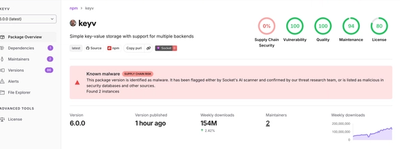
Popular npm packages keyv and cacheable compromised.

Security News
A misconfiguration gave three Anthropic models internet access, and one, believing it was in a simulation, shipped a credential-stealing package to PyPI.