
Product
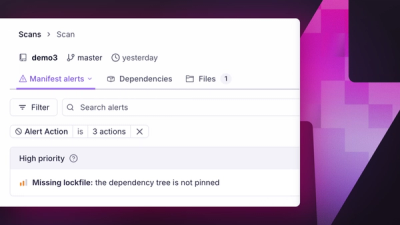
Introducing Manifest Alerts
Socket now detects supply chain risks in project manifests, starting with missing lockfiles that can make dependency installs non-reproducible.
By André Staltz, Trevor Norris - Jun 16, 2026
logscale-mcp-server
Advanced tools
LogScale MCP Server
Query CrowdStrike LogScale logs from AI assistants via the Model Context Protocol












Features • Quick Start • Tools • Usage • Queries • Security • CI • Architecture • Contributing
LogScale MCP Server lets you query CrowdStrike LogScale logs through natural language in VS Code Copilot Chat, Claude Desktop, or any MCP-compatible client. Instead of writing raw CQL queries and managing API calls, just ask:
"Show me errors in the xxxx namespace from the last hour"
"Find all 500 errors from the xyxyxy pod today"
"Search logs for request ID f6796646b043d231bf67f589b7306e9b"
The server handles query submission, polling, result formatting, and pagination automatically.
search_logs and get_query_job for comprehensive log querying1h, 7d) and absolute (epoch milliseconds) time rangeslogscale-mcp-server) and extension (logscale-mcp-vscode)| Area | Details |
|---|---|
| Test Coverage | 97% statements · 91% branches · 95% functions — 67 tests across 6 suites |
| Type Safety | Strict TypeScript with noEmit type checking on every CI run |
| Linting | ESLint with eslint-plugin-security for vulnerability pattern detection |
| Formatting | Prettier-enforced code style across all source and test files |
| Static Analysis | GitHub CodeQL with security-extended query suite |
| Dependency Audit | pnpm audit at moderate+ severity — zero known vulnerabilities |
| SBOM & CVE Scan | Trivy filesystem scan for CRITICAL and HIGH severity vulnerabilities |
| Secret Scanning | Gitleaks in CI + pre-commit hook for local secret detection |
| Dependency Review | PR-level review blocking moderate+ severity and GPL-3.0/AGPL-3.0 licenses |
| Commit Standards | Conventional Commits enforced via commitlint |
| Multi-Node Testing | CI tests on Node.js 18, 20, and 22 |
# Install globally
npm install -g logscale-mcp-server

# Or run directly with npx
npx logscale-mcp-server
git clone https://github.com/bhayanak/logscale-mcp-server.git
cd logscale-mcp-server
pnpm install
pnpm -r build
| Variable | Required | Description |
|---|---|---|
LOGSCALE_BASE_URL | Yes | LogScale instance URL (include path prefix like /logs if needed) |
LOGSCALE_API_TOKEN | Yes | Bearer token for authentication |
LOGSCALE_REPOSITORY | No | Default repository name |
LOGSCALE_TIMEOUT_MS | No | Max poll timeout (default: 60000) |
LOGSCALE_POLL_INTERVAL_MS | No | Poll interval (default: 1000) |
LOGSCALE_MAX_EVENTS | No | Default pagination limit (default: 200) |
search_logsSubmit a CQL query, wait for results, and return formatted log events.
| Parameter | Type | Required | Description |
|---|---|---|---|
queryString | string | Yes | CQL query string |
start | string/number | No | Start time — relative ("1h", "7d") or epoch ms |
end | string/number | No | End time — "now" or epoch ms |
repository | string | No | Target repository (overrides default) |
maxEvents | number | No | Max events to return (default: 200, max: 500) |
get_query_jobCheck status or retrieve results of an existing query job.
| Parameter | Type | Required | Description |
|---|---|---|---|
jobId | string | Yes | Query job ID from a previous search_logs call |
repository | string | No | Repository the job was submitted to |
maxEvents | number | No | Max events to return |
Add to .vscode/mcp.json:
{
  "servers": {
    "logscale": {
      "command": "npx",
      "args": ["-y", "logscale-mcp-server"],
      "env": {
        "LOGSCALE_BASE_URL": "https://your-logscale-instance.com",
        "LOGSCALE_API_TOKEN": "your-api-token",
        "LOGSCALE_REPOSITORY": "your-repository"
      }
    }
  }
}
Add to ~/Library/Application Support/Claude/claude_desktop_config.json:
{
  "mcpServers": {
    "logscale": {
      "command": "npx",
      "args": ["-y", "logscale-mcp-server"],
      "env": {
        "LOGSCALE_BASE_URL": "https://your-logscale-instance.com",
        "LOGSCALE_API_TOKEN": "your-api-token",
        "LOGSCALE_REPOSITORY": "your-repository"
      }
    }
  }
}
# Simple namespace filter
"kubernetes.namespace_name" = "your-namespace"

# Filter by namespace AND app label
"kubernetes.namespace_name" = "your-namespace"
| "kubernetes.labels.app_kubernetes_io/instance" = "your-instance-name"

# Search for errors in a namespace
kubernetes.namespace_name = "your-namespace" | ERROR

# Chain multiple filters
kubernetes.namespace_name = "your-namespace"
| 81bd572b6f202eccb9538408cb764c89
| "Pod Network CIDR is not provided"

# Aggregations
ERROR | groupBy(kubernetes.pod_name, function=count())
ERROR | top(log, limit=10)
ERROR | timechart(span=5m)
| Format | Example | Description |
|---|---|---|
| Relative | "1h", "24h", "7d", "30m" | Lookback from now |
| Absolute | 1773599400000 | Epoch milliseconds |
| End | "now" or epoch ms | End of time window |
AI Client (VS Code Copilot, Claude Desktop)
    ↕  MCP (stdio transport)
LogScale MCP Server (TypeScript / Node.js)
    ↕  HTTPS (REST API)
CrowdStrike LogScale (Query Jobs API)
The server uses LogScale's 2-step Query Jobs API:
POST /api/v1/repositories/{repo}/queryjobs → returns job IDGET /api/v1/repositories/{repo}/queryjobs/{id} → poll until done, return resultsThe LOGSCALE_BASE_URL is likely incorrect. Many LogScale deployments serve the API under a path prefix (e.g., /logs). Check the URL in your browser's network tab — if API calls go to https://host/logs/api/v1/..., set:
LOGSCALE_BASE_URL=https://your-host/logs
Verify your LOGSCALE_API_TOKEN is valid and has read permission on the target repository.
Check the LOGSCALE_REPOSITORY name matches exactly (case-sensitive).
FAQs
MCP server for querying CrowdStrike LogScale logs
We found that logscale-mcp-server demonstrated a healthy version release cadence and project activity because the last version was released less than a year ago. It has 1 open source maintainer collaborating on the project.
Did you know?

Socket for GitHub automatically highlights issues in each pull request and monitors the health of all your open source dependencies. Discover the contents of your packages and block harmful activity before you install or update your dependencies.
Product
Socket now detects supply chain risks in project manifests, starting with missing lockfiles that can make dependency installs non-reproducible.

Research
/Security News
The trojanized extensions use TinyGo-compiled WebAssembly and Solana transaction memos to resolve command-and-control infrastructure.

Security News
Anthropic says the directive cited national security concerns over a narrow jailbreak, but offered no specific technical details.