

Product
PHP and Composer Support Is Now in Beta
Socket’s PHP and Composer support is now in Beta for all customers, with PHP reachability analysis generally available.
By Trevor Norris, Benjamin Barslev - Aug 21, 2026
Run commands on repeat. Manage them from a terminal board.
loop-task is a cross-platform CLI that runs shell commands at human-readable intervals. Create loops in the background, manage them from an interactive TUI board, or run them in the foreground.



npm install -g loop-task
loop-task                          # open the board (requires Bun)
loop-task start                    # start the daemon, restore persisted loops
loop-task new 30m -- npm test      # create a background loop
loop-task run --now 10s -- echo hi # run a loop in the foreground
Or run it directly:
npx loop-task
npx loop-task new 30m -- npm test
Install Bun:
npm install -g bun
start, new, and run work with Node alone. The board auto-delegates to Bun when needed.
| Command | Description |
|---|---|
loop-task | Open the interactive board (requires Bun) |
loop-task start | Start the background daemon, restore persisted loops |
loop-task new <interval> -- <command> | Create a background loop |
loop-task run <interval> -- <command> | Run a loop in the foreground |
new and run)| Option | Description |
|---|---|
--now | Run immediately before waiting |
--max-runs <n> | Stop after N executions |
--cwd <dir> | Working directory for the command |
--verbose | Show execution details |
-h, --help | Display help |
-V, --version | Display version |
# Run tests every 30 minutes
loop-task new 30m -- npm test

# Run immediately, then every hour
loop-task new --now 1h -- npm test

# Run up to 5 times, then stop
loop-task run --max-runs 5 5m -- npm test

# Agent workflow — schedule an AI task every 30 minutes
loop-task new 30m --now -- opencode run "find and fix lint issues"

# Run in a specific directory
loop-task new 30m --cwd ./packages/api -- npm test

# Verbose mode
loop-task run --verbose 30m -- npm test
When the command has its own flags, use -- to stop argument parsing:
loop-task new 30m -- node -e "console.log('hello')"
The board is the primary way to manage loops. It shows all loops, their status, run history, and logs in a single terminal interface.
↑/↓, j/k    move selection
Enter       edit selected loop
n           create a new loop
p           pause / resume selected loop
r           force run selected loop now
del         delete selected loop
/           search loops
f           cycle status filter
s           cycle sort mode
←/→         switch between panels
h           toggle help
Esc         quit
Destructive actions (pause, force run, delete) prompt a confirmation before executing.
When creating or editing a loop:
| Field | Description |
|---|---|
| Interval | How often to run (30s, 5m, 1h, 1d, 1w) |
| Command | The full command line |
| Description | Optional label shown in the list; defaults to the command |
| Working dir | Directory the command runs in; defaults to current directory |
| Run immediately? | Run once now, then every interval, or wait the first interval |
| Max runs | Stop after N runs, or leave blank to run forever |
loop-task (board) ──IPC──► daemon ──► loop 1 (background process)
                          ├──► loop 2
                          └──► loop 3
loop-task start or any command that needs it.loop-task start or loop-task new ... spawns the daemon if not runningloop-task opens the board for interactive managementloop-task start restores all persisted loops with correct timing| Format | Description |
|---|---|
10s | 10 seconds |
5m | 5 minutes |
1h | 1 hour |
1d | 1 day |
1w | 1 week |
Requires Bun >= 1.2 for package management and the board, and Node.js >= 20 for the CLI and daemon.
bun install
npm run build
Run locally:
bun run dev                                    # board
node dist/entry.js new --now 30m -- npm test   # background loop
node dist/entry.js run --now --max-runs 1 10s -- echo hello  # foreground
Quality gates:
bun run typecheck
bun run lint
bun run test
npm run build
MIT
FAQs
Loop engineering toolkit. Run any command on a cadence, in the background, managed from a terminal board. Schedule tests, builds, syncs, or agent prompts.
The npm package loop-task receives a total of 94 weekly downloads. As such, loop-task popularity was classified as not popular.
We found that loop-task demonstrated a healthy version release cadence and project activity because the last version was released less than a year ago. It has 1 open source maintainer collaborating on the project.
Product
Socket’s PHP and Composer support is now in Beta for all customers, with PHP reachability analysis generally available.
Product
Socket is bringing experimental protection to Firefox, scanning 97,000+ extensions in Mozilla's official directory for malware and risky updates.
Research
/Security News
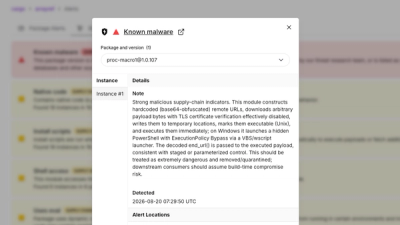
Three compromised Rust crates pulled in a malicious dependency that downloaded and executed cross-platform malware during Cargo builds.