
Research
/Security News
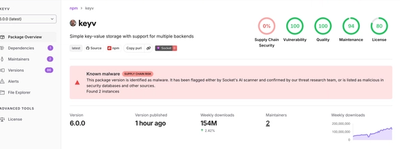
Popular npm Packages in the keyv and Cacheable Namespaces Compromised in Active Supply Chain Attack
Popular npm packages keyv and cacheable compromised.
By Socket Research Team - Aug 04, 2026
loopback-mcp-server
Advanced tools
Loopback — a project-tagged feedback bus for coding agents (Claude Code, Codex, Gemini CLI) over MCP. Capture UI/backend/usage/UX feedback once; let any agent claim, fix, and write the change back.
Pin feedback on the app you're building. Any coding agent claims it. The pin turns green when the fix is verified.
Loopback is the interactive feedback layer between real product usage and your
coding agents: one script tag makes the app you're running locally commentable
(Vercel-toolbar-style toolbar, element-anchored pins; deployed public sites go
via the /ingest rails instead — see surface compatibility), every pin auto-captures
the functional context — failing requests with response bodies, console
trail, the route journey that led there, LLM run metadata, typed repro steps —
and lands in one project-tagged queue that Claude
Code, Codex, and Gemini CLI all work over MCP. When an agent's fix is
verified, the pin turns green on the page, live.


https://github.com/user-attachments/assets/77c24102-f6e8-44cf-8055-9e9415a4084e

Seeded demo capture (generated by scripts/screenshot.mjs): the contact form's
backend bug pinned, claimed by claude-code, marked fixed with a linked change,
verified — pin and badge green. The wrong AI answer is still amber/open.
Coding agents can fix anything you can describe — but the loop back from real usage is missing. You notice a broken flow, screenshot it, re-describe it in a prompt, paste console output, explain which project it belongs to. Every time, for every agent. Vercel's comments have no public API; Claude Design's anchored comments are artifact-scoped; error trackers don't know your queue.
Loopback is that missing loop, built as a hub:
project slug in
one shared SQLite DB (~/.loopback/loopback.db). Agents registered once per
machine; consuming repos add only a widget tag and a slug.POST with its 500 response body — a frontend pin
carries the backend root cause. Pin an AI answer and the run metadata
(run_id, model, trace_url) rides along. CAPTURE THE HUB AGENTS
┌───────────────────────────┐ ┌─────────────────────────────┐ ┌─────────────────────────┐
│ widget pin on any app │──►│ loopback-mcp-server │◄──│ Claude Code │
│ · console + network ride │ │ one shared SQLite DB │ │ Codex (peers) │
│ · 500 bodies captured │ │ ~/.loopback/loopback.db │ │ Gemini CLI │
│ · AI run context │ │ │ └────────────┬────────────┘
├───────────────────────────┤ │ stdio (per-agent spawn) │ │
│ POST /ingest │──►│ --http on 127.0.0.1:7077 │ list → claim → fix →
│ · CI hooks, cron, │ │ (required for widgets) │ link change → fixed →
│ Sentry/PostHog pollers │ │ │ verify → resolve
└───────────────────────────┘ └──────────────┬──────────────┘ │
│ │
pins turn green on the page ◄─────┴───── status write-back ◄──────┘
Run it per-invocation over stdio (each agent spawns it; same DB = same
queue) or as one long-running --http service on 127.0.0.1:7077
(required for widgets — keep it alive with pm2/launchd/systemd:
integrations/keep-alive.md).
Requires Node ≥ 22.13 (built-in node:sqlite — zero native deps).
git clone https://github.com/joshidikshant/loopback && cd loopback
npm install                    # prepare script builds dist/
node dist/index.js --http      # the hub, on 127.0.0.1:7077
node demo/serve.mjs            # demo app on 127.0.0.1:5173 (broken backend + wrong AI answer)
Open http://127.0.0.1:5173 → submit the form (it fails politely) → ✦ Loopback → Pin feedback on an element → click the submit button → Send. The form shows the captured failed request. Then tell any connected agent "work the feedback queue for acme-demo" — or watch the item at http://127.0.0.1:7077/queue and be the agent yourself over MCP. When it's resolved, the open page announces it and the pin goes green.
Register the MCP server + instructions once per agent; after this, new projects
are a two-minute init. The copy-paste version — Claude Code (.mcp.json in
your project, or ~/.claude.json for all projects):
{
  "mcpServers": {
    "loopback": {
      "command": "npx",
      "args": ["-y", "loopback-mcp-server"]
    }
  }
}
Codex and Gemini CLI take the same command/args in their own config — the
server is the same binary over stdio. All three are equal citizens — full
per-agent pages in integrations/:
| Agent | MCP registration | Instructions/skill channel |
|---|---|---|
| Claude Code | claude mcp add --scope user loopback -- npx -y loopback-mcp-server — or the plugin: claude plugin marketplace add joshidikshant/loopback && claude plugin install loopback@loopback | @AGENTS.md import in CLAUDE.md + skill at .claude/skills/loopback/ → claude.md |
| Codex | ~/.codex/config.toml: [mcp_servers.loopback] command/args (or project-scoped .codex/config.toml) | AGENTS.md read natively + native SKILL.md at .agents/skills/loopback/ → codex.md |
| Gemini CLI | ~/.gemini/settings.json → mcpServers.loopback | AGENTS.md via context.fileName + @AGENTS.md in GEMINI.md + /loopback command → gemini.md |
All three also accept the long-running instance over streamable HTTP
(http://127.0.0.1:7077/mcp) instead of spawning — see the per-agent pages.
loopback-mcp-server --http, kept alive per keep-alive.md.<script src="http://127.0.0.1:7077/widget.js"
data-project="my-app" data-endpoint="http://127.0.0.1:7077"></script>
npx loopback-mcp-server init --project my-app --write
@AGENTS.md imports
in CLAUDE.md and GEMINI.md, the same SKILL.md installed for Claude
(.claude/skills/) and Codex (.agents/skills/), MCP registration for all
three (.mcp.json, .gemini/settings.json, .codex/config.toml), and a
/loopback Gemini command. Merges are non-destructive and idempotent —
re-run it anytime.With the hub running (loopback-mcp-server --http), everything happens on two
surfaces and one sentence to an agent:
| I want to… | Do this |
|---|---|
| Report something on a page with the widget | Click ✦ Loopback → Pin feedback on an element, click the thing, describe it. Failing requests, console, and AI run context attach themselves. |
| See the queue | http://127.0.0.1:7077/queue — filter with ?project=<slug>, click a row for a quick read |
| Read everything on one item | Click its id → http://127.0.0.1:7077/queue/<id>. Deep-linkable: paste it to a teammate or an agent. |
| Comment or change status myself | On the item view — plain forms, no agent needed |
| Get it fixed | In the repo, tell any agent: "work the feedback queue for <slug>" |
| Watch it close | The pin on your page turns green and announces itself; the item shows the commit/PR |
| File from a script or CI | POST /ingest with {"project","type","title","body"} |
Writes that change an item (comment, status) are same-origin only — see Security below.
Loopback is its own reference integration — it eats its own dog food, and so can you. Four ways in, from most to least convenient:
http://127.0.0.1:7077/queue — the capture widget is embedded there with
data-project=loopback. Click ✦ Loopback → Pin feedback on an element,
click whatever is wrong, describe it. Same loop as any other project.init), say
"file feedback for loopback: <what's wrong>" — the skill and AGENTS.md
section are already installed for Claude, Codex, and Gemini.curl it from anywhere:
curl -X POST http://127.0.0.1:7077/ingest -H 'Content-Type: application/json' \
  -d '{"project":"loopback","type":"ux","severity":"p2",
       "title":"…","body":"what happened / what you expected"}'
Then work it like any queue: "work the feedback queue for loopback". Every Loopback defect in this repo's history was filed and closed exactly this way.
/queue is a React + shadcn app (dashboard/, built with the real shadcn
CLI). Filter by clicking status tiles or any project / severity / type cell —
filters compose and live in the URL, so every view is linkable. Open an item to
read everything captured, edit it (title, body, severity, type — every change
lands on the audit trail), comment, change status, and attach files.
Attachments declare why they exist, because that decides what an agent does:
| Intent | Meaning |
|---|---|
reference | Context for the fix — a screenshot, a spec, a "make it look like this". Read it, then leave it. It never ships. |
asset | A deliverable. The blob store is a transfer buffer: the item carries a target_path and the agent copies the file into the repo there and commits it. |
Blobs live in ~/.loopback/blobs/<item>/, beside the DB rather than inside it,
and agents get an absolute local path so they copy the file instead of
decoding it out of the protocol.
The build output is committed to public/dashboard/, so
npx loopback-mcp-server still needs no React, no Tailwind and no build step —
the hub just serves files. npm run dashboard:build after changing
dashboard/src; dashboard-gate fails CI if the committed build has drifted.
Both surfaces — widget and /queue — are built from one token set in vanilla
CSS that speaks shadcn/ui's contract (oklch variables, .dark, the
multiplicative radius scale). No React, no Tailwind, no build step; drop
design/tokens.css into any shadcn/v0 project and it themes from that
project's palette. Full rationale and the shadow-DOM isolation rules:
design/README.md.
Loopback also publishes a shadcn registry, so React projects can install its pieces and the shadcn MCP can discover them:
npx shadcn@latest add https://raw.githubusercontent.com/joshidikshant/loopback/main/public/r/loopback-theme.json
npx shadcn@latest add https://raw.githubusercontent.com/joshidikshant/loopback/main/public/r/loopback-components.json
npx shadcn@latest add https://raw.githubusercontent.com/joshidikshant/loopback/main/public/r/loopback-widget.json
Three items:
loopback-theme ships the FULL shadcn theme contract (background,
foreground, primary, muted, ring, radius…) alongside the --lb-* feedback
status/severity tokens, so installing it replaces your palette. If you
only want the Loopback-specific tokens, copy the --lb-* block out of
design/tokens.css instead.loopback-components — vanilla CSS recipes for the shadcn component
vocabulary (lb-btn, lb-badge, lb-card…), for surfaces that want the
look without React.loopback-widget drops the capture widget into public/.Register "@loopback" in your components.json to install by name and let an
agent with the shadcn MCP browse the registry.
The queue is transport-agnostic — the widget is just its richest producer. Full matrix, native snippets (Swift/Kotlin/C#/shell), and the honest edges: docs/05-surface-compatibility.md.
| Surface | Status |
|---|---|
| Web apps in local dev (any framework) · browser extensions (bundle the widget file — MV3 forbids remote scripts) · Electron/Tauri · WebViews | ✅ widget: pins + auto-context + green write-back |
| Deployed public sites | ✖ Chrome 142+ blocks a public page from reaching 127.0.0.1. Use the Sentry/PostHog rails instead. |
| Native macOS/Windows apps · CLIs · CI/cron · agents/automations | ✅ POST /ingest or MCP (~10-line debug-menu snippet; status via /queue) |
| iOS/Android simulators & emulators | ✅ shared loopback / adb reverse |
| iOS/Android physical devices on LAN | ✅ --host 0.0.0.0 (opt-in; prints a bearer token — trusted networks only) |
| iOS/Android production | ✅ via Sentry/PostHog rails (their SDKs capture; bridge to the queue) |
~58KB (19KB gzipped) of dependency-free vanilla JS in a shadow-DOM host — it never fights your app's CSS or framework.
backend when failed requests exist,
usage when AI context is present.extra.failed_responses. Calls
to Loopback itself are never recorded.data-loopback-context='{"run_id":...}' is parsed into extra.context.#id / [data-testid]
preferred, nth-of-type fallback, depth-capped) + outerHTML snippet +
viewport + UA.pushState/popstate) refresh
pins immediately — no stale pins from the previous route.GET /feedback on load and every 10s —
amber open, deeper amber triaged, blue in_progress, pale green
fixed (an agent says it is done), full green verified (confirmed
against the running app), gray wontfix. The two greens are deliberately
different: the pin earning its full colour only at verified is the whole
point, so fixed reads as provisional. Click a pin for id/status/assignee/PR.window.__loopback = { pins, refresh(), project, endpoint, version } (adapted from DOM-Review's __domReviewAPI, MIT) — used by the
E2E suite, usable by any agent driving a browser.| Tool | What it does |
|---|---|
loopback_submit_feedback | File an item: project, type ui|backend|usage|ux, severity p0–p3, route/url/selector, console[], network[], repro[], extra (run context…) |
loopback_list_feedback | Filter (project/route/status/type/severity/source/assignee) + paginate (total/has_more/next_offset); severity-then-newest |
loopback_get_feedback | Full item: all context + linked change + comment trail |
loopback_update_feedback | Correct an item after filing: title, body, severity, type, project, or route — re-rank a severity, fix a mis-guessed type, move it to the right project |
loopback_claim_feedback | Atomic claim; a conflict names the holder; force to take over; open/triaged → in_progress |
loopback_update_status | open → triaged → in_progress → fixed → verified | wontfix; note becomes an audit comment |
loopback_add_comment | Root-cause notes, questions, reasoning trail |
loopback_link_change | Merge repo/branch/commit/pr_url/diff_summary onto the item |
loopback_resolve_feedback | Close as verified (confirmed for real) or wontfix |
loopback_get_stats | project × status counts |
Responses are markdown (default) or JSON via response_format, always with
structuredContent; long output truncates at 25k chars with guidance.
--http, port 7077 / LOOPBACK_HTTP_PORT / --port)| Endpoint | Purpose |
|---|---|
POST /mcp | Stateless MCP streamable HTTP (fresh server per request; GET/DELETE → 405) |
POST /ingest | Plain-JSON submit — widgets, CI hooks, cron ingestors (201 + item; 400 with field-level issues) |
GET /feedback | List/filter (widget pin hydration) |
GET /queue/:id | Full item view — all captured context + comment/status actions |
POST /queue/:id/comment · POST /queue/:id/status | Human triage writes (same-origin only) |
GET /feedback/:id | One item with its full trail, as JSON |
POST /feedback/:id/attachments | Attach a screenshot or asset to an item (name/intent/target as query params, body is the bytes) |
GET /blob/:id/:attachmentId | Fetch one attachment's bytes |
DELETE /feedback/:id/attachments/:attachmentId | Remove an attachment |
GET /widget.js | The embeddable widget |
GET /health | Liveness |
Security: the trust boundary is not "localhost" — a loopback port is reachable from every page open in your browser. So:
POST /ingest, GET /feedback and GET /widget.js only
— the three things the widget genuinely needs from a foreign origin.extra — captured response bodies, which routinely
contain auth headers — is never served cross-origin./mcp,
requires an origin pinned at startup from the bind config. Local tooling that
sends no Origin (curl, MCP clients) still works.http(s) —
enforced by safeHref() in the dashboard, which resolves the URL and reads
its protocol. data:, vbscript: and file: render as plain text.A non-loopback bind requires a token. On 127.0.0.1 there is none — it
would protect nothing the OS does not already protect. The moment --host /
LOOPBACK_HOST widens the bind, the server generates one (or takes
LOOPBACK_TOKEN) and prints a ?token=… URL; the token is accepted once from
the query string, moved into an HttpOnly cookie, and stripped from the URL so
it does not persist in history or referrers. Tools send
Authorization: Bearer <token>. Comparison is constant-time over a digest, so
neither the value nor its length leaks through timing.
Four endpoints stay open on a LAN bind, deliberately:
| Open | Why |
|---|---|
POST /ingest | The widget runs on a phone against an arbitrary host page and has nowhere to keep a secret. Intake is append-only and rate-limited (60/min per IP, 429 past that): a LAN caller can file noise, not read or change anything, and not fill the disk. |
GET /widget.js | Anything embedded in a served script is readable by anyone who can fetch it. |
GET /feedback?view=pins | The minimum needed to draw pins and show one turn green. A strict projection — no body, console, network, repro steps, comments or attachments — of what is already visible on the page. |
GET /health | Liveness only — {ok, name, version}. A keep-alive probe cannot be made to carry a token. |
Everything else — the dashboard, full reads, every write, and /mcp, which
exposes all ten tools — refuses an unauthenticated caller with 401. The split
is asserted in scripts/e2e.mjs in both directions, and
npm run canary proves that assertion fails when the check is disabled.
This is a shared secret on a trusted network, not a substitute for real auth. Before exposing Loopback beyond a LAN, put it behind a reverse proxy.
Loopback carries the identity the official MCP Registry uses to prove package ownership:
| Where | Field | Value |
|---|---|---|
package.json | mcpName | io.github.joshidikshant/loopback |
server.json | name | io.github.joshidikshant/loopback |
The registry fetches the published npm version metadata and requires
mcpName to equal server.json's name exactly; GitHub-based authentication
additionally requires the io.github.<username>/ prefix. server.json stays in
the repo and out of the npm tarball — the package only needs to carry mcpName.
Because npm versions are immutable, a mismatch costs a version number rather
than a retry. npm run smoke therefore asserts all six coupled fields (three
versions, the name pair, the npm identifier) and npm run canary proves that
assertion fails when they drift.
To release and submit:
npm publish --otp=<code>          # 2FA code from your authenticator
mcp-publisher validate            # checks server.json against the live registry
mcp-publisher login github        # opens a browser
mcp-publisher publish             # reads server.json
npm run verify:release            # proves all three channels from a clean dir
Run validate before publish — it checks the manifest against the real
registry without spending an attempt. Run verify:release after, and read what
it prints: it installs the published tarball into a clean directory, renders
init from it, speaks real MCP to the result, confirms the registry listing
resolves to the version you just shipped, and runs the plugin's own registered
command from an empty directory. Every one of those steps has caught a real bug
that the source-side gates could not see. description is capped at 100
characters and is rejected, not truncated, past it, so npm run smoke
asserts that limit locally as well.
npm run build
npm run smoke            # real MCP client over stdio: 10 tools, full loop, atomic-claim conflict
npm run e2e              # Playwright: pin capture → 500-body & run-context assertions → agent over MCP-HTTP → green pins
npm run init-gate        # init renderings ×3 agents, byte-level idempotence, merge safety
npm run registry-gate    # the published shadcn registry still resolves and installs
npm run dashboard-gate   # the committed dashboard build matches dashboard/src
npm run impeccable-gate  # design anti-patterns in the shipped UI (canary-verified)
npm run widget-token-gate # the widget's inlined tokens still equal design/tokens.css
npm run a11y-gate        # contrast, target size, names, landmarks, motion — measured in a browser
CI runs all of them on every push (LOOPBACK_E2E_CHROMIUM overrides the
browser binary if needed).
Several of these are built to resist passing for the wrong reason, because the
underlying tools fail open: a stale dashboard build serves happily with no error
anywhere, and impeccable detect exits 0 when it scans nothing. So
dashboard-gate rebuilds and compares rather than trusting mtimes, and
impeccable-gate scans a canary fixture that is required to trip before it
will believe a clean result.
a11y-gate and widget-token-gate exist because the two things they check —
accessibility and cross-surface token parity — regressed silently more than
once. The widget inlines its own copy of the tokens (it ships as one file and
cannot @import them) and had already drifted; components.css hardcoded a
near-white pin colour that broke the moment a status token went pale. Every gate
here has had both of its failure paths verified by deliberately breaking them.
Loopback is deliberately only the bus + capture layer. Pair it with the mature MCP-native pieces — the build-vs-borrow memo is the full analysis:
POST /ingest with source: "sentry"source: "posthog", replay_url attachedThe full history lives in docs/ (original spec, build-vs-borrow memo, interaction-layer analysis, technical path). Calls made in this build:
node:sqlite, never better-sqlite3 — native builds fail in clean
environments; zero native deps is the feature.@AGENTS.md (imports beat symlinks for Windows safety). One
playbook source renders into every native mechanism; no agent is "the
default"..codex/config.toml — verified supported
(loads once you trust the repo); init also prints the global block.init writes a repo-relative path when the server lives inside the
onboarded repo, npx loopback-mcp-server everywhere else — committed
configs must work on every clone; a machine path works on exactly one.
(Originally: absolute path for stable checkouts, npx github: for
ephemeral runs — both retired once the package was on npm.)/ingest accepts unknown extra fields (no .strict()) — older hubs
must not reject newer widgets; forward compatibility beats strictness at
the ingestion boundary.init re-runs are byte-idempotent; files a human
has taken over (generated marker removed) are left untouched.src/ the bus: server (10 tools) · store (node:sqlite) · http · init
widget/ loopback-widget.js — the embeddable capture layer
dashboard/ React + shadcn source for /queue (built output in public/dashboard)
demo/ intentionally broken playground app
design/ shared tokens.css — one design system for widget, dashboard, registry
public/ built dashboard + the published shadcn registry (public/r)
skills/ CANONICAL loopback SKILL.md — every other copy is rendered from it
integrations/ canonical playbook + per-agent setup + widget embed + keep-alive
plugin/ Claude Code plugin (skill + MCP registration); repo doubles as its marketplace
scripts/ e2e.mjs · the seven gates · canary-all.mjs · screenshot.mjs
release-preflight.mjs (pre-publish) · release-verify.mjs (post-publish) · bump-version.mjs
docs/ the decision history (spec → memo → paths → technical path) + ROADMAP
assets/ the README screenshot (generated by scripts/screenshot.mjs)
.github/ ci.yml · canary.yml · readme-checks.yml · issue and PR templates
.impeccable/ design-detector config (the skill itself is not vendored — see .gitignore)
CONTRIBUTING.md how to run the gates, and why a new gate needs a canary case
SECURITY.md the trust boundary, what is deliberately open, and what is out of scope
CHANGELOG.md every release, with the reasoning that produced it
Two manifests at the root do different jobs: registry.json publishes the
shadcn components, and server.json is the MCP Registry entry (see
Publishing to the MCP Registry).
The root also carries agent config that init itself writes — the repo
onboards itself, so these are working proof the command produces what it
claims, and init-gate re-renders them on every CI run to prove they have not
drifted:
AGENTS.md · CLAUDE.md · GEMINI.md   the queue playbook, per agent
.claude/ .agents/                   the loopback skill for Claude Code / Codex
.codex/ .gemini/                    per-agent MCP + command registration
.mcp.json                           MCP server registration for this repo
.claude-plugin/ is the one root dot-directory init does not write: it is
the marketplace manifest for the plugin this repo hosts, maintained by hand and
bumped by npm run bump. init-gate asserts its version matches rather than
re-rendering it.
MIT © Dikshant Joshi
FAQs
Loopback — a project-tagged feedback bus for coding agents (Claude Code, Codex, Gemini CLI) over MCP. Capture UI/backend/usage/UX feedback once; let any agent claim, fix, and write the change back.
The npm package loopback-mcp-server receives a total of 648 weekly downloads. As such, loopback-mcp-server popularity was classified as not popular.
We found that loopback-mcp-server demonstrated a healthy version release cadence and project activity because the last version was released less than a year ago. It has 1 open source maintainer collaborating on the project.
Did you know?

Socket for GitHub automatically highlights issues in each pull request and monitors the health of all your open source dependencies. Discover the contents of your packages and block harmful activity before you install or update your dependencies.
Research
/Security News
Popular npm packages keyv and cacheable compromised.

Security News
A misconfiguration gave three Anthropic models internet access, and one, believing it was in a simulation, shipped a credential-stealing package to PyPI.

Security News
/Company News
Socket has joined the new Composer and Packagist sponsorship program as a launch sponsor, supporting the team that keeps PHP's package ecosystem secure.