
Product
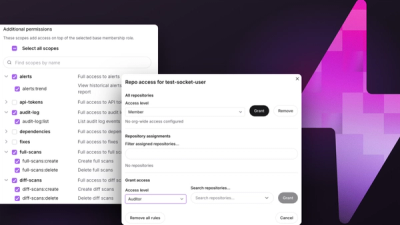
Introducing Repository Access Permissions and Custom Roles
Socket now supports Custom Roles and Repository Access Permissions so organizations can control who can access specific repositories and actions.
By Joe Werle - Jun 19, 2026
See your codebase as a living architecture map — then edit the map and let Claude build the code


See your codebase as a living, zoomable map — then edit the map and let Claude build the code.
You know the feeling of opening an unfamiliar project and clicking through folder after folder, trying to hold the whole thing in your head? Lore Map replaces that with a picture. Run one command inside any project and it opens a live, zoomable map of your architecture in the browser — backend, frontend, database, integrations — with the real wiring drawn out. Double-click any box to go deeper: actual database tables and how they relate, real files and how they import each other, the structure you'd otherwise have to reconstruct by hand.
Then it flips: the map isn't just to look at — it's how you change the code. Edit a box, jot a note, connect two things, and hit Build. Lore turns your edits into a precise instruction and Claude writes the code — either right there with a live progress bar, or handed off to your own Claude Code session to run while you watch. It runs entirely on your machine, on your own Claude subscription (no API key required). One install, four commands. See your project. Edit the picture. Ship the code.
npm install -g lore-map
cd your-project
lore deep-scan
Install once, then from inside any project:
lore plan         # new idea → Claude proposes a starting architecture you expand
lore scan         # existing project → quick high-level map
lore deep-scan    # existing project → full map with real internals (tables, modules, relations)
lore sync         # update the map against the current code
Each opens a local UI at http://localhost:3333 and runs on your machine. Close the tab or Ctrl+C to stop.
deep-scan has Claude read your real source, so it maps Python, JS/TS, Java, Go, SQL — whatever you've got. (Database schemas and JS/TS structure are also parsed precisely and for free.).lore/map.md, and builds read it first to jump straight to the relevant files instead of crawling the whole repo. Visual map (browser) ← you edit here
│
▼
Interpreter (Haiku) turns your edits into a precise instruction
│
▼
Builder (Claude Agent SDK) reads the map, opens the right files, writes code
│
▼
Your project files the result
Two AI roles, kept separate: a small, cheap interpreter (Haiku) translates your intent, and a user-selectable builder (Sonnet by default, Opus for hard work) writes the code. Scanning and exploring are read-only — your code only changes when you press Build.
Lore uses the Claude Agent SDK, which authenticates two ways:
| How | When | |
|---|---|---|
| Subscription (default) | claude /login (Pro / Max / Team / Enterprise) | Everyday use — draws from your plan's Agent SDK credit, no extra bill |
| API key (fallback) | set ANTHROPIC_API_KEY | Heavy / CI use, or when the monthly credit runs out |
If ANTHROPIC_API_KEY is set it takes precedence; otherwise it uses your subscription.
Optional environment overrides:
| Variable | Default | Purpose |
|---|---|---|
ANTHROPIC_API_KEY | — | API key (otherwise subscription) |
LORE_MODEL | claude-opus-4-8 | Model for scan / plan / compile reasoning |
LORE_BUILDER_MODEL | claude-sonnet-4-6 | Default builder model |
LORE_INTERPRETER_MODEL | claude-haiku-4-5 | Interpreter model |
LORE_PORT | 3333 | Local port |
Minimal and explainable:
.lore/map.md — a compact map of your architecture (so builds stay focused). Gitignorable.CLAUDE.md — your architecture as standing context Claude Code reads automatically (written when you Compile).lore.md — a human-readable blueprint (optional export).Your real code changes only when you click Build.
You need either a Claude subscription (run claude /login once — recommended) or an API key from console.anthropic.com. Lore never forces a key; it defaults to your subscription.
Node.js + Commander (CLI) · Express (local server) · React + Vite + React Flow + Tailwind (UI) · @anthropic-ai/claude-agent-sdk (reasoning + builder, subscription-aware) · @babel/parser + glob (deterministic JS/TS & schema extraction) · Web Speech API (voice input).
git clone https://github.com/srihari7070/lore-ai && cd lore-ai
npm install
npm run dev      # Vite client on :5173, API on :3333 (proxied) — hot reload, full errors
npm run build    # builds dist/client (bundled into the published package)
deep-scan on a real project takes ~1–3 minutes and uses credit/tokens.Issues and PRs welcome. The philosophy is frictionless over featureful — if a change makes Lore feel heavier than not using it, it probably doesn't belong. A great first contribution: a deterministic per-language structure parser (Python, Go, Java…) to make deep-scan cheaper and more complete on common stacks.
MIT © Srihari Ananthan
FAQs
See your codebase as a living architecture map — then edit the map and let Claude build the code
We found that lore-map demonstrated a healthy version release cadence and project activity because the last version was released less than a year ago. It has 1 open source maintainer collaborating on the project.
Did you know?

Socket for GitHub automatically highlights issues in each pull request and monitors the health of all your open source dependencies. Discover the contents of your packages and block harmful activity before you install or update your dependencies.
Product
Socket now supports Custom Roles and Repository Access Permissions so organizations can control who can access specific repositories and actions.
Product
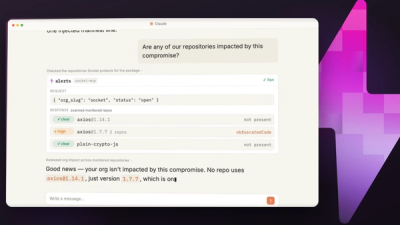
Socket MCP now lets AI assistants review org alerts, investigate threats using the Socket threat feed, and inspect package files in addition to dependency scoring.
Product
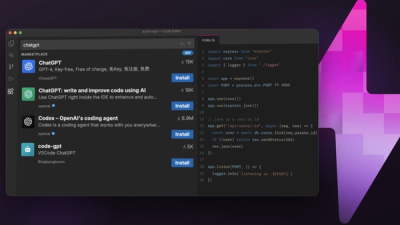
Socket Firewall blocks malicious VS Code and Open VSX extensions before install, protecting developers from compromised editor marketplaces.