


Product
PHP and Composer Support Is Now in Beta
Socket’s PHP and Composer support is now in Beta for all customers, with PHP reachability analysis generally available.
By Trevor Norris, Benjamin Barslev - Aug 21, 2026
MCP server for public Lever job boards. Resolve a company to its board, search its openings and read one posting. No API key required.





An MCP server for the public job boards companies publish through Lever. Search the openings of the companies you name, read one in full, and see the wordings each company filters by. No API key, no account, read-only.
Lever hosts one job board per company, and publishes no index across them. Every question therefore starts with a company name, and this server turns that name into the site name that addresses its board.
resolve_company(["Included Health"]) -> includedhealth, global instance, publishing
search_jobs(["Included Health"], keyword: "therapist")
get_job("includedhealth", "6f97a19f-…")
npx mcp-lever
Claude Desktop, claude_desktop_config.json:
{
  "mcpServers": {
    "lever": {
      "command": "npx",
      "args": ["-y", "mcp-lever"]
    }
  }
}
{
  "mcpServers": {
    "lever": {
      "command": "docker",
      "args": ["run", "-i", "--rm", "ghcr.io/smeet666/mcp-lever:1.0.0"]
    }
  }
}
-i keeps stdin open, which is where the protocol travels, and no -t is
passed: a TTY rewrites the stream and breaks it. The container needs outbound
HTTPS to api.lever.co and api.eu.lever.co, and nothing else: no volume, no
port, no environment variable, no credential.
resolve_companyCompany names in, the Lever site names out, with every instance that answered. It takes a list, because probing ten names costs ten resolutions where a search would read ten boards.
Lever site names distinguish case: Flex answers where flex returns 404. Four
spellings are tried on each of Lever's two instances, stopping at the first one
confirmed. Nothing found is never proof that a company is absent from Lever,
and the answer says so, listing the spellings that were sent.
search_jobscompanies is required, and takes names or site names. Each name is resolved
here, so no preparation is needed.
| Filter | Applied by |
|---|---|
location, team, department, commitment | Lever, on its exact wording |
keyword, workplace_type, country, salary_min, posted_within_days | this server, on the openings it read |
Lever offers no full-text search and accepts no filter on workplace type,
country or salary, which is why those are applied here. limit applies per
company, and a company whose openings fill it may publish more: the notes say
when that happened, and that a count taken inside that window measures the
window.
posted_within_days walks up to five pages per company. Lever pages by title,
so an opening published yesterday sits anywhere in a board, and a recency
question read from the first page answers about the first page.
get_jobOne opening in full: the advert, its named sections, and the salary as published. A search returns rows without the text, because one company's board runs to megabytes.
list_filter_valuesThe team, location and commitment wordings one company uses. Read it before
filtering: Lever matches its own wording, and answers a wording it does not
know with an empty list and no error, which reads as "nothing found". The
vocabulary belongs to each company: one writes Full-time, another Full Time,
another EE Full-Time.
null, never zero. Most openings
publish none, and filtering on salary drops them: the notes say how many.null, never another country. Openings
carrying no country are counted separately when a country filter drops them.per_company says which is which.total_available is always
null, and a full page is no measure of what exists.The server reads api.lever.co and api.eu.lever.co, which Lever documents as
public and whose robots.txt allows everything with Crawl-delay: 1. It sends
one request at a time, a second apart, under a User-Agent naming the project
and a contact address.
It never reads jobs.lever.co, whose robots.txt names six agents and refuses
each of them. Openings carry the address of their page there, because citing an
address is not crawling it.
A major version covers what a caller writes against and reads back:
./client subpath: Client, Read<T>, and the shapes it hands back.These stay minor, and a caller who reads only what it asked for is untouched:
A field that Lever stops publishing is reported as absent rather than removed from the shape, so a schema never narrows without a major version.
The low-level client is published on its own, with the pacing, the cache and the error taxonomy, and no protocol attached:
import { Client } from "mcp-lever/client";

const client = new Client();
const { found } = await client.resolveCompany("Aircall");
const { data } = await client.listPostings({ slug: found[0].slug, instance: "global" });
Errors carry one of six codes: not_found, invalid_input, rate_limited,
parse_failure, network_error, timeout. A failure is never returned as an
empty result.
MIT. Job adverts belong to the companies that published them: credit the company and link the page each opening carries.
Un serveur MCP pour les pages carrières que les entreprises publient à travers Lever. Cherchez les offres des entreprises que vous nommez, lisez-en une en entier, et consultez le vocabulaire de filtre propre à chacune. Sans clé d'API, sans compte, en lecture seule.
Lever héberge une page carrières par entreprise et ne publie aucun index qui les traverse. Toute question part donc d'un nom d'entreprise, que ce serveur transforme en identifiant de site.
resolve_company(["Included Health"])  ->  includedhealth, instance globale, publie
search_jobs(["Included Health"], keyword: "therapist")
get_job("includedhealth", "6f97a19f-…")
npx mcp-lever
Claude Desktop, dans claude_desktop_config.json :
{
  "mcpServers": {
    "lever": {
      "command": "npx",
      "args": ["-y", "mcp-lever"]
    }
  }
}
{
  "mcpServers": {
    "lever": {
      "command": "docker",
      "args": ["run", "-i", "--rm", "ghcr.io/smeet666/mcp-lever:1.0.0"]
    }
  }
}
-i garde l'entrée standard ouverte, qui est le canal du protocole, et aucun
-t n'est passé : un terminal réécrit le flux et le casse. Le conteneur a
besoin d'un accès HTTPS sortant vers api.lever.co et api.eu.lever.co, et de
rien d'autre : aucun volume, aucun port, aucune variable d'environnement, aucun
identifiant.
resolve_companyDes noms d'entreprises en entrée, leurs identifiants de site en sortie, avec chaque instance qui a répondu. L'outil prend une liste, parce que sonder dix noms coûte dix résolutions là où une recherche lirait dix pages carrières.
Les identifiants distinguent la casse : Flex répond là où flex rend 404.
Quatre formes sont essayées sur chacune des deux instances, en s'arrêtant à la
première confirmée. Ne rien trouver ne prouve jamais qu'une entreprise est
absente de Lever, et la réponse le dit, en listant les formes envoyées.
search_jobscompanies est requis et accepte des noms ou des identifiants. Chaque nom est
résolu ici, sans préparation.
| Filtre | Appliqué par |
|---|---|
location, team, department, commitment | Lever, sur son libellé exact |
keyword, workplace_type, country, salary_min, posted_within_days | ce serveur, sur les offres lues |
Lever n'offre aucune recherche plein texte et n'accepte de filtre ni sur le mode
de travail, ni sur le pays, ni sur le salaire. limit s'applique par entreprise,
et une entreprise qui le remplit peut publier davantage : les notes le disent, et
disent aussi qu'un compte pris dans cette fenêtre mesure la fenêtre.
posted_within_days parcourt jusqu'à cinq pages par entreprise. Lever pagine par
titre, donc une offre publiée hier se trouve n'importe où dans une page
carrières, et une question de fraîcheur lue sur la première page répond sur la
première page.
get_jobUne offre en entier : l'annonce, ses rubriques nommées, et le salaire tel que publié. Une recherche rend des lignes sans le texte, une page carrières pesant plusieurs mégaoctets.
list_filter_valuesLes libellés d'équipe, de lieu et de type de contrat qu'une entreprise emploie.
À lire avant de filtrer : Lever exige son propre libellé et répond à un libellé
inconnu par une liste vide, sans erreur, ce qui se lit « rien trouvé ». Le
vocabulaire appartient à chaque entreprise : l'une écrit Full-time, une autre
Full Time, une troisième EE Full-Time.
null, jamais zéro. La plupart des
offres n'en publient aucun, et filtrer sur le salaire les écarte : les notes
disent combien.null, jamais un autre pays. Les
offres sans pays sont comptées à part quand un filtre les écarte.per_company dit laquelle.total_available
vaut toujours null, et une page pleine ne mesure rien.Le serveur lit api.lever.co et api.eu.lever.co, que Lever documente comme
publics et dont le robots.txt autorise tout avec Crawl-delay: 1. Il envoie
une requête à la fois, à une seconde d'intervalle, sous un User-Agent portant
le nom du projet et une adresse de contact.
Il ne lit jamais jobs.lever.co, dont le robots.txt nomme six agents et les
refuse chacun. Les offres portent l'adresse de leur page là-bas, citer une
adresse n'étant pas la parcourir.
Une version majeure couvre ce qu'un appelant écrit et relit :
./client : Client, Read<T>, et les formes qu'il rend.Restent mineurs, et laissent intact un appelant qui ne lit que ce qu'il a demandé :
Un champ que Lever cesse de publier se rend absent plutôt que retiré de la forme, de sorte qu'un schéma ne se rétrécit jamais sans version majeure.
La couche basse est publiée seule, avec son rythme, son cache et sa taxonomie d'erreurs, sans protocole attaché :
import { Client } from "mcp-lever/client";

const client = new Client();
const { found } = await client.resolveCompany("Aircall");
const { data } = await client.listPostings({ slug: found[0].slug, instance: "global" });
Les erreurs portent l'un de six codes : not_found, invalid_input,
rate_limited, parse_failure, network_error, timeout. Une panne n'est
jamais rendue comme un résultat vide.
MIT. Les annonces appartiennent aux entreprises qui les publient : créditez l'entreprise et liez la page que chaque offre porte.
FAQs
MCP server for public Lever job boards. Resolve a company to its board, search its openings and read one posting. No API key required.
The npm package mcp-lever receives a total of 70 weekly downloads. As such, mcp-lever popularity was classified as not popular.
We found that mcp-lever demonstrated a healthy version release cadence and project activity because the last version was released less than a year ago. It has 1 open source maintainer collaborating on the project.
Product
Socket’s PHP and Composer support is now in Beta for all customers, with PHP reachability analysis generally available.
Product
Socket is bringing experimental protection to Firefox, scanning 97,000+ extensions in Mozilla's official directory for malware and risky updates.
Research
/Security News
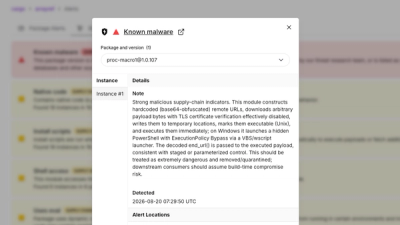
Three compromised Rust crates pulled in a malicious dependency that downloaded and executed cross-platform malware during Cargo builds.