
Product
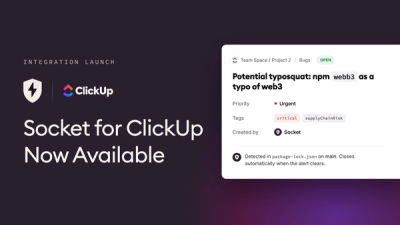
Socket for ClickUp Is Now Available
Create ClickUp tasks from Socket alerts, automate ticketing with custom rules, and keep alert and task status synchronized.
By Jeppe Hasseriis - Aug 26, 2026
meet-live-assist-server
Advanced tools
Local bridge server for the Meet Live Assist browser extension: transcript sink, advice channel, action-item board, snapshots, local STT and TTS. Zero dependencies, binds to 127.0.0.1 only.
Local bridge server for the Meet Live Assist browser extension. The extension captures a Google Meet or Zoom call; this server is what it talks to, and what your own assistant reads.
npx meet-live-assist-server
It prints an auth token on first run. Paste that into the extension's Options once and you are done.
Transcript sink. Every caption line is appended to <data-dir>/<session>.txt, the complete record.
Wake channel. A second file, <session>.wake, gets only the batches worth waking an assistant for
(decisions, blockers, your name, real questions). Tailing that instead of the raw transcript is what keeps
a 40-minute call from costing hundreds of assistant turns.
Advice, board, chat. The assistant posts colour-coded advice, decisions and action items; the panel polls them back.
Snapshots of a shared screen, for visual context.
Local speech-to-text through whisper.cpp, fully offline, for calls with no captions.
Text-to-speech into the call (macOS only, see below).
An MCP front door. The same package ships meet-live-assist-mcp, a stdio MCP adapter over this API, so
an assistant reaches the call through tools instead of shelling out to curl:
claude mcp add meet-live-assist -- npx -y -p meet-live-assist-server meet-live-assist-mcp
It asks this server where its data dir is, so it needs no configuration. The tool that matters is poll:
one call for the transcript batch worth a turn, the panel's state and any pending results, with the read
position held here, per assistant.
A restart is survivable. Live state is snapshotted to <data-dir>/.state/ and reloaded on boot, so
bouncing the server mid-call costs a couple of seconds rather than the meeting. Consent (letting the
assistant drive a tab, post to the meeting chat) and pause/stop deliberately do not come back: they are
answers about one call, and meeting codes repeat.
It binds 127.0.0.1 only, has no accounts and no telemetry, and writes to files you own. Every route except
/health and /auth-check requires the X-MLA-Token header, so a website you happen to be visiting cannot
reach it. Transcripts, snapshots and the stored live state are purged after RETENTION_DAYS (14 by default); the state
directory and its files are owner-only.
If your assistant uses a cloud model, whatever you route to it is subject to that provider's terms. That part is your configuration, not this server.
Node 20+ is the only hard requirement. The audio features need two more binaries:
| install | without it | |
|---|---|---|
ffmpeg | brew install ffmpeg / apt install ffmpeg | no local STT, no audio routing |
whisper-cli + a ggml model in ~/.local/share/whisper/ | brew install whisper-cpp | no local STT (captions still work) |
Text-to-speech is macOS-only. It uses say and afplay. Everywhere else the server runs fine and
advice appears in the panel as text; only the spoken output is missing.
All optional, all env vars.
| var | default | what it does |
|---|---|---|
PORT | 8848 | the extension has host permission for 127.0.0.1:8848; changing it needs a matching extension setting |
TRANSCRIPTS_DIR | ~/meet-live-assist/transcripts | data dir (transcripts, snapshots, .mla-token) |
RETENTION_DAYS | 14 | purge transcripts and snapshots older than this (0 keeps them forever) |
WAKE_BASE_MS / WAKE_MAX_MS | 10000 / 90000 | wake-gate window: starts here, doubles on an empty batch up to the max |
WAKE_FORCE_MS | 180000 | flush whatever is buffered after this long, gate or no gate |
WAKE_MIN_GAP_MS | 8000 | floor between two wakes |
WHISPER_MODEL | ~/.local/share/whisper/ggml-base.bin | which ggml model to transcribe with |
WHISPER_PROMPT | a generic technical word list | bias whisper toward your own product names and ticket prefixes |
FFMPEG / WHISPER_CLI / WHISPER_SERVER | resolved from Homebrew, /usr/local, /usr/bin, then PATH | override a binary path |
TTS_VOICE | Zosia | macOS voice for spoken advice |
curl -s http://127.0.0.1:8848/health
# {"ok":true,"dir":"...","tools":{"ffmpeg":true,"whisper":true,"whisperModel":"ggml-base.bin","blackhole":false}}
tools tells you which optional features are live, so a missing ffmpeg shows up here instead of as a
mystery later.
FAQs
Local bridge server for the Meet Live Assist browser extension: transcript sink, advice channel, action-item board, snapshots, local STT and TTS. Zero dependencies, binds to 127.0.0.1 only.
The npm package meet-live-assist-server receives a total of 61 weekly downloads. As such, meet-live-assist-server popularity was classified as not popular.
We found that meet-live-assist-server demonstrated a healthy version release cadence and project activity because the last version was released less than a year ago. It has 1 open source maintainer collaborating on the project.
Product
Create ClickUp tasks from Socket alerts, automate ticketing with custom rules, and keep alert and task status synchronized.
Product
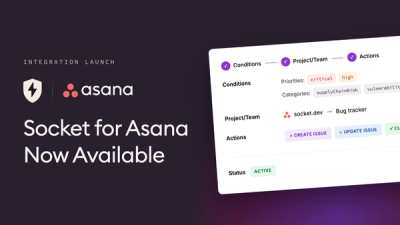
Create and manage Asana tasks directly from Socket alerts, with manual task creation, automated ticketing rules, and two-way sync.

Security News
Open VSX has removed three extension IDs from its malicious-extension list as the legitimate publishers they impersonated move to claim the names for themselves.