
Research
/Security News
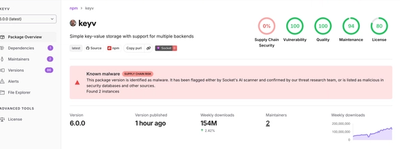
Popular npm Packages in the keyv and Cacheable Namespaces Compromised in Active Supply Chain Attack
Popular npm packages keyv and cacheable compromised.
By Socket Research Team - Aug 04, 2026
memdata-mcp
Advanced tools


MCP server for MemData - persistent memory for AI agents.
Give Claude, Cursor, or any MCP-compatible AI long-term memory across conversations.
What it does: Store notes, decisions, and context → retrieve them semantically later. Your AI remembers everything.
Agents can now pay for themselves. No API key. No human in the loop.
Using the x402 payment protocol, autonomous agents can use their wallet to pay per request with USDC on Base. Your wallet address IS your identity - same wallet, same memories across sessions.
AI assistants forget everything between sessions. MemData fixes that:
Works with Claude Desktop, Claude Code, Cursor, and any MCP client.
Use an API key. You manage the subscription, your AI gets memory.
Claude Desktop (~/Library/Application Support/Claude/claude_desktop_config.json):
{
  "mcpServers": {
    "memdata": {
      "command": "npx",
      "args": ["memdata-mcp"],
      "env": {
        "MEMDATA_API_KEY": "md_your_key"
      }
    }
  }
}
Claude Code (~/.claude.json or project .mcp.json):
{
  "mcpServers": {
    "memdata": {
      "command": "npx",
      "args": ["memdata-mcp"],
      "env": {
        "MEMDATA_API_KEY": "md_your_key"
      }
    }
  }
}
Cursor (~/.cursor/mcp.json):
{
  "mcpServers": {
    "memdata": {
      "command": "npx",
      "args": ["memdata-mcp"],
      "env": {
        "MEMDATA_API_KEY": "md_your_key"
      }
    }
  }
}
New in v1.7.0 - No API key. No human. Just your wallet.
Traditional AI memory requires API keys tied to human accounts. But autonomous agents running 24/7 need memory that:
This is memory infrastructure for the autonomous agent economy.
{
  "mcpServers": {
    "memdata": {
      "command": "npx",
      "args": ["memdata-mcp"],
      "env": {
        "X402_WALLET_KEY": "your_private_key_hex"
      }
    }
  }
}
402 Payment Required with priceYour wallet address IS your identity. Same wallet = same memories, across any host or platform.
| Operation | Price | What it does |
|---|---|---|
| Query | $0.001 | Semantic search across memories |
| Ingest | $0.005 | Store and embed new content |
| Identity | $0.001 | Session start, get/set agent identity |
| Artifacts | $0.001 | List or delete stored memories |
The MCP automatically handles 402 responses and payment signatures using @x402/fetch.
| Type | MCP | Dashboard/API | Processing |
|---|---|---|---|
| Text | ✅ | ✅ | Chunked & embedded |
| Markdown | ✅ | ✅ | Chunked & embedded |
| ❌ | ✅ | OCR + chunking | |
| Images (PNG, JPG) | ❌ | ✅ | OCR extraction |
| Audio (MP3, WAV, M4A) | ❌ | ✅ | Transcription |
Note: MCP tools handle text content directly. For files (PDFs, images, audio), use the dashboard or HTTP API.
| Tool | Description |
|---|---|
memdata_ingest | Store text in long-term memory |
memdata_query | Search memory with natural language |
memdata_list | List all stored memories |
memdata_delete | Delete a memory by ID |
memdata_status | Check API health and storage usage |
| Tool | Description |
|---|---|
memdata_session_start | 🚀 CALL FIRST - Get identity, last session handoff, recent activity |
memdata_set_identity | Set your agent name and identity summary |
memdata_session_end | Save a handoff before session ends - preserved for next session |
memdata_query_timerange | Search with date filters (since/until) |
memdata_relationships | Find related entities (people, companies, projects) |
memdata_whoami → memdata_session_start - Renamed for clarity. The name now signals "call this first at every session". Description includes 🚀 emoji to catch attention in tool lists.session_endmemdata_ingestStore text in long-term memory.
"Remember that we decided to use PostgreSQL for the new project."
Parameters:
content (string) - Text to storename (string) - Source identifier (e.g., "meeting-notes-jan-29")memdata_querySearch memory with natural language.
"What database did we choose?"
Parameters:
query (string) - Natural language searchlimit (number, optional) - Max results (default: 5)memdata_listList all stored memories with chunk counts.
memdata_deleteDelete a memory by artifact ID (get IDs from memdata_list).
memdata_statusCheck API connectivity and storage usage.
memdata_session_start🚀 Call this first at the start of every session. Essential for session continuity.
"Start my session" / "What was I working on?"
Returns: agent name, identity summary, session count, last session handoff, recent activity.
v1.5.0: Renamed from
memdata_whoamifor clarity - the name signals "call me first".
memdata_set_identitySet or update your agent identity.
Parameters:
agent_name (string, optional) - Your name (e.g., "MemBrain")identity_summary (string, optional) - Who you are and your purposememdata_session_endSave context before ending a session. Next session will see this handoff.
Parameters:
summary (string) - What happened this sessionworking_on (string, optional) - Current focuscontext (object, optional) - Additional context to preservememdata_query_timerangeSearch memory within a date range.
"What did I work on last week?"
Parameters:
query (string) - Natural language searchsince (string, optional) - ISO date (e.g., "2026-01-01")until (string, optional) - ISO date (e.g., "2026-01-31")limit (number, optional) - Max resultsmemdata_relationshipsFind entities that appear together in your memory.
"Who has John Smith worked with?"
Parameters:
entity (string) - Name to search fortype (string, optional) - Filter by type (person, company, project)limit (number, optional) - Max relationshipsScores of 30-50% are typical for good matches. Semantic search finds meaning, not keywords.
| Variable | Required | Description |
|---|---|---|
MEMDATA_API_KEY | Option 1 | API key for subscribers (from memdata.ai) |
X402_WALLET_KEY | Option 2 | Private key for pay-per-use (USDC on Base) |
MEMDATA_API_URL | No | API URL (default: https://memdata.ai) |
Note: Use either MEMDATA_API_KEY (subscription) or X402_WALLET_KEY (pay-per-use), not both.
This is a thin MCP client that calls the MemData API. It does not:
You can inspect the source code in src/index.ts.
Once configured, just talk to your AI:
You: "Remember that we chose PostgreSQL for the user service"
AI: [calls memdata_ingest] → Stored in memory

... days later ...

You: "What database are we using for users?"
AI: [calls memdata_query] → "PostgreSQL for the user service" (73% match)
Issues and PRs welcome! This is the open-source MCP client for the hosted MemData service.
MIT
FAQs
MCP server for MemData - persistent memory for AI agents
We found that memdata-mcp demonstrated a healthy version release cadence and project activity because the last version was released less than a year ago. It has 1 open source maintainer collaborating on the project.
Did you know?

Socket for GitHub automatically highlights issues in each pull request and monitors the health of all your open source dependencies. Discover the contents of your packages and block harmful activity before you install or update your dependencies.
Research
/Security News
Popular npm packages keyv and cacheable compromised.

Security News
A misconfiguration gave three Anthropic models internet access, and one, believing it was in a simulation, shipped a credential-stealing package to PyPI.

Security News
/Company News
Socket has joined the new Composer and Packagist sponsorship program as a launch sponsor, supporting the team that keeps PHP's package ecosystem secure.